

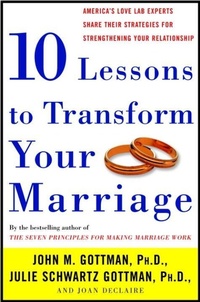
Ten Lessons to Transform Your Marriage
America's Love Lab Experts Share Their Strategies for Strengthening Your Relationship
1st Edition
Published on 16. May 2006
288 pages
978-0-307-34711-4 (ISBN)
Description

In Ten Lessons to Transform Your Marriage, marital psychologists John and Julie Gottman provide vital tools-scientifically based and empirically verified-that you can use to regain affection and romance lost through years of ineffective communication.
In 1994, Dr. John Gottman and his colleagues at the University of Washington made a startling announcement: Through scientific observation and mathematical analysis, they could predict-with more than 90 percent accuracy-whether a marriage would succeed or fail. The only thing they did not yet know was how to turn a failing marriage into a successful one, so Gottman teamed up with his clinical psychologist wife, Dr. Julie Schwartz Gottman, to develop intervention methods. Now the Gottmans, together with the Love Lab research facility, have put these ideas into practice.
What emerged from the Gottmans' collaboration and decades of research is a body of advice that's based on two surprisingly simple truths: Happily married couples behave like good friends, and they handle their conflicts in gentle, positive ways. The authors offer an intimate look at ten couples who have learned to work through potentially destructive problems-extramarital affairs, workaholism, parenthood adjustments, serious illnesses, lack of intimacy-and examine what they've done to improve communication and get their marriages back on track.
Hundreds of thousands have seen their relationships improve thanks to the Gottmans' work. Whether you want to make a strong relationship more fulfilling or rescue one that's headed for disaster, Ten Lessons to Transform Your Marriage is essential reading.
In 1994, Dr. John Gottman and his colleagues at the University of Washington made a startling announcement: Through scientific observation and mathematical analysis, they could predict-with more than 90 percent accuracy-whether a marriage would succeed or fail. The only thing they did not yet know was how to turn a failing marriage into a successful one, so Gottman teamed up with his clinical psychologist wife, Dr. Julie Schwartz Gottman, to develop intervention methods. Now the Gottmans, together with the Love Lab research facility, have put these ideas into practice.
What emerged from the Gottmans' collaboration and decades of research is a body of advice that's based on two surprisingly simple truths: Happily married couples behave like good friends, and they handle their conflicts in gentle, positive ways. The authors offer an intimate look at ten couples who have learned to work through potentially destructive problems-extramarital affairs, workaholism, parenthood adjustments, serious illnesses, lack of intimacy-and examine what they've done to improve communication and get their marriages back on track.
Hundreds of thousands have seen their relationships improve thanks to the Gottmans' work. Whether you want to make a strong relationship more fulfilling or rescue one that's headed for disaster, Ten Lessons to Transform Your Marriage is essential reading.
More details
Other editions
Additional editions
John Gottman | Julie Schwartz Gottman | Joan DeClaire
Ten Lessons to Transform Your Marriage
America's Love Lab Experts Share Their Strategies for Strengthening Your Relationship
Book
06/2007
Harmony/Rodale/Convergent
€18.50
No shipping information available

John M. Gottman | Julie Schwartz Gottman | Joan de Claire
Ten Lessons to Transform Your Marriage
America's Love Lab Experts Share Their Strategies for Strengthening Your Relationship
Book
05/2006
Crown Publishing Group (NY)
€43.00
Article exhausted; check different version
John M. Gottman | Julie Schwartz Gottman | Joan de Claire
10 Lessons to Transform Your Marriage
America's Love Lab Experts Share Their Strategies for Strengthening Your Relationship
Audio
05/2006
Random House Inc
€48.65
Article exhausted; check different version
Persons
John M. Gottman, Ph.D., and Julie Schwartz Gottman, Ph.D., are the founders and directors of the Gottman Institute and the Relationship Research Institute in Seattle.
The bestselling author of The Seven Principles for Making Marriage Work and The Relationship Cure, among other books, John Gottman is a professor of psychology, an elected fellow of the American Psychological Association, and the recipient of numerous awards and commendations. His research and findings have been featured in the Wall Street Journal, Time, the bestselling book Blink, and in the broadcast media.
Julie Schwartz Gottman established the Gottman Institute's Marriage Clinic and serves as its clinical director. A clinical psychologist, she is in private practice in Seattle, where she and John live.
Joan DeClaire is a writer specializing in psychology, health, and family issues.
The bestselling author of The Seven Principles for Making Marriage Work and The Relationship Cure, among other books, John Gottman is a professor of psychology, an elected fellow of the American Psychological Association, and the recipient of numerous awards and commendations. His research and findings have been featured in the Wall Street Journal, Time, the bestselling book Blink, and in the broadcast media.
Julie Schwartz Gottman established the Gottman Institute's Marriage Clinic and serves as its clinical director. A clinical psychologist, she is in private practice in Seattle, where she and John live.
Joan DeClaire is a writer specializing in psychology, health, and family issues.
Content
- Intro
- Other Titles
- Title Page
- Copyright
- Dedication
- Contents
- Acknowledgments
- Introduction - From Predicting Divorce to Preventing It: An Introductory Message from John and Julie Gottman
- Chapter 1 - "All You Ever Do Is Work"
- Our Analysis: A Cycle of Criticize/Defend/Countercriticize
- Our Advice
- One Year Later
- Healthy Complaining Versus Harmful Complaining
- The "Oversensitive" Partner
- When One Partner Works Too Much
- Quiz: Is There Too Much Criticism in Your Relationship?
- Exercise: Listen for the Longing Behind Your Partner's Complaints
- Exercise: What's Your Mission? What's Your Legacy?
- Chapter 2 - "Will We Ever Get Over Your Affair?"
- Our Analysis: Sidestepping Difficult Feelings Blocks Emotional Intimacy
- Our Advice
- One Year Later
- The Hazards of Avoiding Conflict
- The Affair-Prone Marriage
- Quiz: Do You Avoid Conflicts, or Do You Talk About Them?
- Exercise: Calm Down to Avoid Flooding
- Exercise: Identifying Your Feelings
- Exercise: The Marital Poop Detector
- Chapter 3 - "After All the Crises in Our Lives, We Don't Feel Close Anymore"
- Our Analysis: Stress Creates Emotional Distance and Hinders Romance
- Our Advice
- One Year Later
- How a Little Selfishness Can Help Your Marriage
- Quiz: How Much Stress Have You Had Lately?
- Exercise: Steps to a Healthier Lifestyle
- Exercise: Keep Your Love Map Up-to-Date
- Chapter 4 - "You Never Talk to Me"
- Our Analysis: Attacks and Counterattacks Make the Marriage Unsafe for Conversation
- Our Advice
- One Year Later
- The Antidotes to Contempt: Fondness and Admiration
- Quiz: Is There More Room for Fondness and Admiration in Your Marriage?
- Exercise: Three Things I Like About You
- Exercise: Nurturing Fondness in Your Relationship-A Seven-Week Plan
- Chapter 5 - "You Don't Care About My Dreams"
- Our Analysis: Ignoring Dreams Beneath the Conflict Stalls Communication
- Our Advice
- One Year Later
- Your Hidden Dreams and Aspirations: The "Prairie Dogs" of Marital Conflict
- Quiz: What Are the Dreams Within Your Conflicts?
- Exercise: Responding to the Dreams Within Your Conflict
- Chapter 6 - "You're So Distant and Irritable All the Time"
- Our Analysis: Avoiding Emotional Intensity Postpones Healing
- Our Advice
- One Year Later
- Helping Your Partner Through Depression
- Quiz: Are You Depressed?
- Quiz: Are You Anxious?
- Exercise: Establish a Ritual for Stress-Reducing Conversation
- Chapter 7 - "I Shouldn't Have to Nag!"
- Our Analysis: Harsh Words and Defensiveness Trump Good Intentions
- Our Advice
- One Year Later
- Quiz: Harsh Start-up: A Problem in Your Marriage?
- Exercise: Turning Harsh Start-up to Softened Start-up
- Quiz: Are You Open to Your Partner's Influence?
- Exercise: Using the Aikido Principle to Accept Influence
- Chapter 8 - "There's No Passion, There's No Fun"
- Our Analysis: Failure to Express Anger Leads to Emotional Distance
- Our Advice
- One Year Later
- How Anger Can Enhance a Marriage
- A Special Message for Husbands: "Embrace Her Anger"
- Quiz: How Do You Feel About Anger?
- Exercise: When You and Your Partner Have Different Ideas About Anger
- Exercise: Responding to Anger in a Helpful Way
- Chapter 9 - "We Only Have Time for the Kids Now"
- Our Analysis: Focus on the Kids Disguises the Real Trouble-Failure at Expressing Needs
- Our Advice
- Two Months Later
- What's Wrong with a Child-Centered Marriage?
- Quiz: Is Your Marriage Child-Centered?
- Exercise: Give Me a Clue
- Exercise: Turning Toward Your Partner's Bids for Connection
- Busting the Myth of Spontaneity in Romance
- Exercise: A Blueprint for Handling Conflict
- Chapter 10 - "You're Not Satisfied Unless There's Some Drama"
- Our Analysis: Perpetual Issues Lead to Conflict Avoidance, Lack of Connection
- Our Advice
- Two Years Later
- Don't Get Gridlocked over Perpetual Issues
- Quiz: What Are Your Perpetual Issues and What Are Your Gridlocked Problems?
- Exercise: Creating a Culture of Shared Values and Meaning
- Exercise: Thanksgiving Checklist
- Index
