

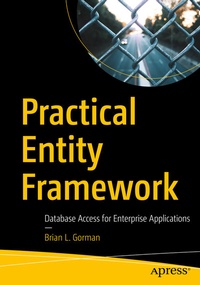
Practical Entity Framework
Description

Practical Entity Framework begins with a simple overview of the two most common approaches to working with databases-database first and code first-and then focuses on working in a code first manner. Taking the code first approach allows the entire database to be built and maintained in code so there is never a situation in which you cannot restore the database schema. Additionally, the code first approach creates an entirely transparent record of changes to thedatabase that is easily tracked in source control. Emphasis throughout the book is on leaving you well positioned to architect and lead data development efforts for your organization.
What You Will Learn
- Build robust and maintainable databases using a code first approach
- Create and execute stored procedures, triggers, and functions
- Analyze and optimize performance of database queries
- Ensure data integrity through keys, constraints, and relationships
Who This Book Is For
.NET developers who work with enterprise-level applications and need to interact with data structures and data within the back end data store, developers who want to take a code first approach to building database applications to prevent conflicts and optimize efficiency, and those who are moving into full-stack roles, or into senior and architecturalroles, and will be responsible for database design and implementation
More details
Other editions
Additional editions
Person
Content
Introduction.- Part I. Getting Started.- 1. Introduction to Entity Framework.- 2. Working with an Existing Database.- 3. Entity Framework: Code First.- Part II. Building the Data Solution.- 4. Models and the Data Context.- 5. Constraints, Keys, and Relationships.- 6. Data Access (Create, Read, Update, Delete).- 7. Stored Procedures, Views, and Functions.- 8. Sorting, Filtering, and Paging.- Part III. Enhancing the Data Solution.- 9. LINQ for Queries and Projections.- 10. Encryption of Data.- 11. Repository and Unit of Work Patterns.- 12. Unit Testing, Integration Testing, and Mocking.- 13. Alternatives to Entity Framework: Dapper.- 14. Asynchronous Data Operations and Multiple Database Contexts.- Part IV. Recipes for Success.- 15. .NET 5 and Entity Framework.- 16. Appendix A: Troubleshooting.
