

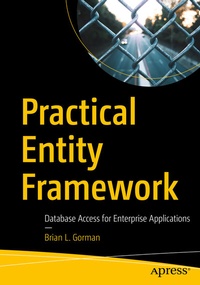
Practical Entity Framework
Database Access for Enterprise Applications
Published on 6. September 2020
Book
Paperback/Softback
XXVIII, 649 pages
978-1-4842-6043-2 (ISBN)
Description
Determine your object relational mapper (ORM) of choice for enterprise applications using .NET Framework, and especially .NET Framework Core 3.1 and higher. Real-world examples and considerations are presented in this book to help you create robust and efficient database solutions. Throughout the text, actual problems, questions, and common pitfalls are provided to help you recognize optimal solutions for maximum success in the different application scenarios you might encounter.
Practical Entity Framework begins with a simple overview of the two most common approaches to working with databases-database first and code first-and then focuses on working in a code first manner. Taking the code first approach allows the entire database to be built and maintained in code so there is never a situation in which you cannot restore the database schema. Additionally, the code first approach creates an entirely transparent record of changes to the database that is easily tracked in source control. Emphasis throughout the book is on leaving you well positioned to architect and lead data development efforts for your organization.
What You Will Learn
Who This Book Is For
.NET developers who work with enterprise-level applications and need to interact with data structures and data within the back end data store, developers who want to take a code first approach to building database applications to prevent conflicts and optimize efficiency, and those who are moving into full-stack roles, or into senior and architectural roles, and will be responsible for database design and implementation
Practical Entity Framework begins with a simple overview of the two most common approaches to working with databases-database first and code first-and then focuses on working in a code first manner. Taking the code first approach allows the entire database to be built and maintained in code so there is never a situation in which you cannot restore the database schema. Additionally, the code first approach creates an entirely transparent record of changes to the database that is easily tracked in source control. Emphasis throughout the book is on leaving you well positioned to architect and lead data development efforts for your organization.
What You Will Learn
- Build robust and maintainable databases using a code first approach
- Create and execute stored procedures, triggers, and functions
- Analyze and optimize performance of database queries
- Ensure data integrity through keys, constraints, and relationships
Who This Book Is For
.NET developers who work with enterprise-level applications and need to interact with data structures and data within the back end data store, developers who want to take a code first approach to building database applications to prevent conflicts and optimize efficiency, and those who are moving into full-stack roles, or into senior and architectural roles, and will be responsible for database design and implementation
More details
Edition
1st ed.
Language
English
Place of publication
Berkeley
United States
Target group
Professional and scholarly
Illustrations
424 s/w Abbildungen
424 Illustrations, black and white; XXVIII, 649 p. 424 illus.
Dimensions
Height: 25.4 cm
Width: 17.8 cm
Weight
1274 gr
ISBN-13
978-1-4842-6043-2 (9781484260432)
DOI
10.1007/978-1-4842-6044-9
Schweitzer Classification
Other editions
New editions
Book
12/2025
3rd Edition
APress
€64.19
Available immediately
Book
12/2021
2nd Edition
APress
€69.54
Shipment within 15-20 days
Additional editions
E-Book
08/2020
APress
€39.99
Available for download
Person
Brian Gorman is a developer, computer science instructor, and trainer, and has been working in .NET technologies as long as they have existed. He was originally MCSD certified in .NET 1 and has recently re-certified with MCSA: Web Apps and MCSD: App Builder certifications. Additionally, he became an MCT as of April 2019, and is focusing in on developing and training developers with full-stack web solutions with .NET Core and Azure. In addition to working with .NET technologies, Brian also teaches computer science for Franklin University, where his courses taught have included data structures, algorithms, design patterns, and, more recently, full-stack solutions in the capstone practicum course.
Content
Introduction
Part I. Getting Started1. Introduction to Entity Framework2. Working with an Existing Database3. Entity Framework: Code First
Part II. Building the Data Solution4. Models and the Data Context5. Constraints, Keys, and Relationships6. Data Access (Create, Read, Update, Delete)7. Stored Procedures, Views, and Functions8. Sorting, Filtering, and Paging
Part III. Enhancing the Data Solution9. LINQ for Queries and Projections10. Encryption of Data11. Repository and Unit of Work Patterns12. Unit Testing, Integration Testing, and Mocking13. Alternatives to Entity Framework: Dapper14. Asynchronous Data Operations and Multiple Database Contexts
Part IV. Recipes for Success15. .NET 5 and Entity Framework16. Appendix A: Troubleshooting
Part I. Getting Started1. Introduction to Entity Framework2. Working with an Existing Database3. Entity Framework: Code First
Part II. Building the Data Solution4. Models and the Data Context5. Constraints, Keys, and Relationships6. Data Access (Create, Read, Update, Delete)7. Stored Procedures, Views, and Functions8. Sorting, Filtering, and Paging
Part III. Enhancing the Data Solution9. LINQ for Queries and Projections10. Encryption of Data11. Repository and Unit of Work Patterns12. Unit Testing, Integration Testing, and Mocking13. Alternatives to Entity Framework: Dapper14. Asynchronous Data Operations and Multiple Database Contexts
Part IV. Recipes for Success15. .NET 5 and Entity Framework16. Appendix A: Troubleshooting