

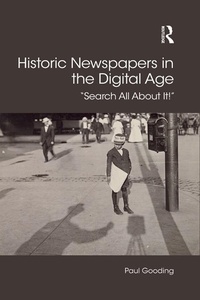
Historic Newspapers in the Digital Age
Search All About It!
Published on 8. December 2016
218 pages
978-1-317-12184-8 (ISBN)
Description

In recent years, cultural institutions and commercial providers have created extensive digitised newspaper collections. This book asks the timely question: what can the large-scale digitisation of newspapers tell us about the wider cultural phenomenon of mass digitisation? The unique form and materiality of newspapers, and their grounding in a particular time and place, provide challenges for researchers and digital resource creators alike. At the same time, the wider context in which digitisation of cultural heritage occurs shapes the impact of digital resources in ways which fall short of the grand ambitions of the wider theoretical discourse. Drawing on case studies from leading digitised newspaper collections, the book aims to provide a bridge between the theory and practice of how these digitised collections are being used. Beginning with an exploration of the hyperbolic nature of technological discourses, the author explores how web interfaces, funding models and the realities of contemporary user behaviour contrast with the hyperbolic discourse surrounding mass digitisation. This book will be of particular interest to those who want to investigate how user studies can inform our understanding of technological phenomena, including digital resource creators, information professionals, students and researchers in universities, libraries, museums and archives.
Reviews / Votes
"Historic Newspapers in the Digital Age will be of interest to media historians and other researchers who use digitised newspapers collections.[...] Overall, this is a very interesting book both for what it tells us about how digital resources are currently used by researchers, and how this diverges from earlier overly optimistic projections of total revolution."-Aaron Ackerley, University of Sheffield, UK
More details
Series
Language
English
Place of publication
London
United Kingdom
Publishing group
Taylor & Francis Ltd
Target group
College/higher education
Illustrations
1 Tables, black and white; 8 Line drawings, black and white
File size
3,03 MB
ISBN-13
978-1-317-12184-8 (9781317121848)
Copyright in bibliographic data and cover images is held by Nielsen Book Services Limited or by the publishers or by their respective licensors: all rights reserved.
Schweitzer Classification
Other editions
Additional editions
Book
06/2018
1st Edition
Routledge
€84.10
Shipment within 10-20 days
Book
12/2016
1st Edition
Routledge
€231.50
Shipment within 10-20 days
Person
Paul Gooding is Research Fellow in Digital Humanities in the School of Art, Media and American Studies at the University of East Anglia, UK.
Content
Contents
Figures and Tables
Preface
Acknowledgements
List of abbreviations
Introduction: Search All About It!
Methods for Assessing Impact
User Studies in the Age of Large-Scale Newspaper Digitisation
Summary
Chapter Bibliography
1 The Myth of the New
Google Books: The Universal Library Reimagined
The Role of the Technological Sublime
Diffusion of Innovations
Mechanical Reproduction and the End of the Age of the Author
The City and Information Overload
Reality and Remediation
Summary: Waiting for the Paradigm Shift
Chapter Bibliography
2 Digitised Newspapers: Histories, Contexts, Behaviours
The History of Newspapers in the United Kingdom
Issues for the Identity of Libraries in the Digital Age
Existing Research into Online User Behaviour
Summary: Concurrent Discourses of Digitisation
Chapter Bibliography
3 Exploring Methods for Evaluating User Behaviour
Methods for Case Study Research
Quantitative Methods
Web Analytics
Referrer Analysis
Citation Analysis
Link Analysis
Qualitative Methods
Interviews
Surveys
Summary
Chapter Bibliography
4 Institutional Impact of Large-Scale Digitised Collection
Institutional Impact
Case Study: Using interviews to identify institutional impacts
Implications for User Support
Licensing and Copyright: Dual Barriers to Impact
What Role do Libraries Have in an Age of Large-Scale Digitisation?
Summary: Online Access and the Future of Libraries
Chapter Bibliography
5 The Impact of Large-Scale Digitisation upon Users
Users of Large-Scale Digitisation
Case Study: Citation Analysis of BNCN
Case Study: Online Survey of Users of Digitised Newspapers
Changing Models of User Behaviour
Case Study: Web Log Analysis of Welsh Newspapers Online
Engagement with Users of Large-Scale Digitised Collections
Summary: Where We're Going We'll Still Need Readers
Chapter Bibliography
6 "Unequally Free": Mapping Public Access to Digitised Collections
Innovative Technologies, Longstanding Tensions
Mapping the Digitised Divide
Case Study: Mapping the Users of Digitised Newspaper Collections
Inequalities in Access by English Public Library Authority
Summary: The Digitised Divide in Action
Chapter Bibliography
7 Conclusion: Where We're Going, We'll Still Need Ranganathan
Introduction
Access to Digitised Library Collections
Recommendations
The Stakes for Digitised Collections
Open Access
Open Interfaces
Open Dialogue
Summary: Library Digitisation as a Public Service
Chapter Bibliography
Figures and Tables
Preface
Acknowledgements
List of abbreviations
Introduction: Search All About It!
Methods for Assessing Impact
User Studies in the Age of Large-Scale Newspaper Digitisation
Summary
Chapter Bibliography
1 The Myth of the New
Google Books: The Universal Library Reimagined
The Role of the Technological Sublime
Diffusion of Innovations
Mechanical Reproduction and the End of the Age of the Author
The City and Information Overload
Reality and Remediation
Summary: Waiting for the Paradigm Shift
Chapter Bibliography
2 Digitised Newspapers: Histories, Contexts, Behaviours
The History of Newspapers in the United Kingdom
Issues for the Identity of Libraries in the Digital Age
Existing Research into Online User Behaviour
Summary: Concurrent Discourses of Digitisation
Chapter Bibliography
3 Exploring Methods for Evaluating User Behaviour
Methods for Case Study Research
Quantitative Methods
Web Analytics
Referrer Analysis
Citation Analysis
Link Analysis
Qualitative Methods
Interviews
Surveys
Summary
Chapter Bibliography
4 Institutional Impact of Large-Scale Digitised Collection
Institutional Impact
Case Study: Using interviews to identify institutional impacts
Implications for User Support
Licensing and Copyright: Dual Barriers to Impact
What Role do Libraries Have in an Age of Large-Scale Digitisation?
Summary: Online Access and the Future of Libraries
Chapter Bibliography
5 The Impact of Large-Scale Digitisation upon Users
Users of Large-Scale Digitisation
Case Study: Citation Analysis of BNCN
Case Study: Online Survey of Users of Digitised Newspapers
Changing Models of User Behaviour
Case Study: Web Log Analysis of Welsh Newspapers Online
Engagement with Users of Large-Scale Digitised Collections
Summary: Where We're Going We'll Still Need Readers
Chapter Bibliography
6 "Unequally Free": Mapping Public Access to Digitised Collections
Innovative Technologies, Longstanding Tensions
Mapping the Digitised Divide
Case Study: Mapping the Users of Digitised Newspaper Collections
Inequalities in Access by English Public Library Authority
Summary: The Digitised Divide in Action
Chapter Bibliography
7 Conclusion: Where We're Going, We'll Still Need Ranganathan
Introduction
Access to Digitised Library Collections
Recommendations
The Stakes for Digitised Collections
Open Access
Open Interfaces
Open Dialogue
Summary: Library Digitisation as a Public Service
Chapter Bibliography
