

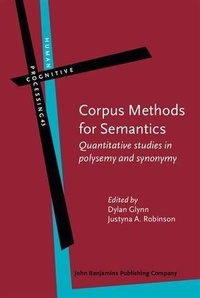
Corpus Methods for Semantics
Quantitative studies in polysemy and synonymy
1st Edition
Published on 6. November 2014
VIII, 545 pages
978-90-272-7033-7 (ISBN)
Description

This volume seeks to advance and popularise the use of corpus-driven quantitative methods in the study of semantics. The first part presents state-of-the-art research in polysemy and synonymy from a Cognitive Linguistic perspective. The second part presents and explains in a didactic manner each of the statistical techniques used in the first part of the volume. A handbook both for linguists working with statistics in corpus research and for linguists in the fields of polysemy and synonymy.
More details
Other editions
Additional editions
Dylan Glynn | Justyna A. Robinson
Corpus Methods for Semantics
Quantitative studies in polysemy and synonymy
Book
11/2014
John Benjamins Publishing Co
€111.30
Shipment within 10-15 days
Persons
Content
- Corpus Methods for Semantics
- Editorial page
- Title page
- LCC data
- Table of contents
- Contributors
- Outline
- 1. Aim of the volume
- 2. Structure and summary
- References
- Section 1. Polysemy and synonymy
- Polysemy and synonymy: Cognitive theory and corpus method
- 1. Introduction: Theory and method
- 2. Polysemy and synonymy: Definition, object and operationalisation
- 3. Complexity and sampling: The need for quantification
- 4. Modelling meaning. Multidimensional patterns and prototype effects
- References
- Competing 'transfer' constructions in Dutch: The case of ont-verbs
- 1. Introduction
- 2. Introducing the Dutch ont-verbs
- 3. Methodology of the case study
- 4. The results of the present-day investigation
- 5. A diachronic perspective
- 6. Conclusion
- References
- Appendix
- Rethinking constructional polysemy: The case of the English conative construction
- 1. Introduction
- 2. The conative construction
- 3. A collexeme analysis of the conative construction
- 4. A collexeme analysis of verb-class-specific constructions
- 5. Conclusion
- References
- Quantifying polysemy in cognitive sociolinguistics
- 1. Polysemy
- 2. Scope of the study
- 3. Data and method
- 4. Hierarchical agglomerative clustering
- 5. Hierarchical agglomerative cluster analysis of collected data
- 6. Logistic regression
- 7. Decision tree analysis
- 8. Summary and discussion of results
- References
- The many uses of run: Corpus methods and Socio-Cognitive Semantics
- 1. Introduction
- 2. Usage-based Cognitive Semantics
- 3. Case study: run in America and Britain in diaries and conversation
- 4. Summary
- References
- Visualizing distances in a set of near-synonyms: Rather, quite, fairly, and pretty
- 1. Introduction
- 2. Previous research
- 3. Method
- 4. Results
- 5. Discussion and conclusion
- References
- A case for the multifactorial assessment of learner language: The uses of may and can in French-English interlanguage
- 1. Introduction and overview
- 2. Setting the stage
- 3. Data and methods
- 4. Results and discussion
- 5. Concluding remarks
- References
- Dutch causative constructions: Quantification of meaning and meaning of quantification
- 1. Introduction
- 2. Dutch causative constructions
- 3. Data and variables
- 4. Statistical analysis
- 5. Linguistic interpretation of the statistical models
- 6. Conclusion
- References
- The semasiological structure of Polish myslec 'to think': A study in verb-prefix semantics
- 1. Introduction
- 2. Introspective conceptual analysis of the prefixed forms of myslec 'to think' in Polish
- 3. The corpus
- 4. Feature annotation
- 5. Multivariate analysis of the results of feature annotation
- 6. Conclusion
- References
- A multifactorial corpus analysis of grammatical synonymy: The Estonian adessive and adposition peal
- 1. Introduction
- 2. The Estonian adessive case and the adposition peal 'on'
- 3. The data sample
- 4. Corpus-linguistic operationalizations and monofactorial results
- 5. Multifactorial results. Logistic regression analysis
- 6. Conclusion
- References
- A diachronic corpus-based multivariate analysis of "I think that" vs. "I think zero"
- 1. Introduction
- 2. Review of the literature
- 3. Data and methods of the current study
- 4. Discussion of the results
- 5. Discussion
- 6. Conclusion
- References
- Section 2. Statistical techniques
- Techniques and tools: Corpus methods and statistics for semantics
- 1. Introduction
- 2. Collocations and features: Two approaches to corpora
- 3. Statistical techniques and tools
- References
- Statistics in R: First steps
- 1. Installing R
- 2. Commands
- 3. The data file
- 4. Importing the data into R
- 5. Making changes to a dataframe in R
- 6. Converting data formats
- 7. Making charts
- 8. Working with scripts
- 9. Extending functionality with packages
- 10. Going further
- References
- Appendix: The tablebind-script
- Frequency tables: Tests, effect sizes, and explorations
- 1. Introduction
- 2. How to analyze frequency tables
- 3. Conclusion
- References
- Collostructional analysis: Measuring associations between constructions and lexical elements
- 1. Introduction
- 2. Collexeme analysis
- 3. Distinctive collexeme analysis
- 4. Covarying-collexeme analysis
- 5. Concluding remarks
- References
- Cluster analysis: Finding structure in linguistic data
- 1. Introduction
- 2. Steps in conducting a cluster analysis
- 3. By way of conclusion
- References
- Appendix
- Correspondence analysis: Exploring data and identifying patterns
- 1. A technique for visualising correlations in categorical data
- 2. Performing and interpreting correspondence analysis in R
- 3. Choice - correspondence or cluster
- 4. Further reading
- References
- Logistic regression: A confirmatory technique for comparisons in corpus linguistics
- 1. Introduction
- 2. Simple logistic regression analysis
- 3. Multiple logistic regression analysis
- 4. Example R code
- 5. Model diagnostics
- 6. Variable selection
- 7. Which conditions should my data set meet?
- 8. Beyond the limits of traditional binomial logistic regression
- 9. Further reading
- References
- Name index
- Subject index
- Dutch causative constructions: Quantification of meaning and meaning of quantification
- 1. Introduction
- 2. Dutch causative constructions
- 3. Data and variables
- 4. Statistical analysis
- 5. Linguistic interpretation of the statistical models
- 6. Conclusion
- References
