

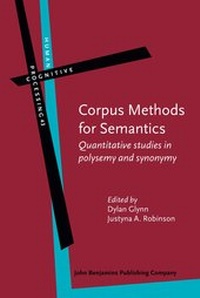
Corpus Methods for Semantics
Quantitative studies in polysemy and synonymy
Published on 6. November 2014
Book
Hardback
545 pages
978-90-272-2397-5 (ISBN)
Description
This volume seeks to advance and popularise the use of corpus-driven quantitative methods in the study of semantics. The first part presents state-of-the-art research in polysemy and synonymy from a Cognitive Linguistic perspective. The second part presents and explains in a didactic manner each of the statistical techniques used in the first part of the volume. A handbook both for linguists working with statistics in corpus research and for linguists in the fields of polysemy and synonymy.
More details
Series
Language
English
Place of publication
Amsterdam
Netherlands
Target group
Professional and scholarly
Illustrations
+ index
Weight
1100 gr
ISBN-13
978-90-272-2397-5 (9789027223975)
Copyright in bibliographic data and cover images is held by Nielsen Book Services Limited or by the publishers or by their respective licensors: all rights reserved.
Schweitzer Classification
Other editions
Additional editions
Dylan Glynn | Justyna A. Robinson
Corpus Methods for Semantics
Quantitative studies in polysemy and synonymy
E-Book
11/2014
1st Edition
John Benjamins Publishing Company
€130.99
Available for download
Persons
Content
1. Contributors; 2. Outline; 3. Section 1. Polysemy and synonymy; 4. Polysemy and synonymy: Corpus method and cognitive theory (by Glynn, Dylan); 5. Competing 'transfer' constructions in Dutch: The case of ont-verbs (by Delorge, Martine); 6. Rethinking constructional polysemy: The case of the English conative construction (by Perek, Florent); 7. Quantifying polysemy in Cognitive Sociolinguistics (by Robinson, Justyna A.); 8. The many uses of run: Corpus methods and Socio-Cognitive Semantics (by Glynn, Dylan); 9. Visualizing distances in a set of near-synonyms: Rather, quite, fairly, and pretty (by Desagulier, Guillaume); 10. A case for the multifactorial assessment of learner language: The uses of may and can in French-English interlanguage (by Deshors, Sandra C.); 11. Dutch causative constructions: Quantification of meaning and meaning of quantification (by Levshina, Natalia); 12. The semasiological structure of Polish myslec 'to think': A study in verb-prefix semantics (by Fabiszak, Malgorzata); 13. A multifactorial corpus analysis of grammatical synonymy: The Estonian adessive and adposition peal 'on' (by Klavan, Jane); 14. A diachronic corpus-based multivariate analysis of "I think that" vs. "I think zero" (by Shank, Christopher); 15. Section 2. Statistical techniques; 16. Techniques and tools: Corpus methods and statistics for semantics (by Glynn, Dylan); 17. Statistics in R: First steps (by Weijer, Joost van de); 18. Frequency tables: Tests, effect sizes, and explorations (by Gries, Stefan Th.); 19. Collostructional analysis: Measuring associations between constructions and lexical elements (by Hilpert, Martin); 20. Cluster analysis: Finding structure in linguistic data (by Divjak, Dagmar); 21. Correspondence analysis: Exploring data and identifying patterns (by Glynn, Dylan); 22. Logistic regression: A confirmatory technique for comparisons in corpus linguistics (by Speelman, Dirk); 23. Name index; 24. Subject index