

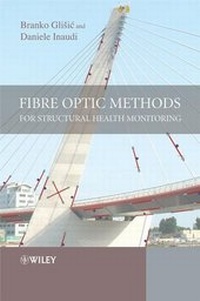
Fibre Optic Methods for Structural Health Monitoring
Description

Reviews / Votes
"In summary, I'm delighted with the book as a source of wellbalanced practical information about an exciting technology."(Geotechnical News, 1 June 2008) "In conclusion, the book is useful for understanding one of thetechnology of structural monitoring for Civil Engineeringapplications today available on the market. But, even moreimportant, the book represents a good guideline for sensorplacement and performance reconstruction from boundary (i.e. notinternal to the structural body) measurements." (Structural ControlHealth Monitoring, 2010) "This makes the book extremely useful for structural inspectorswho need to understand the condition of civil structures from astructural perspective ... Based on this, it can help them to reachcorrect evaluations of the true condition of the structures, and inturn helps them make effective decisions on the final fate of thesestructures." (Can. J. Civ. Eng., 19 February 2008) "In a nutshell, this book is recommended as a good reference andsource of valuable information for basic and applied principles inlong gauge deformation sensing. It embodies the valuable fieldexperiences of the authors for sensor placement and interpretationof data. It is also written in a simple format and without verymuch of rigor for non-optical physics majors." (Structure andInfrastructure Engineering, 1 October 2009) "Overall the Book is organised so that it can be used as astep-by-step guide to implement a monitoring system and includesnumerous application examples on the most common types ofstructures, such as building, bridges, historical monuments, piles,dams, tunnels, pipelines, risers, and off-shore structures, andtheir most frequently monitored parameters." (TMCnet.com, 17 March2011) "...I recommend that you tell your structural engineeringcolleagues about it.... I'm delighted with the book as asource of well balanced practical information about an excitingtechnology." (Geotechnical News, June 2008)More details
Other editions
Additional editions


Persons
Content
Preface.
Acknowledgments.
1 Introduction to Structural Health Monitoring.
1.1 Basic Notions, Needs and Benefits.
1.1.1 Introduction.
1.1.2 Basic Notions.
1.1.3 Monitoring Needs and Benefits.
1.1.4 Whole Lifespan Monitoring.
1.2 The Structural Health Monitoring Process.
1.2.1 Core Activities.
1.2.2 Actors.
1.3 On-Site Example of Structural Health Monitoring Project.
2 Fibre-Optic Sensors.
2.1 Introduction to Fibre-Optic Technology.
2.2 Fibre-Optic Sensing Technologies.
2.2.1 SOFO Interferometric Sensors.
2.2.2 Fabry-Perot Interferometric Sensors.
2.2.3 Fibre Bragg-Grating Sensors.
2.2.4 Distributed Brillouin- and Raman-Scattering Sensors.
2.3 Sensor Packaging.
2.4 Distributed Sensing Cables.
2.4.1 Introduction.
2.4.2 Temperature-Sensing Cable.
2.4.3 Strain-Sensing Tape: SMARTape.
2.4.4 Combined Strain- and Temperature-Sensing: SMARTprofile.
2.5 Software and System Integration.
2.6 Conclusions and Summary.
3 Fibre-Optic Deformation Sensors: Applicability and Interpretation of Measurements.
3.1 Strain Components and Strain Time Evolution.
3.1.1 Basic Notions.
3.1.2 Elastic and Plastic Structural Strain.
3.1.3 Thermal Strain.
3.1.4 Creep.
3.1.5 Shrinkage.
3.1.6 Reference Time and Reference Measurement.
3.2 Sensor Gauge Length and Measurement.
3.2.1 Introduction.
3.2.2 Deformation Sensor Measurements.
3.2.3 Global Structural Monitoring: Basic Notions.
3.2.4 Sensor Measurement Dependence on Strain Distribution: Maximal Gauge Length.
3.2.5 Sensor Measurement in Inhomogeneous Materials: Minimal-Gauge Length.
3.2.6 General Principle in the Determination of Sensor Gauge Length.
3.2.7 Distributed Strain Sensor Measurement.
3.3 Interpretation of strain measurement.
3.3.1 Introduction.
3.3.2 Sources of Errors and Detection of Anomalous Structural Condition.
3.3.3 Determination of Strain Components and Stress from Total-Strain Measurement.
3.3.4 Example of Strain Measurement Interpretation.
4 Sensor Topologies: Monitoring Global Parameters.
4.1 Finite Element Structural Health Monitoring Concept: Introduction.
4.2 Simple Topology and Applications.
4.2.1 Basic Notions on Simple Topology.
4.2.2 Enchained Simple Topology.
4.2.3 Example of an Enchained Simple Topology Application.
4.2.4 Scattered Simple Topology.
4.2.5 Example of a Scattered Simple Topology Application.
4.3 Parallel Topology.
4.3.1 Basic Notions on Parallel Topology: Uniaxial Bending.
4.3.2 Basic Notions on Parallel Topology: Biaxial Bending.
4.3.3 Deformed Shape and Displacement Diagram.
4.3.4 Examples of Parallel Topology Application.
4.4 Crossed Topology.
4.4.1 Basic Notions on Crossed Topology: Planar Case.
4.4.2 Basic Notions on Crossed Topology: Spatial Case.
4.4.3 Example of a Crossed Topology Application.
4.5 Triangular Topology.
4.5.1 Basic Notions on Triangular Topology.
4.5.2 Scattered and Spread Triangular Topologies.
4.5.3 Monitoring of Planar Relative Movements Between Two Blocks.
4.5.4 Example of a Triangular Topology Application.
5 Finite Element Structural Health Monitoring Strategies and Application Examples.
5.1 Introduction.
5.2 Monitoring of Pile Foundations.
5.2.1 Monitoring the Pile.
5.2.2 Monitoring a Group of Piles.
5.2.3 Monitoring of Foundation Slab.
5.2.4 On-Site Example of Piles Monitoring.
5.3 Monitoring of Buildings.
5.3.1 Monitoring of Building Structural Members.
5.3.2 Monitoring of Columns.
5.3.3 Monitoring of Cores.
5.3.4 Monitoring of Frames, Slabs and Walls.
5.3.5 Monitoring of a Whole Building.
5.3.6 On-Site Example of Building Monitoring.
5.4 Monitoring of Bridges.
5.4.1 Introduction.
5.4.2 Monitoring of a Simple Beam.
5.4.3 On-Site Example of Monitoring of a Simple Beam.
5.4.4 Monitoring of a Continuous Girder.
5.4.5 On-Site Example of Monitoring of a Continuous Girder.
5.4.6 Monitoring of a Balanced Cantilever Bridge.
5.4.7 On-Site Example of Monitoring of a Balanced Cantilever Girder.
5.4.8 Monitoring of an Arch Bridge.
5.4.9 On-Site Example of Monitoring of an Arch Bridge.
5.4.10 Monitoring of a Cable-Stayed Bridge.
5.4.11 On-Site Example of Monitoring of a Cable-Stayed Bridge.
5.4.12 Monitoring of a Suspended Bridge.
5.4.13 Bridge Integrity Monitoring.
5.4.14 On-Site Example of Bridge Integrity Monitoring.
5.5 Monitoring of Dams.
5.5.1 Introduction.
5.5.2 Monitoring of an Arch Dam.
5.5.3 On-Site Examples on Monitoring of an Arch Dam.
5.5.4 Monitoring of a Gravity Dam.
5.5.5 On-Site Example of Monitoring a Gravity Dam.
5.5.6 Monitoring of a Dyke (Earth or Rockfill Dam).
5.5.7 On-Site Example of Monitoring a Dyke.
5.6 Monitoring of Tunnels.
5.6.1 Introduction.
5.6.2 Monitoring of Convergence.
5.6.3 On-Site Example of Monitoring of Convergence.
5.6.4 Monitoring of Strain and Deformation.
5.6.5 On-Site Example of Monitoring of Deformation.
5.6.6 Monitoring of Other Parameters and Tunnel Integrity Monitoring.
5.7 Monitoring of Heritage Structures.
5.7.1 Introduction.
5.7.2 Monitoring of San Vigilio Church, Gandria, Switzerland.
5.7.3 Monitoring of Royal Villa, Monza, Italy.
5.7.4 Monitoring of Bolshoi Moskvoretskiy Bridge, Moscow, Russia.
5.8 Monitoring of Pipelines.
5.8.1 Introduction.
5.8.2 Pipeline Monitoring.
5.8.3 Pipeline Monitoring Application Examples.
5.8.4 Conclusions.
6 Conclusions and Outlook.
6.1 Conclusions.
6.2 Outlook.
References.
Index.
