

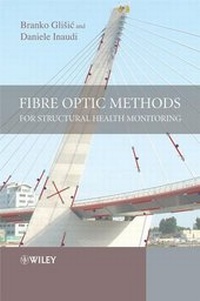
Fibre Optic Methods for Structural Health Monitoring
Will be published approx. on 26. October 2007
Book
Hardback
276 pages
978-0-470-06142-8 (ISBN)
Description
The use of fibre optic sensors in structural health monitoring has rapidly accelerated in recent years. By embedding fibre optic sensors in structures (e.g. buildings, bridges and pipelines) it is possible to obtain real time data on structural changes such as stress or strain. Engineers use monitoring data to detect deviations from a structure's original design performance in order to optimise the operation, repair and maintenance of a structure over time.
Fibre Optic Methods for Structural Health Monitoring is organised as a step-by-step guide to implementing a monitoring system and includes examples of common structures and their most-frequently monitored parameters. This book:
* presents a universal method for static structural health monitoring, using a technique with proven effectiveness in hundreds of applications worldwide;
* discusses a variety of different structures including buildings, bridges, dams, tunnels and pipelines;
* features case studies which describe common problems and offer solutions to those problems;
* provides advice on establishing mechanical parameters to monitor (including deformations, rotations and displacements) and on placing sensors to achieve monitoring objectives;
* identifies methods for interpreting data according to construction material and shows how to apply numerical concepts and formulae to data in order to inform decision making.
Fibre Optic Methods for Structural Health Monitoring is an invaluable reference for practising engineers in the fields of civil, structural and geotechnical engineering. It will also be of interest to academics and undergraduate/graduate students studying civil and structural engineering.
Reviews / Votes
"In summary, I'm delighted with the book as a source of well balanced practical information about an exciting technology." (Geotechnical News, 1 June 2008)"In conclusion, the book is useful for understanding one of the technology of structural monitoring for Civil Engineering applications today available on the market. But, even more important, the book represents a good guideline for sensor placement and performance reconstruction from boundary (i.e. not internal to the structural body) measurements." (Structural Control Health Monitoring, 2010)
"This makes the book extremely useful for structural inspectors who need to understand the condition of civil structures from a structural perspective ... Based on this, it can help them to reach correct evaluations of the true condition of the structures, and in turn helps them make effective decisions on the final fate of these structures." (Can. J. Civ. Eng., 19 February 2008)
"In a nutshell, this book is recommended as a good reference and source of valuable information for basic and applied principles in long gauge deformation sensing. It embodies the valuable field experiences of the authors for sensor placement and interpretation of data. It is also written in a simple format and without very much of rigor for non-optical physics majors." (Structure and Infrastructure Engineering, 1 October 2009)
"Overall the Book is organised so that it can be used as a step-by-step guide to implement a monitoring system and includes numerous application examples on the most common types of structures, such as building, bridges, historical monuments, piles, dams, tunnels, pipelines, risers, and off-shore structures, and their most frequently monitored parameters." (TMCnet.com, 17 March 2011)
"...I recommend that you tell your structural engineering colleagues about it.... I'm delighted with the book as a source of well balanced practical information about an exciting technology." (Geotechnical News, June 2008)
More details
Product info
gebunden
Edition
1. Auflage
Language
English
Place of publication
United States
Publishing group
John Wiley & Sons Inc
Target group
Professional and scholarly
Product notice
sewn/stitched
Cloth over boards
Dimensions
Height: 250 mm
Width: 175 mm
Thickness: 20 mm
Weight
669 gr
ISBN-13
978-0-470-06142-8 (9780470061428)
Schweitzer Classification
Other editions
Additional editions
Branko Glisic | Daniele Inaudi
Fibre Optic Methods for Structural Health Monitoring
E-Book
08/2008
Wiley
€122.99
Available for download
Persons
Dr. Branko Glisic received his degrees in Civil Engineering and Theoretical Mathematics at University of Belgrade, Serbia, and Ph.D. at the EPFL, Switzerland. His thesis focuses on the development of fiber optic sensors for particular applications, and characterization of concrete at very early age. He was employed at SMARTEC SA, Switzerland, where he was involved in research and engineering at different levels of responsibility in numerous structural health monitoring (SHM) projects. Since February 2009 he has been employed as an Assistant Professor at Department of Civil and Environmental Engineering of Princeton University. His main areas of interest are SHM methods, advanced sensory systems, smart structures, SHM data management, and sustainable engineering. Prof. Gli?i? is author and co-author of more than hundred published papers, university course on SHM, short courses on SHM using FOS, and he is a member of several professional associations (ISHMII, ACI, ACSE, IABMAS, IABSE, ISMA). Dr. Daniele Inaudi received a degree in physics at the Swiss Federal Institute of Technology in Zurich (ETHZ). His graduation work was centred on the theoretical and experimental study of the polarization state of the emission of external grating diode lasers and was prized with the ETHZ medal. He is an active member of OSA, SPIE, IABSE, IABMAS, fib, founding member of ISHMII, chairman of the Sensor conference at the annual "SPIE International Symposium on Smart Structures and Materials" and member of the organizing committee of the annual "International conference on Optical Fibre Sensors". Daniele Inaudi is author of more that 80 papers, three book chapters and editor of a book on Optical Nondestructive Testing.
Content
Foreword.
Preface.
Acknowledgments.
1. Introduction to Structural Health Monitoring.
2. Fibre-Optic Sensors.
3. Fibre-Optic Deformation Sensors: Applicability and Interpretation of Measurements.
4. Sensor Topologies: Monitoring Global Parameters.
5. Finite Element Structural Health Monitoring Strategies and Application Examples.
6. Conclusions and Outlook.
References.
Index.