

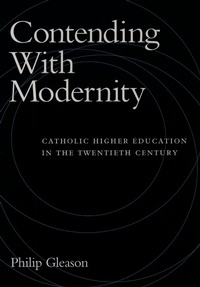
Contending With Modernity
Catholic Higher Education in the Twentieth Century
1st Edition
Published on 28. December 1995
449 pages
978-0-19-535693-9 (ISBN)
Description

How did Catholic colleges and universities deal with the modernization of education and the rise of research universities? In this book, Philip Gleason offers the first comprehensive study of Catholic higher education in the twentieth century, tracing the evolution of responses to an increasingly secular educational system. At the beginning of the century, Catholics accepted modernization in the organizational sphere while resisting it ideologically. Convinced of the truth of their religious and intellectual position, the restructured Catholic colleges grew rapidly after World War I, committed to educating for a "Catholic Renaissance." This spirit of militance carried over into the post-World War II era, but new currents were also stirring as Catholics began to look more favorably on modernity in its American form. Meanwhile, their colleges and universities were being transformed by continuing growth and professionalization. By the 1960's, changes in church teaching and cultural upheaval in American society reinforced the internal transformation already under way, creating an "identity crisis" which left Catholic educators uncertain of their purpose. Emphasizing the importance to American culture of the growth of education at all levels, Gleason connects the Catholic story with major national trends and historical events. By situating developments in higher education within the context of American Catholic thought, Contending with Modernity provides the fullest account available of the intellectual development of American Catholicism in the twentieth century.
More details
Other editions
Additional editions
Book
03/1996
Oxford University Press Inc
€242.10
Shipment within 15-20 days
Content
- Intro
- Contents
- Introduction: Catholic Higher Education in 1900
- The Old-Time Catholic College
- The Catholic University of America
- After Americanism, Modernism
- Part One: Confronting Modernity as the Century Opens
- 1. Awaking to the Organizational Challenge
- Symptoms of Crisis
- Realignment of Secondary and Collegiate Education
- 2. Rationalizing the Catholic System
- The Problem of Unity and the Role of the Catholic University
- The Origins and Early Development of the CEA
- The High School Movement and Standardization
- Standing Firm by the Ratio Studiorum
- Biting the Curricular Bullet
- 3. The Impact of World War I
- The NCWC and the Issue of Centralization
- Standardization Once Again
- The Students' Army Training Corps
- 4. A New Beginning: Catholic Colleges 1900-1930
- The Catholic University of America
- Catholic Women's Colleges, 1900-1930
- The University Movement, 1900-1925
- Part Two: Challenging Modernity Between the Wars
- 5. The Intellectual Context
- The Scholastic Revival
- Neoscholasticism and the Catholic Worldview
- 6. The Beginnings of the Catholic Renaissance
- Americanism and Its Medieval Scholastic Background
- The Postwar Catholic Resurgence
- Developments in the Colleges
- 7. The Catholic Revival Reaches Full Flood
- 1928 and After: The Post-Al Smith Context
- Creating a Catholic Culture
- Catholic Action: Background and Beginnings
- Catholic Action and the Colleges
- Philosophy and Theology
- 8. Institutional Developments: Moving into Graduate Work
- Graduate Work: Background and Beginnings
- Graduate Expansion in the 1920s
- Jesuit Self-Criticism and Reform
- 9. The Tribulations of the Thirties
- Problems with Accreditation
- Reorganization and Its Tensions
- Graduate Work Once Again
- Part Three: World War II and Postwar Crosscurrents
- 10. World War II and Institutional Shifts
- Specialized Wartime Programs
- Research, Development, and Expanding Educational Horizons
- Graduate Work and Related Developments
- The Sister Formation Movement
- 11. Assimilative Tendencies and Curricular Crosscurrents
- Catholic Colleges and the Race Issue
- Catholics and the Postwar Student Movement
- Debating the Liberal Arts
- The Drive for Curricular Integration
- Religion versus Theology
- 12. Controversy: Backlash Against the Catholic Revival
- The Anti-Catholic Backlash
- The Catholic Campaign Against Secularism
- Secularism and the Family Crisis
- John Courtney Murray and the Church-State Issue
- 13. Transition to a New Era
- The Historical Recovery of Americanism
- Self-Criticism and the Search for Excellence
- The Splintering of the Scholastic Synthesis
- 14. The End of an Era
- The Contagion of Liberty
- Accepting Modernity
- Abbreviations Used in Notes
- Notes
- Index
- A
- B
- C
- D
- E
- F
- G
- H
- I
- J
- K
- L
- M
- N
- O
- P
- Q
- R
- S
- T
- U
- V
- W
- X
- Y
- Z
