

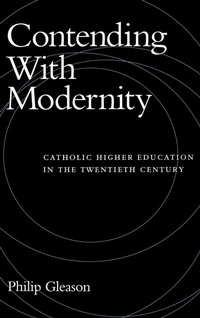
Contending with Modernity
Catholic Higher Education in the Twentieth Century
Published on 14. March 1996
Book
Hardback
448 pages
978-0-19-509828-0 (ISBN)
Description
How did Catholic colleges and universities deal with the modernization of education and the rise of research universities? In this book, Philip Gleason offers the first comprehensive study of Catholic higher education in the twentieth century, tracing the evolution of responses to an increasingly secular educational system. At the beginning of the century, Catholics accepted modernization in the organizational sphere while resisting it ideologically. Convinced
of the truth of their religious and intellectual position, the restructured Catholic colleges grew rapidly after World War I, committed to educating for a "Catholic Renaissance." This spirit of
militance carried over into the post-World War II era, but new currents were also stirring as Catholics began to look more favorably on modernity in its American form. Meanwhile, their colleges and universities were being transformed by continuing growth and professionalization. By the 1960's, changes in church teaching and cultural upheaval in American society reinforced the internal transformation already under way, creating an "identity crisis" which left Catholic educators uncertain of
their purpose. Emphasizing the importance to American culture of the growth of education at all levels, Gleason connects the Catholic story with major national trends and historical events. By
situating developments in higher education within the context of American Catholic thought, Contending with Modernity provides the fullest account available of the intellectual development of American Catholicism in the twentieth century.
of the truth of their religious and intellectual position, the restructured Catholic colleges grew rapidly after World War I, committed to educating for a "Catholic Renaissance." This spirit of
militance carried over into the post-World War II era, but new currents were also stirring as Catholics began to look more favorably on modernity in its American form. Meanwhile, their colleges and universities were being transformed by continuing growth and professionalization. By the 1960's, changes in church teaching and cultural upheaval in American society reinforced the internal transformation already under way, creating an "identity crisis" which left Catholic educators uncertain of
their purpose. Emphasizing the importance to American culture of the growth of education at all levels, Gleason connects the Catholic story with major national trends and historical events. By
situating developments in higher education within the context of American Catholic thought, Contending with Modernity provides the fullest account available of the intellectual development of American Catholicism in the twentieth century.
Reviews / Votes
Philip Gleason has produced a magisterial interpretation of Catholic higher education in the twentieth century....the most reliable and convincing comprehensive history of Catholic higher education. It is a must read for all involved in Catholic higher education and for all those interested in the intellectual and institutional history of religion and education in this country. * U.S. Catholic Historian *More details
Language
English
Place of publication
New York
United States
Target group
Professional and scholarly
Dimensions
Height: 235 mm
Width: 157 mm
Thickness: 31 mm
Weight
880 gr
ISBN-13
978-0-19-509828-0 (9780195098280)
Copyright in bibliographic data and cover images is held by Nielsen Book Services Limited or by the publishers or by their respective licensors: all rights reserved.
Schweitzer Classification
Other editions
Additional editions
E-Book
12/1995
1st Edition
OUP eBook
€136.99
Available for download