

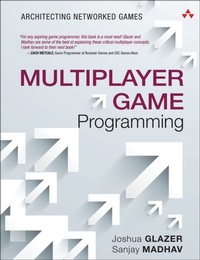
Multiplayer Game Programming
Architecting Networked Games
1st Edition
Published on 20. November 2015
384 pages
978-0-13-403434-8 (ISBN)
Description

The Practical Guide to Building Reliable Networked Multiplayer Games
Networked multiplayer games are a multibillion dollar business: some games now attract tens of millions of players. In this practical, code-rich guide, Joshua Glazer and Sanjay Madhav guide you through every aspect of engineering them. Drawing on their immense experience as both game developers and instructors, the authors lead you through building a robust multiplayer architecture, and creating every engine-level system. You'll learn through in-depth working code examples for two complete games: an action game and a real time strategy (RTS) game.
First, Madhav and Glazer review the essentials of networking and network programming from the standpoint of game developers. Next, they walk through managing game data transmission, updating game objects across the network, and organizing the devices that join your game. You'll learn how to ensure reliable performance despite the Internet's inherent inconsistencies, and how to design game code for maximum security and scalability. The authors conclude by addressing two increasingly crucial issues: incorporating gamer services and hosting your games in the cloud.
This guide's content has been extensively tested through the authors' multiplayer game programming courses at USC. It is equally valuable both to students and to working game programmers moving into networked games.
Coverage includes
How games have evolved to meet the challenges of networked environments
Using Internet communication protocols and standards in game development
Working with Berkeley Socket, the most widely used networking construct in multiplayer gaming
Formatting game data for efficient Internet transmission
Synchronizing states so all players share the same world
Organizing networking topologies for large-scale games
Overcoming latency and jitter problems that cause delays or lost data
Scaling games without compromising performance
Combating security vulnerabilities and software cheats
Leveraging the networking functionality of the popular Unreal 4 and Unity game engines
Integrating gamer services such as matchmaking, achievements, and leaderboards
Running game servers in the cloud
About the Website C++ source code for all examples is available at github.com/MultiplayerBook. Instructors will also find a full set of PowerPoint slides and a sample syllabus.
Networked multiplayer games are a multibillion dollar business: some games now attract tens of millions of players. In this practical, code-rich guide, Joshua Glazer and Sanjay Madhav guide you through every aspect of engineering them. Drawing on their immense experience as both game developers and instructors, the authors lead you through building a robust multiplayer architecture, and creating every engine-level system. You'll learn through in-depth working code examples for two complete games: an action game and a real time strategy (RTS) game.
First, Madhav and Glazer review the essentials of networking and network programming from the standpoint of game developers. Next, they walk through managing game data transmission, updating game objects across the network, and organizing the devices that join your game. You'll learn how to ensure reliable performance despite the Internet's inherent inconsistencies, and how to design game code for maximum security and scalability. The authors conclude by addressing two increasingly crucial issues: incorporating gamer services and hosting your games in the cloud.
This guide's content has been extensively tested through the authors' multiplayer game programming courses at USC. It is equally valuable both to students and to working game programmers moving into networked games.
Coverage includes
How games have evolved to meet the challenges of networked environments
Using Internet communication protocols and standards in game development
Working with Berkeley Socket, the most widely used networking construct in multiplayer gaming
Formatting game data for efficient Internet transmission
Synchronizing states so all players share the same world
Organizing networking topologies for large-scale games
Overcoming latency and jitter problems that cause delays or lost data
Scaling games without compromising performance
Combating security vulnerabilities and software cheats
Leveraging the networking functionality of the popular Unreal 4 and Unity game engines
Integrating gamer services such as matchmaking, achievements, and leaderboards
Running game servers in the cloud
About the Website C++ source code for all examples is available at github.com/MultiplayerBook. Instructors will also find a full set of PowerPoint slides and a sample syllabus.
All prices
More details
Series
Edition
1. Auflage
Language
English
Place of publication
Boston
United States
Publishing group
Pearson Education (US)
Target group
College/higher education
File size
15,79 MB
ISBN-13
978-0-13-403434-8 (9780134034348)
Copyright in bibliographic data and cover images is held by Nielsen Book Services Limited or by the publishers or by their respective licensors: all rights reserved.
Schweitzer Classification
Other editions
Additional editions
Book
01/2016
Addison Wesley
€55.07
Article not available at the moment
Persons
Joshua Glazer is a cofounder and CTO of Naked Sky Entertainment, the independent development studio behind console and PC games such as RoboBlitz, MicroBot, Twister Mania, and more recently, the mobile hits Max Axe and Scrap Force. As a leader of the Naked Sky team, he has consulted on several external projects including Epic Games' Unreal Engine, Riot Games' League of Legends, THQ's Destroy All Humans franchise, and numerous other projects for Electronic Arts, Midway, Microsoft, and Paramount Pictures.
Joshua is also a part-time lecturer at the University of Southern California, where he has enjoyed teaching courses in multiplayer game programming and game engine development.
Sanjay Madhav is a senior lecturer at the University of Southern California, where he teaches several programming and video game programming courses. His flagship course is an undergraduate-level game programming course that he has taught since 2008, but he has taught several other course topics, including game engines, data structures, and compiler development. He is also the author of Game Programming Algorithms and Techniques.
Prior to joining USC, Sanjay worked as a programmer at several video game developers, including Electronic Arts, Neversoft, and Pandemic Studios. His credited games include Medal of Honor: Pacific Assault, Tony Hawk's Project 8, Lord of the Rings: Conquest, and The Saboteur-most of which had networked multiplayer in one form or another.
Joshua is also a part-time lecturer at the University of Southern California, where he has enjoyed teaching courses in multiplayer game programming and game engine development.
Sanjay Madhav is a senior lecturer at the University of Southern California, where he teaches several programming and video game programming courses. His flagship course is an undergraduate-level game programming course that he has taught since 2008, but he has taught several other course topics, including game engines, data structures, and compiler development. He is also the author of Game Programming Algorithms and Techniques.
Prior to joining USC, Sanjay worked as a programmer at several video game developers, including Electronic Arts, Neversoft, and Pandemic Studios. His credited games include Medal of Honor: Pacific Assault, Tony Hawk's Project 8, Lord of the Rings: Conquest, and The Saboteur-most of which had networked multiplayer in one form or another.
Content
Chapter 1: Overview of Networked Games
Chapter 2: The Internet
Chapter 3: Berkeley Sockets
Chapter 4: Object Serialization
Chapter 5: Object Replication
Chapter 6: Network Topologies and Sample Games
Chapter 7: Latency, Jitter, and Reliability
Chapter 8: Improved Latency Handling
Chapter 9: Scalability
Chapter 10: Security
Chapter 11: Real-World Engines
Chapter 12: Gamer Services
Chapter 13: Cloud Hosting Dedicated Servers
Appendix A: A Modern C++ Primer
Index
Chapter 2: The Internet
Chapter 3: Berkeley Sockets
Chapter 4: Object Serialization
Chapter 5: Object Replication
Chapter 6: Network Topologies and Sample Games
Chapter 7: Latency, Jitter, and Reliability
Chapter 8: Improved Latency Handling
Chapter 9: Scalability
Chapter 10: Security
Chapter 11: Real-World Engines
Chapter 12: Gamer Services
Chapter 13: Cloud Hosting Dedicated Servers
Appendix A: A Modern C++ Primer
Index
