

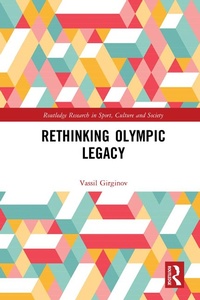
Rethinking Olympic Legacy
1st Edition
Published on 19. April 2018
231 pages
978-1-351-62926-3 (ISBN)
Description

How do Olympic legacies come about? This book offers an alternative approach to the study of Olympic and mega-sport event legacy, challenging how legacy is conceptualised and practised. It shifts the focus from legacy as a retrospective concept concerned with what has been left behind after the Games, to a prospective one interested in actions and interactions stimulated by the Games.
The book argues that creating Olympic legacy is a continuing four-stage process involving 'investing' (the accumulated common Olympic cultural capital), 'interpelling' (forming a trusteeship relationship where one party undertakes to change the capacity of another), 'developing' (ensuring participation in interactions and resource development) and 'codifying' (documenting, sharing and remembering legacies so they become cultural capital). It presents a developmental approach to the Olympics which involves vision, trustees and trusteeship and is concerned with capacity building at individual, organisational and societal levels. Thinking of Olympic legacy as capacity building allows seeing the goal of legacy as an embodiment of the aspirations of the Olympic Movement and the Games to introduce radical change in society by transforming its structure.
Rethinking Olympic Legacy is essential reading for all students and scholars within an interest in the Olympics, as well as for administrators, policymakers and planners involved with mega-sport events.
The book argues that creating Olympic legacy is a continuing four-stage process involving 'investing' (the accumulated common Olympic cultural capital), 'interpelling' (forming a trusteeship relationship where one party undertakes to change the capacity of another), 'developing' (ensuring participation in interactions and resource development) and 'codifying' (documenting, sharing and remembering legacies so they become cultural capital). It presents a developmental approach to the Olympics which involves vision, trustees and trusteeship and is concerned with capacity building at individual, organisational and societal levels. Thinking of Olympic legacy as capacity building allows seeing the goal of legacy as an embodiment of the aspirations of the Olympic Movement and the Games to introduce radical change in society by transforming its structure.
Rethinking Olympic Legacy is essential reading for all students and scholars within an interest in the Olympics, as well as for administrators, policymakers and planners involved with mega-sport events.
More details
Series
Edition
1. Auflage
Language
English
Place of publication
London
United Kingdom
Publishing group
Taylor & Francis Ltd
Target group
College/higher education
Illustrations
45 s/w Tabellen, 6 s/w Zeichnungen
45 Tables, black and white; 6 Line drawings, black and white
File size
1,42 MB
ISBN-13
978-1-351-62926-3 (9781351629263)
Copyright in bibliographic data and cover images is held by Nielsen Book Services Limited or by the publishers or by their respective licensors: all rights reserved.
Schweitzer Classification
Other editions
Additional editions
Vassil Girginov
Rethinking Olympic Legacy
Book
12/2019
1st Edition
Routledge
€68.30
Shipment within 15-20 days
Vassil Girginov
Rethinking Olympic Legacy
Book
04/2018
1st Edition
Routledge
€207.60
Shipment within 10-20 days
Person
Vassil Girginov is Reader in Sport Management and Development at Brunel University London and Visiting Professor at the Russian International Olympic University. His work is concerned with understanding the relationship between the Olympic Games and social change in various cultural and economic milieux. Girginov's most recent publications include: Olympic Studies (4-vol. set; Routledge, 2015), Handbook of the London 2012 Olympic and Paralympic Games (2 vols; Routledge, 2012-2013), Sport Management Cultures (Routledge, 2011), and The Olympics: A Critical Reader (Routledge, 2010).
Content
List of Tables and Figures
Preface: The Whole Book in 500 Words
Acknowledgements
1. Untangling the Link Between the Olympics and Legacy: An Introduction
2. Olympism, Contentious Politics and Social Change
3. A Resource Perspective on the Olympics
4. Leveraging Olympic Resources
5. Olympism in Action: A Capacity Building Perspective
6. National Sport Organisations' Leveraging of the Olympics for Capacity Building
7. Host Country's Higher Education Sector and the Olympics: Interactions, Resources and Capacity Development
8. Olympic Interactions, Resource Leveraging and Capacity Building in Context: The Cases of the British Paralympic Association, British Cycling and the Russian Figure Skating Federation [with Nikolay Peshin]
9. Why Rethink Olympic Legacy? Conclusion
Index
Preface: The Whole Book in 500 Words
Acknowledgements
1. Untangling the Link Between the Olympics and Legacy: An Introduction
2. Olympism, Contentious Politics and Social Change
3. A Resource Perspective on the Olympics
4. Leveraging Olympic Resources
5. Olympism in Action: A Capacity Building Perspective
6. National Sport Organisations' Leveraging of the Olympics for Capacity Building
7. Host Country's Higher Education Sector and the Olympics: Interactions, Resources and Capacity Development
8. Olympic Interactions, Resource Leveraging and Capacity Building in Context: The Cases of the British Paralympic Association, British Cycling and the Russian Figure Skating Federation [with Nikolay Peshin]
9. Why Rethink Olympic Legacy? Conclusion
Index
