

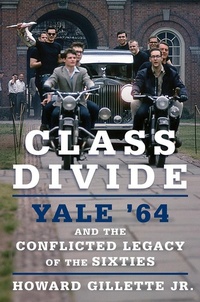
Class Divide
Yale '64 and the Conflicted Legacy of the Sixties
Published on 21. May 2015
312 pages
978-0-8014-5611-4 (ISBN)
Description

Members of the Yale College class of 1964-the first class to matriculate in the 1960s-were poised to take up the positions of leadership that typically followed an Ivy League education. Their mission gained special urgency from the inspiration of John F. Kennedy's presidency and the civil rights movement as it moved north. Ultimately these men proved successful in traditional terms-in the professions, in politics, and in philanthropy-and yet something was different. Challenged by the issues that would define a new era, their lives took a number of unexpected turns. Instead of confirming the triumphal perspective they grew up with in the years after World War II, they embraced new and often conflicting ideas. In the process the group splintered.
In Class Divide, Howard Gillette Jr. draws particularly on more than one hundred interviews with representative members of the Yale class of '64 to examine how they were challenged by the issues that would define the 1960s: civil rights, the power of the state at home and abroad, sexual mores and personal liberty, religious faith, and social responsibility. Among those whose life courses Gillette follows from their formative years in college through the years after graduation are the politicians Joe Lieberman and John Ashcroft, the Harvard humanities professor Stephen Greenblatt, the environmental leader Gus Speth, and the civil rights activist Stephen Bingham.
Although their Ivy League education gave them access to positions in the national elite, the members of Yale '64 nonetheless were too divided to be part of a unified leadership class. Try as they might, they found it impossible to shape a new consensus to replace the one that was undone in their college years and early adulthood.
In Class Divide, Howard Gillette Jr. draws particularly on more than one hundred interviews with representative members of the Yale class of '64 to examine how they were challenged by the issues that would define the 1960s: civil rights, the power of the state at home and abroad, sexual mores and personal liberty, religious faith, and social responsibility. Among those whose life courses Gillette follows from their formative years in college through the years after graduation are the politicians Joe Lieberman and John Ashcroft, the Harvard humanities professor Stephen Greenblatt, the environmental leader Gus Speth, and the civil rights activist Stephen Bingham.
Although their Ivy League education gave them access to positions in the national elite, the members of Yale '64 nonetheless were too divided to be part of a unified leadership class. Try as they might, they found it impossible to shape a new consensus to replace the one that was undone in their college years and early adulthood.
More details
Language
English
Place of publication
Ithaca
United States
Target group
College/higher education
Product notice
Reflowable
Illustrations
16 halftones - 16 Halftones, black and white
ISBN-13
978-0-8014-5611-4 (9780801456114)
Copyright in bibliographic data and cover images is held by Nielsen Book Services Limited or by the publishers or by their respective licensors: all rights reserved.
Schweitzer Classification
Other editions
Additional editions
Book
05/2015
Cornell University Press
€30.00
Shipment within 10-20 days
Person
Howard Gillette Jr. is Professor Emeritus of History at Rutgers, the State University of New Jersey. He is the author of Between Justice and Beauty: Race, Planning, and the Failure of Urban Policy in Washington, D.C.; Camden After the Fall: Decline and Renewal in a Post-Industrial City; and Civitas by Design: Building Better Communities, from the Garden City to the New Urbanism.
Content
Introduction: What a Hinge Generation Can Tell Us1. Bright College Years, 1960-19642. Into the "Long Sixties," 1964-19743. Civil Rights4. War and Peace5. The Greening of '646. God and Man7. Sex and Marriage8. Culture Wars and the UniversityConclusion: After a Long Journey, a Lasting DivideNotes
Acknowledgments
Index
Acknowledgments
Index
