

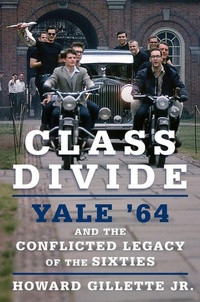
Class Divide
Yale '64 and the Conflicted Legacy of the Sixties
Published on 21. May 2015
Book
Hardback
312 pages
978-0-8014-5365-6 (ISBN)
Description
Members of the Yale College class of 1964-the first class to matriculate in the 1960s-were poised to take up the positions of leadership that typically followed an Ivy League education. Their mission gained special urgency from the inspiration of John F. Kennedy's presidency and the civil rights movement as it moved north. Ultimately these men proved successful in traditional terms-in the professions, in politics, and in philanthropy-and yet something was different. Challenged by the issues that would define a new era, their lives took a number of unexpected turns. Instead of confirming the triumphal perspective they grew up with in the years after World War II, they embraced new and often conflicting ideas. In the process the group splintered.
In Class Divide, Howard Gillette Jr. draws particularly on more than one hundred interviews with representative members of the Yale class of '64 to examine how they were challenged by the issues that would define the 1960s: civil rights, the power of the state at home and abroad, sexual mores and personal liberty, religious faith, and social responsibility. Among those whose life courses Gillette follows from their formative years in college through the years after graduation are the politicians Joe Lieberman and John Ashcroft, the Harvard humanities professor Stephen Greenblatt, the environmental leader Gus Speth, and the civil rights activist Stephen Bingham.
Although their Ivy League education gave them access to positions in the national elite, the members of Yale '64 nonetheless were too divided to be part of a unified leadership class. Try as they might, they found it impossible to shape a new consensus to replace the one that was undone in their college years and early adulthood.
In Class Divide, Howard Gillette Jr. draws particularly on more than one hundred interviews with representative members of the Yale class of '64 to examine how they were challenged by the issues that would define the 1960s: civil rights, the power of the state at home and abroad, sexual mores and personal liberty, religious faith, and social responsibility. Among those whose life courses Gillette follows from their formative years in college through the years after graduation are the politicians Joe Lieberman and John Ashcroft, the Harvard humanities professor Stephen Greenblatt, the environmental leader Gus Speth, and the civil rights activist Stephen Bingham.
Although their Ivy League education gave them access to positions in the national elite, the members of Yale '64 nonetheless were too divided to be part of a unified leadership class. Try as they might, they found it impossible to shape a new consensus to replace the one that was undone in their college years and early adulthood.
Reviews / Votes
"Class Divide is an elegantly crafted account of the effect sixties-era cultural and political rebellion had on a very select group of Americans: the Yale class of 1964. Howard Gillette Jr.'s ability to put the lives of his classmates into sharply drawn historical contexts is quite remarkable. Gillette's subjects went on to do spectacular things and many became nationally known figures, which makes this tale particularly significant as a work of both historical scholarship and cultural criticism." -- David Farber, Temple University, author of <I>Everybody Ought to Be Rich: The Life and Times of John J. Raskob, Capitalist</I> "Class Divide says a lot about America before and after the watershed of the 1960s. Howard Gillette Jr. has transformed the personal stories of Yale's class of '64 into a political and cultural narrative about American society in transition. This insider's collective biography illuminates in a compelling way a key juncture in U.S. history." -- Joseph Soares, Wake Forest University, author of <I>The Power of Privilege: Yale and America's Elite Colleges</I> "Drawing on the stories and reflections of his classmates in the Yale class of '64, Howard Gillette Jr. weaves a compelling portrait of these privileged and idealistic young men as they confronted a world in the midst of upheaval. Gillette's keen historical insights illuminate the complexities of the 1960s and show how the deep divisions of those years continue to shape our nation today." -- Elaine Tyler May, author of <I>America and the Pill: A History of Promise, Peril, and Liberation</I> "In this engaging and insightful portrait of the Yale class of '64, Howard Gillette Jr. adds to our growing awareness of just how revolutionary the sixties were." -- Andrew Hartman, author of <I>A War for the Soul of America: A History of the Culture Wars</I>More details
Language
English
Place of publication
Ithaca
United States
Target group
College/higher education
Product notice
Paper over boards
Illustrations
16 halftones - 16 Halftones, black and white
Dimensions
Height: 241 mm
Width: 163 mm
Thickness: 25 mm
Weight
544 gr
ISBN-13
978-0-8014-5365-6 (9780801453656)
Copyright in bibliographic data and cover images is held by Nielsen Book Services Limited or by the publishers or by their respective licensors: all rights reserved.
Schweitzer Classification
Other editions
Additional editions
E-Book
05/2015
Cornell University Press
€14.49
Available for download
Person
Howard Gillette Jr. is Professor Emeritus of History at Rutgers, the State University of New Jersey. He is the author of Between Justice and Beauty: Race, Planning, and the Failure of Urban Policy in Washington, D.C.; Camden After the Fall: Decline and Renewal in a Post-Industrial City; and Civitas by Design: Building Better Communities, from the Garden City to the New Urbanism.
Content
Introduction: What a Hinge Generation Can Tell Us1. Bright College Years, 1960-19642. Into the "Long Sixties," 1964-19743. Civil Rights4. War and Peace5. The Greening of '646. God and Man7. Sex and Marriage8. Culture Wars and the UniversityConclusion: After a Long Journey, a Lasting DivideNotes
Acknowledgments
Index
Acknowledgments
Index