

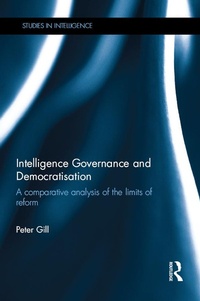
Intelligence Governance and Democratisation
A Comparative Analysis of the Limits of Reform
Published on 20. April 2016
242 pages
978-1-317-54180-6 (ISBN)
Description

This book analyses changes in intelligence governance and offers a comparative analysis of intelligence democratisation.
Within the field of Security Sector Reform (SSR), academics have paid significant attention to both the police and military. The democratisation of intelligence structures that are at the very heart of authoritarian regimes, however, have been relatively ignored. The central aim of this book is to develop a conceptual framework for the specific analytical challenges posed by intelligence as a field of governance. Using examples from Latin America and Europe, it examines the impact of democracy promotion and how the economy, civil society, rule of law, crime, corruption and mass media affect the success or otherwise of achieving democratic control and oversight of intelligence. The volume draws on two main intellectual and political themes: intelligence studies, which is now developing rapidly from its original base in North America and UK; and democratisation studies of the changes taking place in former authoritarian regimes since the mid-1980s including security sector reform. The author concludes that, despite the limited success of democratisation, the dangers inherent in unchecked networks of state, corporate and para-state intelligence organisations demand that academic and policy research continue to meet the challenge.
This book will be of much interest to students of intelligence studies, democracy studies, war and conflict studies, comparative politics and IR in general.
Within the field of Security Sector Reform (SSR), academics have paid significant attention to both the police and military. The democratisation of intelligence structures that are at the very heart of authoritarian regimes, however, have been relatively ignored. The central aim of this book is to develop a conceptual framework for the specific analytical challenges posed by intelligence as a field of governance. Using examples from Latin America and Europe, it examines the impact of democracy promotion and how the economy, civil society, rule of law, crime, corruption and mass media affect the success or otherwise of achieving democratic control and oversight of intelligence. The volume draws on two main intellectual and political themes: intelligence studies, which is now developing rapidly from its original base in North America and UK; and democratisation studies of the changes taking place in former authoritarian regimes since the mid-1980s including security sector reform. The author concludes that, despite the limited success of democratisation, the dangers inherent in unchecked networks of state, corporate and para-state intelligence organisations demand that academic and policy research continue to meet the challenge.
This book will be of much interest to students of intelligence studies, democracy studies, war and conflict studies, comparative politics and IR in general.
More details
Series
Language
English
Place of publication
London
United Kingdom
Publishing group
Taylor & Francis Ltd
Target group
College/higher education
Professional and scholarly
Illustrations
2 s/w Tabellen, 11 s/w Zeichnungen
2 Tables, black and white; 11 Line drawings, black and white
File size
6,14 MB
ISBN-13
978-1-317-54180-6 (9781317541806)
Copyright in bibliographic data and cover images is held by Nielsen Book Services Limited or by the publishers or by their respective licensors: all rights reserved.
Schweitzer Classification
Other editions
Additional editions
Peter Gill
Intelligence Governance and Democratisation
A Comparative Analysis of the Limits of Reform
Book
02/2017
1st Edition
Routledge
€80.30
Shipment within 10-20 days
Peter Gill
Intelligence Governance and Democratisation
A Comparative Analysis of the Limits of Reform
Book
04/2016
1st Edition
Routledge
€241.80
Shipment within 10-20 days
Person
Peter Gill is Honorary Senior Research Fellow at the University of Liverpool, UK. He is the author of Policing Politics (1994), Rounding Up the Usual Suspects (2000) and co-author of Intelligence in an Insecure World (2nd edn, 2012).
Content
1. Intelligence and Democracy 2. Analysing Intelligence: Capacity and Democracy 3. Intelligence in and Beyond the State: A Conceptual Framework 4. Kosovo and Amexica: a tale of two countries 5. Explaining Democratisation: Transnational Factors 6. Explaining Democratisation: The National Dimension 7. Explaining Democratisation: Politics and Organisation 8: Conclusion: Is Democratic Governance a Chimera?
