

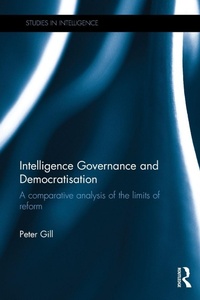
Intelligence Governance and Democratisation
A Comparative Analysis of the Limits of Reform
1st Edition
Published on 3. February 2017
Book
Paperback/Softback
226 pages
978-1-138-64967-5 (ISBN)
Description
This book analyses changes in intelligence governance and offers a comparative analysis of intelligence democratisation.
Within the field of Security Sector Reform (SSR), academics have paid significant attention to both the police and military. The democratisation of intelligence structures that are at the very heart of authorit
Within the field of Security Sector Reform (SSR), academics have paid significant attention to both the police and military. The democratisation of intelligence structures that are at the very heart of authorit
More details
Series
Language
English
Place of publication
London
United Kingdom
Publishing group
Taylor & Francis Ltd
Target group
College/higher education
Professional and scholarly
General, Postgraduate, and Professional
Dimensions
Height: 234 mm
Width: 156 mm
Thickness: 14 mm
Weight
374 gr
ISBN-13
978-1-138-64967-5 (9781138649675)
Copyright in bibliographic data and cover images is held by Nielsen Book Services Limited or by the publishers or by their respective licensors: all rights reserved.
Schweitzer Classification
Other editions
Additional editions
Peter Gill
Intelligence Governance and Democratisation
A Comparative Analysis of the Limits of Reform
Book
04/2016
1st Edition
Routledge
€241.80
Shipment within 10-20 days
Peter Gill
Intelligence Governance and Democratisation
A Comparative Analysis of the Limits of Reform
E-Book
04/2016
Routledge
€73.99
Available for download
Peter Gill
Intelligence Governance and Democratisation
A Comparative Analysis of the Limits of Reform
E-Book
04/2016
Routledge
€73.99
Available for download
Person
Peter Gill is Honorary Senior Research Fellow at the University of Liverpool, UK. He is the author of Policing Politics (1994), Rounding Up the Usual Suspects (2000) and co-author of Intelligence in an Insecure World (2nd edn, 2012).
Content
1. Intelligence and Democracy 2. Analysing Intelligence: Capacity and Democracy 3. Intelligence in and Beyond the State: A Conceptual Framework 4. Kosovo and Amexica: a tale of two countries 5. Explaining Democratisation: Transnational Factors 6. Explaining Democratisation: The National Dimension 7. Explaining Democratisation: Politics and Organisation 8: Conclusion: Is Democratic Governance a Chimera?