

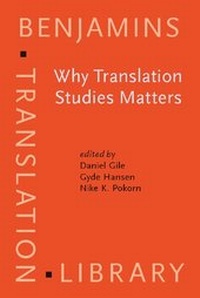
Why Translation Studies Matters
1st Edition
Published on 25. February 2010
XI, 269 pages
978-90-272-8864-6 (ISBN)
Description

Whether Translation Studies really matters is an important and challenging question which practitioners of translation and interpreting raise repeatedly. TS scholars, many of whom are translators and interpreters themselves, are not indifferent to it either. The twenty papers of this thematic volume, contributed by authors from various parts of Europe, from Brazil and from Israel, address it in a positive spirit. Some do so through direct critical reflection and analysis, arguing in particular that the engagement of TS with society should be strengthened so that the latter could benefit more from the former. Others illustrate the relevance and contribution of TS to society and to other disciplines from various angles. Topics broached include the cultural mediation role of translators, issues in literary translation, knowledge as intellectual capital, globalization through English and risks associated with it, bridging languages, mass media, corpora, training, the use of modern technology, interdisciplinarity with psycholinguistics and neurophysiology.
More details
Other editions
Additional editions
Daniel Gile | Gyde Hansen | Nike K. Pokorn
Why Translation Studies Matters
Book
02/2010
John Benjamins Publishing Co
€95.40
Shipment within 10-15 days
Persons
Content
- Why Translation Studies Matters
- Editorial page
- Title page
- LCC data
- Table of contents
- Preface
- Part 1. Does TS matter?
- Why interpreting studies matters
- 1. Introduction
- 2. A 'science' for interpreting
- 2.1 Seen by psychologists
- 2.2 Seen by sociologists - or not
- 3. To whom it matters
- 3.1 Interpreter education
- 3.2 Interpreting research community
- 3.3 Practice and profession
- 3.4 Institutional (user) contexts
- 4. Conclusion
- References
- What matters to Translation Studies?
- 1. Introduction
- 2. Division of academic labour
- 3. Division of labour in Translation Studies
- 4. Public translation studies
- 5. Academic activism?
- References
- Part 2. Translation and society
- Translators as cultural mediators
- 1. Introduction
- 2. Explicitation
- 3. Possible reasons for the translator strategy
- 4. Conclusions and implications for Translation Studies
- References
- Censorship in the translations and pseudo-translations of the West
- 1. Introduction
- 2. Material and methods
- 3. Censorship under the Franco regime
- 4. Results
- 5. Censorship and sexual morality
- 6. Conclusions
- References
- A world without God
- 1. Introduction
- 2. The role of Translation Studies
- 3. Methods
- 4. Salten's Bambi
- 5. Slovene Bambi
- 6. Conclusions
- References
- Manipulating the matricial norms
- 1. Introduction
- 2. The "boom" in Swedish crime fiction?
- 3. The source text and the target texts of La caverna de las ideas
- 4. The novel La caverna de las ideas
- 5. Comparing the translations
- 5.1 The translation of the title of the novel
- 5.2 The name of the translator
- 5.3 Three examples of manipulation of matricial norms in the English translation
- 6. Conclusions
- References
- Knowledge in Translation Studies and translation practice
- 1. Introduction
- 2. Knowledge and intellectual capital
- 3. Approaches to Knowledge Management
- 4. Parallels between KM, translation practice and Translation Studies
- 5. Knowledge in translation practice
- 6. Relevance of Translation Studies for business and society
- 7. Conclusion
- References
- Part 3. Language issues
- Is Translation Studies going Anglo-Saxon?
- Introduction
- 1. Globalizing Translation Studies?
- 2. The limits of my world
- 3. Possible solutions?
- 4. The potential of bridge languages
- References
- Slowakisch: Brückensprache zur slawischen Welt?
- 1. Einleitung
- 2. English only?
- 3. Eurocomprehension
- 4. EuroCom für slawische Sprachen
- 5. Brückensprache Russisch?
- 6. Brückensprache Slowakisch?
- Literatur
- Translation Studies and mass media research
- 1. Introduction
- 2. English and globalization
- 3. Hebrew vs. the minority languages
- 4. Arabic vs. Russian
- 5. Dualism and a hybrid identity
- 6. Concluding remarks
- References
- Register shifts in translations of popular fiction from English into Slovene
- 1. Introduction
- 2. Popular fiction
- 2.1 Translating popular fiction
- 2.2 Reading popular fiction
- 3. Register in translation
- 4. Research material
- 4.1 The translators
- 4.2 Method
- 5. Findings
- 5.1 Increased formality
- 5.2 Decreased formality
- 5.3 Shifts of field
- 5.4 Other shifts that influence the register level
- 5.4.1 Shifts of meaning
- 5.4.2 Stylistic shifts
- 6. Conclusion
- References
- Getting the ACCENT right in Translation Studies
- 1. Introduction
- 2. Material and methods
- 2.1 The corpus
- 2.2 Rhetorical categories in the results section
- 2.3 Methods and analyses
- 3. Results
- 3.1 Quantitative analysis
- 3.2 Qualitative analysis: Linguistic profiles
- 3.3 Translation behaviour
- 4. Application
- 4.1 Strategies for Spanish-English translation based on the English profile
- 4.2 Strategies for English-Spanish translation based on the Spanish profile
- 5. Conclusions
- References
- Die Kirche im Dorf oder die Regierung im Wald lassen
- Vorbemerkung
- 1. Problemstellung
- 2. Namen von Organisationen: Abgrenzung und Überblick
- 2.1 Organisationsnamen vs. Anthroponyme
- 2.2 Organisationsnamen vs. Toponyme
- 2.3 Organisationsnamen vs. Produktnamen
- 2.4 Organisationsnamen und Realien
- 3. Fallbeispiel
- 4. Grundsätzliche Lösungsmöglichkeiten
- 5. Namengebung
- 6. Entscheidungsweg für die praxis der radioübersetzungen
- 6.1 Selbstübersetzung?
- 6.2 Nachschlagewerke?
- 6.3 Schwesterorganisationen?
- 6.4 Parallelübersetzungen?
- 6.5 Translatorischer Präzedenzfall?
- 6.6 Konsultation des Denotats
- 7. Schlussbemerkung
- Literatur
- Online-Quellen
- Part 4. Assessment and training
- Magnifying glasses modifying maps
- 1. Introduction
- 2. Knowledge about translation in introductory courses
- 3. The impact of declarative knowledge at the 'novice' stage
- 4. Trying to explain the experiment results
- Acknowledgements
- References
- Effects of short intensive practice on interpreter trainees' performance
- 1. Introduction
- 2. Quality assessment in simultaneous interpreting
- 3. Practice conditions
- 4. Experiment
- 5. Analysis
- 6. Results
- 7. Conclusions
- References
- Corpora in translator training
- 1. Introduction: Corpora in Translation Studies, Translator Education and the Translation Profession
- 2. The MeLLANGE eLearning course on "Corpora for Translation"
- 2.1 Contents, principles and objectives
- 2.2 Creation and implementation
- 3. Testing the course
- 4. Concluding remarks: Course availability and prospects
- References
- Part 5. Psychology
- Psycholinguistik, Übersetzungswissenschaft und Expertiseforschung im Rahmen der interdisziplinären Forschung
- 1. Introduction
- 2. Experimenteller Hintergrund
- 2.1 Kognitive Repräsentation
- 3. Das Experiment
- 4. Semantisches Priming und sprachliche Expertise
- 5. Automatisierung von Teilprozessen im Rahmen der kognitiven Expertise des Übersetzers
- 6. Sprachliche und translatorische Expertise
- 7. Die Übersetzungswissenschaft zwischen Psycholinguistik und Expertiseforschung
- Bibliographie
- Interpreting Studies and psycholinguistics
- Introduction
- 1. How psycholinguistics contributes to IS
- 1.1 Theoretical approaches - memory models
- 1.2 Experimental methodology - memory and the mental lexicon
- 2. How Interpreting Studies may contribute to psycholinguistics
- 3. COGSIMO - objectives and work-in-progress report
- 3.1 Processing of cognates
- 3.2 Semantic verbal fluency
- 4. Conclusions
- References
- fMRI for exploring simultaneous interpreting
- 1. Introduction
- 2. functional Magnetic Resonance Imaging
- 3. Research into the neurophysiology of SI
- 4. The study
- 4.1 Subjects
- 4.2 Subdivision of the speech, sequences and duration
- 4.3 Technical sequences of the study
- 5. Results and discussion
- 6. Conclusion
- References
- Internet references
- Part 6. Postscript
- Why Translation Studies matters
- 1. Introduction
- 2. The 'scientific' dimension of the contribution of TS
- 2.1 The 'scientific' contribution of TS to Translation practice
- 2.2.1 The relevance of TS to Translators' needs
- 2.2.2 The 'scientific' effectiveness of TS with regard to the Translators' needs
- 2.3 The 'scientific' contribution of TS to Translator Training
- 3. The 'social' dimension of the contribution of TS
- 4. Conclusion
- References
- Name index
- Concept index
- The series Benjamins Translation Library
