

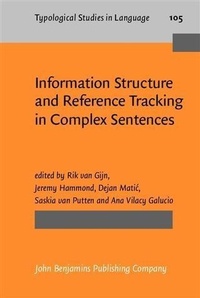
Information Structure and Reference Tracking in Complex Sentences
1st Edition
Published on 5. March 2014
VI, 409 pages
978-90-272-7075-7 (ISBN)
Description

This volume is dedicated to exploring the crossroads where complex sentences and information management - more specifically information structure and reference tracking - come together. Complex sentences are a highly relevant but understudied domain for studying notions of IS and RT. On the one hand, a complex sentence can be studied as a mini-unit of discourse consisting of two or more elements describing events, situations, or processes, with its own internal information-structural and referential organization. On the other hand, complex sentences can be studied as parts of larger discourse structures, such as narratives or conversations, in terms of how their information-structural characteristics relate to this wider context. The book offers new perspectives for the study of the interaction between complex sentences and information management, and moreover adds typological breadth by focusing on lesser studied languages from several parts of the world.
More details
Other editions
Additional editions
Rik Gijn | Jeremy Hammond | Dejan Matic
Information Structure and Reference Tracking in Complex Sentences
Book
03/2014
John Benjamins Publishing Co
€104.94
Shipment within 10-15 days
Persons
Content
- Information Structure and Reference Tracking in Complex Sentences
- Editorial page
- Title page
- LCC data
- Table of contents
- Information structure and reference tracking in complex sentences
- 1. Information structure and reference tracking
- 2. Complex sentences
- 3. Information structure and complex sentences
- 3.1 External IS in Daughter subordination
- 3.2 External IS in Ad-subordination
- 3.3 Internal IS
- 3.3.1 Internal IS in Daughter subordination
- 3.3.2 Internal IS in Ad-subordination
- 3.4 Dependent non-subordinate elements
- 4. Reference tracking in complex sentences
- 4.1 Freedom of referential choice (restricted - unrestricted)
- 4.2 Parameter 1 - Encoding strategy (reduction - preservation - addition)
- 4.3 Parameter 2 - Referential interpretation domain (self-contained versus non-local)
- 4.4 Parameter 3 - locus of marking (main versus dependent
- initial versus non-initial)
- 4.5 Parameter 4 - the nature of controllers and pivots: Syntactic, sematic, pragmatic
- 5. RT, IS, and other discourse factors
- 6. Switch reference beyond the sentence
- Abbreviations
- References
- Subordinate Clauses and exclusive focus in Makhuwa
- 1. Introduction
- 2. The conjoint-disjoint alternation
- 2.1 Followed by a noun
- 2.2 Followed by an adverb
- 3. Situatives
- 4. Focused subordinate clauses
- 4.1 Focused Situatives
- 4.2 Relative clauses
- 5. Focus, presupposition and incomplete clauses
- 6. Summary and further questions
- Abbreviations
- References
- Left dislocation and subordination in Avatime (Kwa)
- 1. Introduction
- 1.1 Theoretical background
- 1.2 Avatime
- 1.3 Methods
- 2. Left dislocation
- 2.1 Form
- 2.1.1 Properties of left dislocation
- 2.1.2 No resumptive pronoun
- 2.1.3 Subjects
- 2.2 Function
- 2.2.1 Theoretical background
- 2.2.2 Avatime
- 2.3 Summary
- 3. Subordination
- 3.1 Complement clauses
- 3.2 Relative clauses
- 3.3 Adverbial clauses
- 3.3.1 Temporal and conditional clauses
- 3.3.1.1 The conjunction gi. Constructions in which a word for 'time' is modified by a relative clause, such as (29) could be classified as temporal adverbial clauses. This type of clause is likely at the origin of Avatime temporal clauses introduced with
- 3.3.1.2 The conjunction xe´. The particle xe´ is a broadly used conjunction that indicates temporal and conditional clauses, but also coordination. In this section I will concentrate on the subordinating functions.
- 3.3.2 Purpose clauses
- 3.3.3 Reason clauses
- 3.4 Summary
- 4. Left dislocation and subordination
- 4.1 Data
- 4.2 Analyeis
- 4.2.1 Function
- 4.2.2 Syntax
- 5. Conclusion and discussion
- Abbreviations
- References
- Chechen extraposition as an information ordering strategy
- 1. Introduction
- 2. Basic concepts
- 2.1 Focus and word order
- 2.2 The postverbal position
- 2.3 Relative clauses
- 3. Focus and relative clauses
- 3.1 Extraposition of relative clauses
- 3.2 Extraposition and focus
- 4. Corpus investigation
- 4.1 Canonical relative clauses
- 4.2 Extraposed relative clauses
- 4.2.1 Finding extraposed relative clauses
- 4.2.2 Reverbal argument heads
- 4.2.3 Preverbal adjunct heads
- 4.2.4 Clause-initial argument heads
- 4.2.5 Postverbal argument heads
- 4.2.6 Embedded heads
- 4.2.7 Restrictive versus non-restrictive extraposed relative clauses
- 5. Conclusions
- Abbreviations
- References
- Questions and syntactic islands in Tundra Yukaghir
- 1. Introduction
- 2. Preliminaries: Questions and dependent clauses in Tundra Yukaghir
- 2.1 Questions
- 2.2 Relative and adjunct clauses
- 3. Formal properties of questioned islands
- 3.1 Syntactic limits of questioned islands
- 3.2 Focus structure and agreement
- 3.3 Locality restrictions
- 3.4 The scope paradox
- 4. Questioned islands in discourse
- 4.1 Matrix contexts
- 4.2 Answers to sentences with questioned islands
- 5. Putting the pieces together: Questioned islands and focus structure
- 5.1 Focusability
- 5.2 The semantics of questioned islands
- 5.3 Focusability and the interrogative domain
- 6. Retrospects and prospects
- Abbreviations
- References
- Constituent Order and Information Structure in Karitiana
- 1. Overview of the language
- 1.1 Word order and agreement in main clauses
- 1.2 The absence of inflection in verb final subordinate clauses
- 1.2.1 Adverbial subordinate clauses
- 1.2.2 "Complement" subordinate clauses
- 1.2.3 Relative clauses
- 1.3 Discussion
- 2. Focus phenomena in main clauses
- 2.1 Focus in wh-environments
- 2.2 Declarative and non-declarative object focus constructions
- 2.3 Subject focus
- 2.4 Focused Postpositional Phrases
- 3. Topic phenomena in main clauses
- 3.1 Discourse topic
- 3.2 Shifted Topic
- 4. The syntax and information structure of subordination in Karitiana
- 4.1 The syntax of subordination
- 4.2 On the origins of the focus construction
- 4.2.1 The origin of the focus morpheme a-
- 4.2.2 The origin of the focus morpheme ti-
- 4.3 Focus in subordinate clauses from a narrative
- 5. Conclusion
- Abbreviations
- References
- Mood selection in the complement of negation matrices in Spanish
- 1. Introduction
- 2. Mood distribution in Spanish complements
- 3. Pragmatic presupposition and assertion, and mood selection in Spanish complements
- 4. Information Structure Theory and mood distribution in Spanish complements
- 5. Discourse motivation of mood selection in the complement of negation and doubt matrices
- 5.1 Conceptual parallel between the complements of comment and doubt/negation matrices
- 5.2 Negation and pragmatic presupposition
- 6. IS analysis of negation and doubt matrices in Spanish
- 6.1 Mood variability in the complement of negative doubt matrices
- 7. Referent accessibility
- 7.1 Discourse referent accommodation
- 8. Apparent counterexamples to the proposed account of mood distribution
- 8.1 Negation matrices with propositional complements in indicative mood
- 8.2 Assertive matrices with active propositional complements in indicative mood
- 9. Conclusions of mood selection in doubt and negation matrices
- Abbreviations
- References
- Topic management and clause combination in the Papuan language Usan
- 1. Introduction
- 2. Clause chaining and switch reference usage in Usan
- 3. Subordination
- 3.1 Eng-construction
- 3.2 Given nominal constituent
- 3.3 Relative clause
- 3.4 Conditional and Temporal contingency
- 3.5 Antithetical and counter-expectation
- 3.6 Sentence-final eng
- 4. Scope of Negation and other modalities
- 4.1 Negation
- 4.2 Scope of other modalities
- 5. Organization in discourse: Tail-Head linkage and Presuppositional nominal
- 6. Conclusion
- Abbreviations
- References
- Switch-reference antecedence and subordination in Whitesands (Oceanic)
- 1. Introduction and Background
- 1.1 Linguistic Theory
- 1.2 Descriptive History
- 2. Data
- 2.1 Whitesands Data
- 2.2 Presentational Conventions
- 3. Canonical Switch Reference
- 3.1 Sentence Structure and Verb Agreement
- 3.1.1 Typology
- 3.1.2 Whitesands Grammar
- 3.2 Canonical Different Referent Complex Clauses
- 3.2.1 Tense
- 3.2.2 Reference: Person and Number
- 3.3 Complex Clauses m-
- 3.3.1 Canonical Same Subject Clauses
- 3.4 Summary
- 4. Echo Referent and Subordination
- 4.1 echo referent and Discourse
- 4.2 Adjacent non-triggers in Discourse
- 4.2.1 Relative Clauses
- 4.2.2 Complement Clauses
- 5. Discussion
- Abbreviations
- References
- Repeated dependent clauses in Yurakaré
- 1. Introduction
- 2. Switch reference in Yurakaré
- 3. Tail-head linkage
- 4. Repeated citations
- 5. Connecting form and function
- 6. Conclusion
- Abbreviations
- References
- Clause chaining, switch reference and nominalisations in Aguaruna (Jivaroan)
- 1. Introduction
- 1.1 Background information and grammatical overview
- 1.2 Overview of information-structuring strategies
- 1.3 The data
- 2. Finiteness and dependency
- 2.1 Preliminaries and definitions
- 2.2 Finiteness
- 2.3 Morphology of dependent verb forms
- 2.4 Nominalisations
- 3. Clause combinations
- 3.1 Modification
- 3.2 Syntactic status of dependent clauses
- 3.2.1 Mood/modality marking
- 3.2.2 Centre-embedding
- 4. Clause chaining
- 5. Tail-head linkage
- 6. Nominalisations
- 7. Discussion
- Abbreviations
- References
- The multiple coreference systems in the Ese Ejja subordinate clauses
- 1. Introduction
- 2. About switch-reference systems
- 2.1 The discovery of switch-reference systems
- 2.2 Bipartite switch-reference system in Cavineña (Tacanan)
- 3. Basics of Ese Ejja (Tacanan)
- 3.1 Main clause properties
- 3.2 Subordinate-clause properties
- 4. Ese Ejja tripartite switch-reference systems
- 4.1 MC driven
- 4.1.1 Set 1: 'Different Subject' subordinators
- 4.1.2 Set 2: (Non-)Coreference with the MC subject
- 4.1.3 Set 2&3: 'Subject' subdivision into A and U
- 4.1.4 Currently known distribution and alignment
- 4.2 DC driven
- 4.2.1 -ajo : 'different subject' subordinator
- 4.2.2 -maxe: 'same subject' subordinator
- 4.2.3 -axe : 'subject-to-X coreference'
- 4.2.4 Summary
- 4.3 A strictly syntactic pivot
- 4.4 Function in a wider discourse context
- 5. Formal similarities and possible origins
- 6. Other switch systems in the area
- 7. Conclusion
- Abbreviations
- References
- Argument marking and reference tracking in Mekens
- 1. Introduction
- 2. Mekens
- 2.1 Data and presentational conventions
- 2.2 Mekens grammar: An overview
- 2.2.1 Person agreement
- 3. Interclausal reference tracking and information structure
- 3.1 Omission of identical subjects
- 3.2 Reference tracking through subject agreement markers
- 4. Mekens reference tracking in a broader perspective
- 5. Conclusion
- Abbreviations
- References
- Author index
- Language index
- Subject index
