

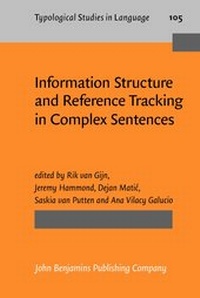
Information Structure and Reference Tracking in Complex Sentences
Published on 5. March 2014
Book
Hardback
409 pages
978-90-272-0686-2 (ISBN)
Description
This volume is dedicated to exploring the crossroads where complex sentences and information management - more specifically information structure and reference tracking - come together. Complex sentences are a highly relevant but understudied domain for studying notions of IS and RT. On the one hand, a complex sentence can be studied as a mini-unit of discourse consisting of two or more elements describing events, situations, or processes, with its own internal information-structural and referential organization. On the other hand, complex sentences can be studied as parts of larger discourse structures, such as narratives or conversations, in terms of how their information-structural characteristics relate to this wider context. The book offers new perspectives for the study of the interaction between complex sentences and information management, and moreover adds typological breadth by focusing on lesser studied languages from several parts of the world.
More details
Series
Language
English
Place of publication
Amsterdam
Netherlands
Target group
College/higher education
Illustrations
+ index
Weight
875 gr
ISBN-13
978-90-272-0686-2 (9789027206862)
Copyright in bibliographic data and cover images is held by Nielsen Book Services Limited or by the publishers or by their respective licensors: all rights reserved.
Schweitzer Classification
Other editions
Additional editions
Rik van Gijn | Jeremy Hammond | Dejan Matic
Information Structure and Reference Tracking in Complex Sentences
E-Book
03/2014
1st Edition
John Benjamins Publishing Company
€122.99
Available for download
Persons
Content
1. Information structure and reference tracking in complex sentences: An overview (by Matic, Dejan); 2. Part I. Information structure in complex sentences; 3. Subordinate clauses and exclusive focus in Makhuwa (by Wal, Jenneke van der); 4. Left dislocation and subordination in Avatime (Kwa) (by Putten, Saskia van); 5. Chechen extraposition as an information ordering strategy (by Komen, Erwin R.); 6. Questions and syntactic islands in Tundra Yukaghir (by Matic, Dejan); 7. Constituent order and information structure in Karitiana (by Storto, Luciana); 8. Mood selection in the complement of negation matrices in Spanish (by Ibarluzea, Patxi Laskurain); 9. Part II. Reference tracking in complex sentences; 10. Topic management and clause combination in the Papuan language Usan (by Reesink, Ger P.); 11. Switch-reference antecedence and subordination in Whitesands (Oceanic) (by Hammond, Jeremy); 12. Repeated dependent clauses in Yurakare (by Gijn, Rik van); 13. Clause chaining, switch reference and nominalisations in Aguaruna (Jivaroan) (by Overall, Simon E.); 14. The multiple coreference systems in the Ese Ejja subordinate clauses (by Vuillermet, Marine); 15. Argument marking and reference tracking in Mekens (by Galucio, Ana Vilacy); 16. Author index; 17. Language index; 18. Subject index