

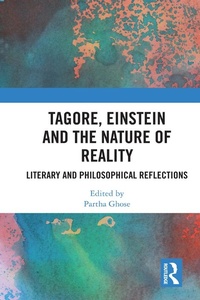
Tagore, Einstein and the Nature of Reality
Literary and Philosophical Reflections
1st Edition
Published on 2. April 2019
252 pages
978-0-429-52043-3 (ISBN)
Description

This volume consists of a selection of scholarly essays from literature, philosophy and history on the conception of reality as understood by Rabindranath Tagore and Albert Einstein.
The nature of reality has been a long-debated issue among scientists and philosophers. Tagore (1861-1941) met Einstein (1879-1955) at the latter's house in Kaputh, Germany on 14 July 1930 and had a long conversation on this issue. This conversation has been widely quoted and discussed by scientists, philosophers and scholars from the literary world. The important question that Tagore and Einstein discussed was whether the world is a unity dependent on humanity, or the world is a reality independent of the human factor. Einstein believed that reality is independent of the mind and the human factor. On the other hand, Tagore adopted the opposite view. Nevertheless, both Einstein and Tagore claimed to be realists - their conceptions of reality were obviously fundamentally different. Where does the difference lie? Can it be harmonized at a deeper level?
This volume brings together for the first time a gamut of views on this subject from eminent scholars. It presents some key reflections on reality, language, poetry, truth, science, personality, human sciences, virtue ethics, intelligibility and creativity. It will be useful to scholars and researchers of philosophy, literature, history and political studies, as also to those interested in Tagore.
The nature of reality has been a long-debated issue among scientists and philosophers. Tagore (1861-1941) met Einstein (1879-1955) at the latter's house in Kaputh, Germany on 14 July 1930 and had a long conversation on this issue. This conversation has been widely quoted and discussed by scientists, philosophers and scholars from the literary world. The important question that Tagore and Einstein discussed was whether the world is a unity dependent on humanity, or the world is a reality independent of the human factor. Einstein believed that reality is independent of the mind and the human factor. On the other hand, Tagore adopted the opposite view. Nevertheless, both Einstein and Tagore claimed to be realists - their conceptions of reality were obviously fundamentally different. Where does the difference lie? Can it be harmonized at a deeper level?
This volume brings together for the first time a gamut of views on this subject from eminent scholars. It presents some key reflections on reality, language, poetry, truth, science, personality, human sciences, virtue ethics, intelligibility and creativity. It will be useful to scholars and researchers of philosophy, literature, history and political studies, as also to those interested in Tagore.
More details
Edition
1. Auflage
Language
English
Place of publication
London
United Kingdom
Publishing group
Taylor & Francis Ltd
Target group
College/higher education
Illustrations
1 Halftones, black and white; 1 Illustrations, black and white
File size
1,61 MB
ISBN-13
978-0-429-52043-3 (9780429520433)
Copyright in bibliographic data and cover images is held by Nielsen Book Services Limited or by the publishers or by their respective licensors: all rights reserved.
Schweitzer Classification
Other editions
Additional editions
Book
12/2020
1st Edition
Routledge India
€56.00
Shipment within 15-20 days
Book
03/2019
1st Edition
CRC Press
€206.10
Shipment within 15-20 days
Person
Partha Ghose is a theoretical physicist and Honorary Scientist at the National Academy of Sciences, India. He retired as Professor, S. N. Bose National Centre for Basic Sciences, Kolkata in 1999. He is a Fellow of the National Academy of Sciences, India; the West Bengal Academy of Science & Technology; a member of the Board of Trustees of the Academy of Fine Arts, Kolkata; and former Chairman of the Satyajit Ray Film & Television Institute, Kolkata. He specializes in the foundations of quantum mechanics and unified theories. He was awarded the Indira Gandhi Prize for the popularization of science by the Indian National Science Academy. His exposition of Rabindranath Tagore's philosophy and music has found expression in several scholarly papers. His publications include the book Testing Quantum Mechanics on New Ground (1999).
Content
Introduction. Preamble: A Man-Centric View: Poet and Scientist Bimal Krishna Matilal 1. Poetic Reality Nirmalangshu Mukherji 2. Too Big a Bang for Language: Tagore's Critique Reloaded Probal Dasgupta 3. Tagore's Truth Amiya Dev 4. Seeing things: Tagore's Sense of the Real Supriya Chaudhuri 5. Science and the World of Personality Shefali Moitra 6. Positing the Human in the Human Sciences Sourin Bhattacharya 7. Why the Moth Cannot be a Poet Saranindranath Tagore 8. Tagore-Wittgenstein Interface: The Poet's Activism and Virtue Ethics Sitansu Sekhar Chakravarti 9. Two Conceptions of Reality: Tagore and Einstein Syed Sayeed 10. Reality and Intelligibility Bijoy Boruah 11. The Creative Mind: A Mirror or a Component of Reality? Ashish Lahiri
