

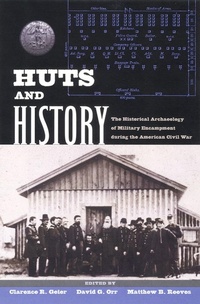
Huts and History
Description

Exploring Civil War camp sites and the lives of the soldiers who lived in them
The American Civil War soldier, confined much of the time to his camp, suffered from boredom and sickness. Encampment was not only tedious but detrimental to his health; far more soldiers died of diseases from sharing close quarters with their comrades than from wounds on the battlefield. Until now, archaeologists have concentrated their study on the battle sites and overlooked the importance of the camps. This edited collection is the first dedicated to the archaeology of Civil War encampments. The authors contend that intensive study to interpret and preserve these sites will help to ensure their protection as well as expand our understanding of the 19th-century soldier's life.
Whether they mobilized tens of thousands of men for training or taught maneuvers to smaller groups, encampments are significant in several ways: as ?cultural landscapes? characterized by architectural features, as socially and politically organized ?mobile communities,? and as infrastructures created to support soldiers' needs. The authors' techniques can be applied to camps not only of the Civil War but the French and Indian War, the American Revolution, the War of 1812, the Mexican War, and the Indian campaign.
More details
Other editions
Additional editions
Persons
Content
List of Figures
List of Tables
Foreword
Part I. Introduction and Background
Clarence R. Geier, David G. Orr, and Matthew B. Reeves
1. ?I Am Now Very Comfortably Situated for the Winter Having a Very Nice Chimney Attached to My Tent, and Everything That Tends to Make This Unhappy Life Pleasant and Agreeable?
Clarence R. Geier, David G. Orr, and Matthew B. Reeves
2. Blueprint for Nineteenth-Century Camps: Castramentation, 1778?1865
Joseph W. A. Whitehorne
Part II. Survey and Management of Civil War Encampments
Matthew B. Reeves, Clarence R. Geier, and David G. Orr
3. Finding Civil War Sites: What Relic Hunters Know, What Archaeologists Should and Need to Know
Bryan L. Corle and Joseph F. Balicki
4. Guarding the Junction: The Encampment of the 14th New Jersey Infantry
Brandon S. Bies
Part III. Encampment Plan and Layout
Clarence R. Geier, David G. Orr, and Matthew B. Reeves
5. ?Masterly Inactivity?: The Confederate Cantonment Supporting the 1861?1862 Blockade of the Potomac River, Evansport, Virginia
Joseph F. Balicki
6. Civil War Housing Insights from Camp Nelson, Kentucky
W. Stephen McBride and Kim A. McBride
Part IV. Encampment Architecture and Material Culture
David G. Orr, Clarence R. Geier, and Matthew B. Reeves
7. ?Right Nice Little House[s]?: Winter Camp Architecture of the American Civil War
Dean E. Nelson
8. Under the Forest Floor: Excavations at a Confederate Winter Encampment, Orange, Virginia
Matthew B. Reeves and Clarence R. Geier
9. ?Beautiful Confusion?: The Archaeology of Civil War Camp Life in an Urban Context
Garrett R. Fesler, Matthew R. Laird, and Hank D. Lutton
10. Cabin in Command: The City Point Headquarters of Ulysses S. Grant
David G. Orr
Part V. Conclusions and Beginnings
David G. Orr and Clarence R. Geier
List of Contributors
Index
