

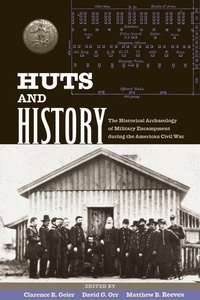
Huts and History
The Historical Archaeology of Military Encampment During the American Civil War
Published on 29. April 2026
Book
Paperback/Softback
298 pages
978-0-8130-8135-9 (ISBN)
Description
Exploring Civil War camp sites and the lives of the soldiers who lived in them
The American Civil War soldier, confined much of the time to his camp, suffered from boredom and sickness. Encampment was not only tedious but detrimental to his health; far more soldiers died of diseases from sharing close quarters with their comrades than from wounds on the battlefield. Until now, archaeologists have concentrated their study on the battle sites and overlooked the importance of the camps. This edited collection is the first dedicated to the archaeology of Civil War encampments. The authors contend that intensive study to interpret and preserve these sites will help to ensure their protection as well as expand our understanding of the 19th-century soldier's life.
Whether they mobilized tens of thousands of men for training or taught maneuvers to smaller groups, encampments are significant in several ways: as "cultural landscapes" characterized by architectural features, as socially and politically organized "mobile communities," and as infrastructures created to support soldiers' needs. The authors' techniques can be applied to camps not only of the Civil War but the French and Indian War, the American Revolution, the War of 1812, the Mexican War, and the Indian campaign.
The American Civil War soldier, confined much of the time to his camp, suffered from boredom and sickness. Encampment was not only tedious but detrimental to his health; far more soldiers died of diseases from sharing close quarters with their comrades than from wounds on the battlefield. Until now, archaeologists have concentrated their study on the battle sites and overlooked the importance of the camps. This edited collection is the first dedicated to the archaeology of Civil War encampments. The authors contend that intensive study to interpret and preserve these sites will help to ensure their protection as well as expand our understanding of the 19th-century soldier's life.
Whether they mobilized tens of thousands of men for training or taught maneuvers to smaller groups, encampments are significant in several ways: as "cultural landscapes" characterized by architectural features, as socially and politically organized "mobile communities," and as infrastructures created to support soldiers' needs. The authors' techniques can be applied to camps not only of the Civil War but the French and Indian War, the American Revolution, the War of 1812, the Mexican War, and the Indian campaign.
Reviews / Votes
"Answering how physical place shaped Civil War soldier experience requires untraditional historical approaches. . . . [Huts and History] employs historical archeology to investigate the makeup and geography of soldier camps. . . . The volume serves as a call to action for further investigation of place in soldier studies and for better preservation of neglected Civil War campsites. "-H-Net"Reminds historians that encampments have been overlooked in favor of battlefields, even though the former were more numerous and the venue for most of soldier life. . . . Every study in this book reinforces the argument that historians ought to take encampment sites and military archaeology more seriously."-Journal of Southern HistoryMore details
Language
English
Place of publication
Florida
United States
Target group
Professional and scholarly
College/higher education
Product notice
Paperback (trade)
Illustrations
82 Illustrations, black and white - 3 Tables, black and white
Dimensions
Height: 234 mm
Width: 156 mm
Thickness: 18 mm
Weight
511 gr
ISBN-13
978-0-8130-8135-9 (9780813081359)
Copyright in bibliographic data and cover images is held by Nielsen Book Services Limited or by the publishers or by their respective licensors: all rights reserved.
Schweitzer Classification
Other editions
Additional editions
Clarence R. Geier | David G. Orr | Matthew B. Reeves
Huts and History
The Historical Archaeology of Military Encampment During the American Civil War
E-Book
04/2026
1st Edition
University Press of Florida
€28.99
Available for download
Persons
Clarence R. Geier is professor emeritus of anthropology at James Madison University, is coeditor of From These Honored Dead: Historical Archaeology of the American Civil War.
David Orr professor emeritus of anthropology at Temple University, is coeditor of Historical Archaeology of the Revolutionary War Encampments of Washington's Army.
Matthew Reeves is director of archaeology for the Montpelier Foundation and adjunct associate professor of anthropology at James Madison University.
David Orr professor emeritus of anthropology at Temple University, is coeditor of Historical Archaeology of the Revolutionary War Encampments of Washington's Army.
Matthew Reeves is director of archaeology for the Montpelier Foundation and adjunct associate professor of anthropology at James Madison University.