

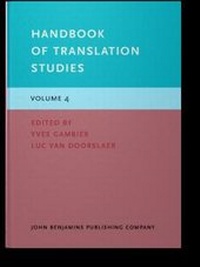
Handbook of Translation Studies
Volume 4
1st Edition
Published on 20. December 2013
XII, 232 pages
978-90-272-7081-8 (ISBN)
Description

As a meaningful manifestation of how institutionalized the discipline has become, the new Handbook of Translation Studies is most welcome. It joins the other signs of maturation such as Summer Schools, the development of academic curricula, historical surveys, journals, book series, textbooks, terminologies, bibliographies and encyclopedias.
The HTS aims at disseminating knowledge about translation and interpreting and providing easy access to a large range of topics, traditions, and methods to a relatively broad audience: not only students who often adamantly prefer such user-friendliness, researchers and lecturers in Translation Studies, Translation & Interpreting professionals; but also scholars and experts from other disciplines (among which linguistics, sociology, history, psychology). In addition the HTS addresses any of those with a professional or personal interest in the problems of translation, interpreting, localization, editing, etc., such as communication specialists, journalists, literary critics, editors, public servants, business managers, (intercultural) organization specialists, media specialists, marketing professionals.
The usability, accessibility and flexibility of the HTS depend on the commitment of people who agree that Translation Studies does matter. All users are therefore invited to share their feedback. Any questions, remarks and suggestions for improvement can be sent to the editorial team at hts@kuleuven.be.
Next to the book edition (in printed and electronic, PDF, format), HTS is also available as an online resource, connected with the Translation Studies Bibliography. For access to the Handbook of Translation Studies Online, please visit http://www.benjamins.com/online/hts/
The HTS aims at disseminating knowledge about translation and interpreting and providing easy access to a large range of topics, traditions, and methods to a relatively broad audience: not only students who often adamantly prefer such user-friendliness, researchers and lecturers in Translation Studies, Translation & Interpreting professionals; but also scholars and experts from other disciplines (among which linguistics, sociology, history, psychology). In addition the HTS addresses any of those with a professional or personal interest in the problems of translation, interpreting, localization, editing, etc., such as communication specialists, journalists, literary critics, editors, public servants, business managers, (intercultural) organization specialists, media specialists, marketing professionals.
The usability, accessibility and flexibility of the HTS depend on the commitment of people who agree that Translation Studies does matter. All users are therefore invited to share their feedback. Any questions, remarks and suggestions for improvement can be sent to the editorial team at hts@kuleuven.be.
Next to the book edition (in printed and electronic, PDF, format), HTS is also available as an online resource, connected with the Translation Studies Bibliography. For access to the Handbook of Translation Studies Online, please visit http://www.benjamins.com/online/hts/
More details
Other editions
Additional editions
Book
12/2013
John Benjamins Publishing Co
€95.40
Shipment within 10-15 days
Persons
Content
- Intro
- Handbook of Translation Studies
- Editorial page
- Title page
- LCC data
- supporting universities
- Table of contents
- Introduction
- Table of contents
- Introduction
- Anthologies and translation
- 1. Introduction
- 2. Etymology and neighboring notions
- 3. Purposes and types
- 4. Selection criteria, recontextualization and authorship
- 5. Anthologies and Translation Studies
- 6. Future perspectives
- Assumed translation
- 1. Historical relativism
- 2. Critical reception
- 3. Towards assumed transfer?
- Translator and author
- 1. Introduction
- 2. Authorship: A shifting concept or quality
- 3. The translator as author
- 4. The author as translator
- 5. Concluding remarks: An attempt at encompassing the debate
- Bibliometrics
- 1. Bibliometrics, scientometrics and webometrics
- 2. Bibliographical databases
- 3. Research areas and methods
- 4. Controversial issues
- Further essential reading
- Communism and Translation Studies
- 1. Mapping translation flows
- 2. Censorship/circumventions, subversions, resistances
- 3. Practices and status of the translator in a politicised context
- Conflict and Translation
- Further essential reading
- Contrastive Linguistics and Translation Studies
- 1. Introduction
- 2. How Contrastive Linguistics informs and influences Translation Studies
- 3. How Translation Studies informs and influences Contrastive Linguistics
- 4. Translation Studies and Contrastive Linguistics as cooperative fields
- Further reading
- Creativity
- References
- Discourse analysis
- 1. Discourse and discourse analysis
- 2. Methods of discourse analysis
- 3. Discourse and discourse analysis in Translation Studies
- Empirical approaches
- 1. Introduction
- 2. The enquiry
- 3. The experiment
- 4. Trace analysis
- 5. Summary
- Further reading
- English as a lingua franca and translation
- 1. What is English as a lingua franca?
- 2. ELF: A threat to multilingual communication and translation?
- Genres, text-types and translation
- 1. Genres
- 2. Specialization and training
- 3. Text linguistics and text-types
- 4. Translation and text-typology
- 5. Text-types and technology
- 6. Conclusion
- Impact of translation
- References
- Impact of translation theory
- 1. Preliminary remarks
- 2. A thin line between impact and irritation
- 3. Theory: Small or theory extra-large?
- 4. Social impact and institutionalization
- 5. In translation didactics
- Further reading
- Knowledge management and translation
- 1. Translation and KM from the KM perspective
- 2. Translation and KM from the translation studies perspective: Translation as knowledge work
- 3. Organisational and personal KM
- 4. KM, terminology and technical translation
- 5. KM in translator and interpreter training
- Multimodality and audiovisual translation
- References
- Narratives and contextual frames
- 1. Narrative theory in Translation and Interpreting Studies
- 2. Contextual frames and notions of framing
- Further Reading
- Nation, empire, translation
- 1. Translation as a sign of hegemony
- 2. Translation, nation and religion
- 3. Translation, religion and imperial expansion in the modern period
- 4. The normativization of indigenous languages
- 5. The translator as a traitor to a nation
- 6. Translation in old and new empires
- Official translation
- References
- Original and translation
- 1. Identity in the form of 'functional identity'
- 1.1 Identity in terms of 'aesthetic effect'
- 1.2 Identity provoked through familiarity
- 2. The relation original-translation in terms of interpretation, perception and inference
- 2.1 Identification through interpretation - the hermeneutical tracing
- 2.2 Perception as the link between original and translation
- 2.3 Similarity through inference
- 3. Similarity and differences defining the original-translation relation
- 3.1 A relation similar to 'family resemblance'
- 3.2 The ideal translation as unavoidably and intentionally different
- 3.3 Translation and original - forms of writing
- 4. Translation and original - not the same work
- 5. Conclusion
- Popularization and translation
- 1. The concept of popularization
- 2. The relationship between popularization and translation
- 3. Main research interests
- 3.1 Translating popularized texts
- 3.2 ranslation as a process of popularization
- 3.3 Creation of a new genre
- 4. Further research directions
- Reception and translation
- 1. From the text and author to the reader
- 2. Reception in Translation Studies
- 2.1 Reception from a social perspective
- 2.2 Readers response and assessment
- Further essential reading
- Scientificity and theory in Translation Studies
- 1. The scientificity issue in Translation Studies
- 2. Two scientific cultures
- 3. What are scientific theories?
- 4. Scientific theories in Translation Studies
- 5. Conclusion: Is TS scientific?
- Social media and translations
- References
- Social systems and translation
- 1. Early systemic thinking
- 2. Social-systemic paradigms
- 3. Translation as a social system
- 4. Translation in the social system
- 5. Negotiating between structures and agents
- 6. Why study translation in relation to social systems?
- Acknowledgements
- Subtitles and language learning
- 1. Subtitled audiovisuals in informal and formal language-learning contexts
- 1.1 Subtitles and informal foreign-language learning
- 1.2 Subtitles and formal foreign-language learning
- 2. The pedagogical relevance of interlingual, intralingual and reversed subtitles
- 2.1 Description of the three types of subtitles
- 2.2 Subtitles as learning aids
- 2.3 Interlingual standard and reversed subtitles
- 2.4 Intralingual subtitles
- 3. The translation of subtitles as a language-learning tool
- 4. Concluding remarks and a challenge for the future
- Webliography
- Teaching interpreting/Training interpreters
- 1. Institutionalization - academization - diversification
- 2. Curriculum
- 3. Teaching
- Further reading
- Translation zone
- References
- Translational turn
- 1. The turn to "translation" - a "translational turn"?
- 2. Concretizing an expanded translation category
- 2.1 Translation as self-translation and transformation
- 2.2 Culture as translation
- 2.3 Cross-disciplinary approaches to a "translational turn"
- 3. Global and epistemological dimensions of a "translational turn"
- 3.1 From universalization to cross-categorical translation
- 3.2 Humanities as "translation studies"
- Travel and translation
- 1. Translation practices in travel
- 2. Ideas, cities and migration
- Visibility (and invisibility)
- References
- Voices in Translation
- 1. The voices of authors and translators
- 2. The voices of the implied author, narrators and characters
- 3. Final reflections
- Funding
- References
- Further essential reading
- Subject index
