

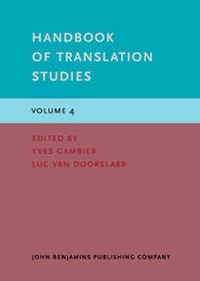
Handbook of Translation Studies
Volume 4
Published on 20. December 2013
Book
Hardback
232 pages
978-90-272-0334-2 (ISBN)
Description
As a meaningful manifestation of how institutionalized the discipline has become, the new Handbook of Translation Studies is most welcome. It joins the other signs of maturation such as Summer Schools, the development of academic curricula, historical surveys, journals, book series, textbooks, terminologies, bibliographies and encyclopedias.
The HTS aims at disseminating knowledge about translation and interpreting and providing easy access to a large range of topics, traditions, and methods to a relatively broad audience: not only students who often adamantly prefer such user-friendliness, researchers and lecturers in Translation Studies, Translation & Interpreting professionals; but also scholars and experts from other disciplines (among which linguistics, sociology, history, psychology). In addition the HTS addresses any of those with a professional or personal interest in the problems of translation, interpreting, localization, editing, etc., such as communication specialists, journalists, literary critics, editors, public servants, business managers, (intercultural) organization specialists, media specialists, marketing professionals.
The usability, accessibility and flexibility of the HTS depend on the commitment of people who agree that Translation Studies does matter. All users are therefore invited to share their feedback. Any questions, remarks and suggestions for improvement can be sent to the editorial team at hts@kuleuven.be.
Next to the book edition (in printed and electronic, PDF, format), HTS is also available as an online resource, connected with the Translation Studies Bibliography. For access to the Handbook of Translation Studies Online, please visit http://www.benjamins.com/online/hts/
The HTS aims at disseminating knowledge about translation and interpreting and providing easy access to a large range of topics, traditions, and methods to a relatively broad audience: not only students who often adamantly prefer such user-friendliness, researchers and lecturers in Translation Studies, Translation & Interpreting professionals; but also scholars and experts from other disciplines (among which linguistics, sociology, history, psychology). In addition the HTS addresses any of those with a professional or personal interest in the problems of translation, interpreting, localization, editing, etc., such as communication specialists, journalists, literary critics, editors, public servants, business managers, (intercultural) organization specialists, media specialists, marketing professionals.
The usability, accessibility and flexibility of the HTS depend on the commitment of people who agree that Translation Studies does matter. All users are therefore invited to share their feedback. Any questions, remarks and suggestions for improvement can be sent to the editorial team at hts@kuleuven.be.
Next to the book edition (in printed and electronic, PDF, format), HTS is also available as an online resource, connected with the Translation Studies Bibliography. For access to the Handbook of Translation Studies Online, please visit http://www.benjamins.com/online/hts/
Reviews / Votes
Being so good in so many aspects, this volume, along with other volumes of the Handbook of Translation Studies, is a perfect reference and textbook for different university courses in translation theory and history. Not only does it present various problems of translation and interpreting in a coherent and succinct manner but it also provides references to more detailed studies of particular translation and interpreting issues.Generally speaking, the variety of the topics discussed, the functionality of the Handbook of Translation Studies as a printed and online project as well as the involvement of so many translation and interpreting scholars in providing entries to the project are all praiseworthy. Without a doubt, this Handbook has a chance of becoming one of the most important sources of information on a variety of topics from translation and interpreting studies and therefore I happily recommend anyone interested in translation and interpreting, regardless of their experience and expertise in this field, familiarising with the project of the Handbook of Translation Studies. This is certainly a must-read volume for all students and beginning translation and interpreting scholars looking for the explanation of key terms of translation studies or for ideas for their own further research. The volume with its rich contents has it all - definitions and discussions of the terms and concepts, supplemented with some comments on how a given issue/concept might be developed/might develop in the future. Obviously, the references included in each entry make it even easier for the readers to find the relevant literature and study a given concept in greater detail. -- Marcin Walczynski, on Linguist List 2013
More details
Series
Language
English
Place of publication
Amsterdam
Netherlands
Target group
Professional and scholarly
Illustrations
+ index
Dimensions
Height: 245 mm
Width: 174 mm
Weight
620 gr
ISBN-13
978-90-272-0334-2 (9789027203342)
Copyright in bibliographic data and cover images is held by Nielsen Book Services Limited or by the publishers or by their respective licensors: all rights reserved.
Schweitzer Classification
Other editions
Additional editions
E-Book
12/2013
1st Edition
John Benjamins Publishing Company
€112.99
Available for download
Persons
Content
1. Introduction (by Gambier, Yves); 2. Anthologies and translation (by Seruya, Teresa); 3. Assumed translation (by D'hulst, Lieven); 4. Author and translator (by Flynn, Peter); 5. Bibliometrics (by Grbic, Nadja); 6. Communism and Translation Studies (by Popa, Ioana); 7. Conflict and Translation (by Salama-Carr, Myriam); 8. Contrastive Linguistics and Translation Studies (by Vandepitte, Sonia); 9. Creativity (by O'Sullivan, Carol); 10. Discourse analysis (by Schaffner, Christina); 11. Empirical approaches (by Kunzli, Alexander); 12. English as a lingua franca and translation (by House, Juliane); 13. Genres, text-types and translation (by Gambier, Yves); 14. Impact of translation (by Woodsworth, Judith); 15. Impact of translation theory (by van Doorslaer, Luc); 16. Intercultural Mediation (by Katan, David); 17. Knowledge management and translation (by Risku, Hanna); 18. Multimodality and audiovisual translation (by Taylor, Christopher); 19. Narratives and contextual frames (by Harding, Sue-Ann Jane); 20. Nation, empire, translation (by Valdeon, Roberto A.); 21. Official translation (by Merkle, Denise); 22. Original and translation (by Laiho, Leena); 23. Popularization and translation (by Liao, Min-Hsiu); 24. Power and translation (by Strowe, Anna); 25. Reception and translation (by Brems, Elke); 26. Scientificity and theory in Translation Studies (by Gile, Daniel); 27. Social media and translations (by Desjardins, Renee); 28. Social systems and translation (by Tyulenev, Sergey); 29. Subtitles and language learning (by Caimi, Annamaria); 30. Teaching interpreting/Training interpreters (by Pochhacker, Franz); 31. Translation zone (by Simon, Sherry); 32. Translational turn (by Bachmann-Medick, Doris); 33. Travel and translation (by Cronin, Michael); 34. Visibility (and invisibility) (by R. Emmerich, Karen); 35. Voices in Translation (by Alvstad, Cecilia)