

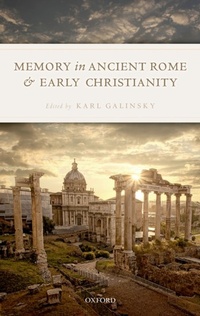
Memory in Ancient Rome and Early Christianity
1st Edition
Published on 18. December 2015
448 pages
978-0-19-106219-3 (ISBN)
Description

What and how do people remember? Who controls the process of what we call cultural or social memory? What is forgotten and why? People's memories are not the same as history written in retrospect; they are malleable and an ongoing process of construction and reconstruction. Ancient Rome provided much of the cultural framework for early Christianity, and in both the role of memory was pervasive. Memory in Ancient Rome and Early Christianity presents perspectives from an international and interdisciplinary range of contributors on the literature, history, archaeology, and religion of a major world civilization, based on an informed engagement with important concepts and issues in memory studies. Moving beyond terms such as 'collective', 'social', and 'cultural memory' as standard tropes, the volume offers a selective exploration of the wealth of topics which comprise memory studies, and also features a contribution from a leading neuroscientist on the actual workings of the human memory. It is an importamt resource for anyone interested in Roman antiquity, the beginnings of Christianity, and the role of memory in history.
More details
Other editions
Additional editions

Karl Galinsky
Memory in Ancient Rome and Early Christianity
Software
03/2016
Oxford University Press, USA
€138.12
Article exhausted; check different version
Karl Galinsky
Memory in Ancient Rome and Early Christianity
Book
12/2015
Oxford University Press
€200.90
Shipment within 15-20 days
Person
Karl Galinsky is Floyd A. Cailloux Centennial Professor of Classics and University Distinguished Teaching Professor at the University of Texas at Austin.
Content
- Preface
- List of Figures
- List of Contributors
- Introduction
- Part I: Memory and Roman Writers
- 1: Alain Gowing: Memory as Motive in Tacitus
- 2: Brigitte Libby: Forgetful Theseus and Mindful Aeneas in Catullus 64 and Aeneid 4
- 3: Jörg Rüpke: Knowledge of Religion in Valerius Maximus' exempla: Roman Historiography and Tiberian Memory Culture
- Part II: Memory and Roman Emperors
- 4: Eric Orlin: Augustan Reconstruction and Roman Memory
- 5: Charles Hedrick, Jr.: Qualis artifex pereo: The Generation of Roman Memories of Nero
- Part III: Roman Honorific Statues: Memory or Just Honour?
- 6: Karl-Joachim Hölkeskamp: In the Web of (Hi)stories: memoria: Monuments and Their Myth-historical 'Interconnectedness'
- 7: Elke Stein-Hölkeskamp: Marius, Sulla, and the War over Monumental Memory and Public Space
- 8: Diana Ng: Monuments, Memory, and Status Recognition in Roman Asia Minor
- Part IV: Memory in Roman Religion and Early Christianity
- 9: Nicola Denzey-Lewis: The Crafting of Memory in Late Roman Mortuary Spaces
- 10: John Kloppemborg: Memory, Performance and the Sayings of Jesus
- 11: Jodi Magness: Sweet Memory: Archaeological Evidence of Jesus in Jerusalem
- 12: Milton Moreland: Moving Peter to Rome: Social Memory and Ritualized Space After 70 CE
- Part V: A Perspective from Neuropsychology
- 13: Ann-Kathrin Stock, Hannah,Gajsar, and Onur Güntürkün: The Neuroscience of Memory
- Index
