

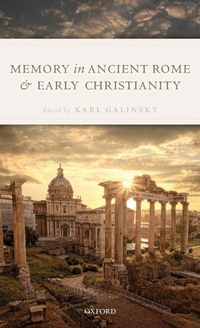
Memory in Ancient Rome and Early Christianity
Published on 17. December 2015
Book
Hardback
422 pages
978-0-19-874476-4 (ISBN)
Description
What and how do people remember? Who controls the process of what we call cultural or social memory? What is forgotten and why? People's memories are not the same as history written in retrospect; they are malleable and an ongoing process of construction and reconstruction. Ancient Rome provided much of the cultural framework for early Christianity, and in both the role of memory was pervasive. Memory in Ancient Rome and Early Christianity presents perspectives from an international and interdisciplinary range of contributors on the literature, history, archaeology, and religion of a major world civilization, based on an informed engagement with important concepts and issues in memory studies. It offers a selective exploration of the wealth of topics which comprise memory studies, and also features a contribution from a leading neuroscientist on the actual workings of the human memory.
Reviews / Votes
Karl Galinsky is not a scholar to embrace such rigid or facile dichotomies. In a lifetime of scholarship on Augustus, classical reception, and now, on social memory, Galinsky has consistently and vocally advocated the need to tear down conceptual walls ... This book succeeds in telling a powerful story ... anyone who values dialogue -- between science and the humanities, classics and religious studies, or among people of faith learning more about their own religious traditions -- will recognize its implication: memories that have been acquired through learned behavior can, with some difficulty, be unlearned, too. * Douglas Boin, Bryn Mawr Classical Review * I found this book very interesting. Galinsky, I believe, has provided historians of Ancient Rome with an intriguing collection of essays on the role of memory. The essays as a whole demonstrate the viability of this field of study. * Stephen Campbell, Sheperds * Similarly, perhaps the most unique and interesting feature of this book is the final essay; one does not frequently encounter neuroscientific discussions of memory, neuronal networks, and brain plasticity in books on Roman or early Christian history! Between these two bookends, Libby's discussion of memory and intertextuality, Hedrick's quadrangular model of memory, history, experience, and fantasy, Stein-Hoelkeskamp's prefiguration of the collapse of the Republic in Sulla's take-over of Roman monumental memory, and Denzey Lewis' presentation of a pagan response to the Empire's Christianization stand out as especially read-worthy ... these essays provide an admirable example of the uses to which historians of antiquity are putting the amorphous field of memory studies. * Rafael Rodriguez, Enoch Seminar *More details
Other editions
Additional editions
Karl Galinsky
Memory in Ancient Rome and Early Christianity
Book
04/2018
Oxford University Press
€38.37
Shipment within 15-20 days
Karl Galinsky
Memory in Ancient Rome and Early Christianity
E-Book
12/2015
1st Edition
OUP eBook
€18.99
Available for download
Person
Karl Galinsky is Floyd A. Cailloux Centennial Professor of Classics and University Distinguished Teaching Professor at the University of Texas at Austin.
Content
PART I: MEMORY AND ROMAN WRITERS; PART II: MEMORY AND ROMAN EMPERORS; PART III: ROMAN HONORIFIC STATUES: MEMORY OR JUST HONOUR?; PART IV: MEMORY IN ROMAN RELIGION AND EARLY CHRISTIANITY; PART V: A PERSPECTIVE FROM NEUROPSYCHOLOGY