

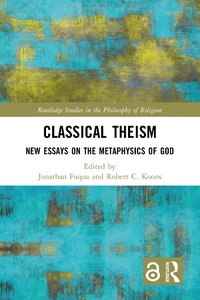
Classical Theism
New Essays on the Metaphysics of God
1st Edition
Published on 10. February 2023
354 pages
978-1-000-83688-2 (ISBN)
Description

This volume provides a contemporary account of classical theism. It features 17 original essays from leading scholars that advance the discussion of classical theism in new and interesting directions.
It's safe to say that classical theism-the view that God is simple, omniscient, and the greatest possible being-is no longer the assumed view in analytic philosophy of religion. It is often dismissed as being rooted in outdated metaphysical systems of the sort advanced by ancient and medieval philosophers. The main purpose of this volume is twofold: to provide a contemporary account of what classical theism is and to advance the scholarly discussion about classical theism. In Section I, the contributors offer a clear and cutting-edge account of the nature and existence of the God and the historical and theological foundations of classical theism. Section II contains chapters on a variety of topics, such as whether classical theism's doctrine of simplicity needs revision, whether simplicity is compatible with the Christian doctrine of the Incarnation, and whether the hypothesis of a multiplicity of divine ideas is consistent with divine simplicity, among others.
Classical Theism will appeal to scholars and advanced students in the philosophy of religion who are interested in the nature of God.
Chapters 2 and 6 of this book are freely available as downloadable Open Access PDFs at http://www.taylorfrancis.com under a Creative Commons Attribution-Non Commercial-No Derivatives (CC-BY-NC-ND) 4.0 license.
It's safe to say that classical theism-the view that God is simple, omniscient, and the greatest possible being-is no longer the assumed view in analytic philosophy of religion. It is often dismissed as being rooted in outdated metaphysical systems of the sort advanced by ancient and medieval philosophers. The main purpose of this volume is twofold: to provide a contemporary account of what classical theism is and to advance the scholarly discussion about classical theism. In Section I, the contributors offer a clear and cutting-edge account of the nature and existence of the God and the historical and theological foundations of classical theism. Section II contains chapters on a variety of topics, such as whether classical theism's doctrine of simplicity needs revision, whether simplicity is compatible with the Christian doctrine of the Incarnation, and whether the hypothesis of a multiplicity of divine ideas is consistent with divine simplicity, among others.
Classical Theism will appeal to scholars and advanced students in the philosophy of religion who are interested in the nature of God.
Chapters 2 and 6 of this book are freely available as downloadable Open Access PDFs at http://www.taylorfrancis.com under a Creative Commons Attribution-Non Commercial-No Derivatives (CC-BY-NC-ND) 4.0 license.
More details
Series
Edition
1. Auflage
Language
English
Place of publication
London
United Kingdom
Publishing group
Taylor & Francis Ltd
Target group
College/higher education
Professional and scholarly
Illustrations
2 Line drawings, black and white; 2 Illustrations, black and white
ISBN-13
978-1-000-83688-2 (9781000836882)
Copyright in bibliographic data and cover images is held by Nielsen Book Services Limited or by the publishers or by their respective licensors: all rights reserved.
Schweitzer Classification
Other editions
Additional editions
Book
08/2024
1st Edition
Routledge
€65.10
Shipment within 10-20 days
Book
02/2023
1st Edition
Routledge
€186.90
Shipment within 10-20 days
Persons
Jonathan Fuqua is an assistant professor of philosophy at Conception Seminary College, USA. He specializes in the philosophy of religion, ethics, and epistemology. He is the co-editor of Faith and Reason (2019) and The Cambridge Handbook to Religious Epistemology (forthcoming). His articles have appeared in such places as the Oxford Journal of Law and Religion, American Philosophical Quarterly, Synthese, and Philosophia.
Robert C. Koons is a professor of philosophy at the University of Texas at Austin, USA. He specializes in logic, metaphysics, and philosophy of religion. He is the author of Paradoxes of Belief and Strategic Rationality (1992) and Realism Regained (2000), co-author of Metaphysics: The Fundamentals (2015) and The Atlas of Reality (2017), and the co-editor of The Waning of Materialism (2010) and Neo-Aristotelian Perspectives on the Philosophy of Science (Routledge, 2017).
Robert C. Koons is a professor of philosophy at the University of Texas at Austin, USA. He specializes in logic, metaphysics, and philosophy of religion. He is the author of Paradoxes of Belief and Strategic Rationality (1992) and Realism Regained (2000), co-author of Metaphysics: The Fundamentals (2015) and The Atlas of Reality (2017), and the co-editor of The Waning of Materialism (2010) and Neo-Aristotelian Perspectives on the Philosophy of Science (Routledge, 2017).
Content
Introduction Jonathan Fuqua and Robert C. Koons Section I: What Is Classical Theism? 1. What Is Classical Theism? Edward Feser 2. Does the God of Classical Theism Exist? Robert C. Koons 3. Some Arguments for Divine Simplicity Alexander R. Pruss 4. The Problem of Talking about "the God of gods" Gyula Klima 5. Anselmian Classical Theism Katherin Rogers 6. Thomist Classical Theism: Divine Simplicity within Aquinas's Triplex Via Theology Daniel De Haan 7. The Unity of the Divine Nature: Four Theories Timothy O'Connor 8. A Metaphysical Inquiry into Islamic Theism Enis Doko and Jamie B. Turner 9. Classical Theism and Jewish Conceptions of God Samuel Lebens 10. Searching for the Ineffable: Classical Theism and Eastern Thought About God Erik Baldwin and Tyler Dalton McNabb Section II: Classical Theism: Problems and Applications 11. Divine Ideas and Divine Simplicity Gregory T. Doolan 12. How the Absolutely Simple Creator Escapes a Modal Collapse Christopher Tomaszewski 13. Defending Divine Impassibility James E. Dolezal 14. Classical Theism and Divine Action Michael J. Dodds 15. Classical Theism, Divine Beauty, and the Doctrine of the Trinity Mark K. Spencer 16. The Incarnation of a Simple God Tim Pawl 17. Classical Theists Are Committed to the Palamite Essence-Energies Distinction (Or, How to Make Sense of the Fact That God Does Not Intrinsically Differ Even Though He Can Do Otherwise) James Rooney
