

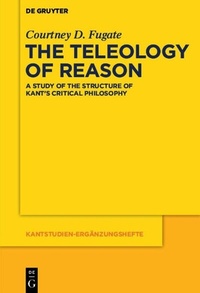
The Teleology of Reason
Description

This work argues that teleological motives lie at the heart of Kant's critical philosophy and that a precise analysis of teleological structures can both illuminate the basic strategy of its fundamental arguments and provide a key to understanding its unity. It thus aims, through an examination of each of Kant's major writings, to provide a detailed interpretation of his claim that philosophy in the true sense must consist of a
teleologia rationis humanae.
The author argues that Kant's critical philosophy forged a new link between traditional teleological concepts and the basic structure of rationality, one that would later inform the dynamic conception of reason at the heart of German Idealism. The process by which this was accomplished began with Kant's development of a uniquely teleological conception of systematic unity already in the precritical period. The individual chapters of this work attempt to show how Kant adapted and refined this conception of systematic unity so that it came to form the structural basis for the critical philosophy.
More details
Other editions
Additional editions
Person
Content
2 - Part I: Preliminary Investigations [Seite 17]
2.1 - Chapter 1. Motivations [Seite 19]
2.1.1 - Introduction [Seite 19]
2.1.1.1 - §. 1. Preliminary Sketch of the Telic Structure of Kant [Seite §. 1. Preliminary Sketch of the Telic Structure of Kant]
's System of Philosophy - 20 [Seite 20]
2.1.1.1.1 - [Seite ]
§. 1.1. The Teleology of Theoretical Reason - 21 [Seite 21]
2.1.1.1.2 - §. [Seite §.]
1.2. The Teleology of Pure Practical Reason - 25 [Seite 25]
2.1.1.1.3 - [Seite ]
§. 1.3. The Doctrine of Wisdom as the End of the System of Philosophy - 29 [Seite 29]
2.1.1.1.4 - §. 1.4. Teleology and the [Seite §. 1.4. Teleology and the ]
Transcendental Possibility of the Kantian System of Philosophy - 31 [Seite 31]
2.1.1.1.5 - §. 1.5. The Unity of Reason [Seite 36]
2.1.1.2 - §. 2. The Teleological Tradition Before an d After Kant [Seite 40]
2.1.1.2.1 - §. 2.1. Teleology in the Philosophies of Kant's German Predecessors [Seite 46]
2.1.1.2.2 - §. 2.2. The Legacy of Kant's Teleology of Reason in Fichte [Seite 49]
2.1.1.3 - §. 3. Current Views on the Role of Teleology in Kant's Cr itical Philosophy [Seite 58]
2.1.1.3.1 - §. 3.1. Reactions to the PopularView [Seite 63]
2.1.1.3.2 - §. 3.2. Teleology in special studies of Kant's philosophy [Seite 67]
2.1.2 - Conclusion [Seite 72]
2.2 - Chapter 2. Teleology: Rudiments of a Theory [Seite 73]
2.2.1 - Introduction [Seite 73]
2.2.2 - Teleology: Not Reducible to a Pattern of Behavior [Seite 76]
2.2.3 - Two Examples of this Tendency in Studies of the History of Philosohpy: Bennett and Couturat [Seite 80]
2.2.3.1 - [Seite ]
§. 1. Teleological Inferences: From Pattern to Purpose - 84 [Seite 84]
2.2.3.1.1 - §. 1.1. Teleological and Non-Teleological Inferences [Seite 88]
2.2.3.1.2 - §. 1.2. Traditional Teleological Arguments for God's Existence [Seite 91]
2.2.3.1.3 - §. 1.3. Concluding Reflections [Seite 96]
2.2.3.2 - [Seite ]
§. 2. Teleological Explanations: From Purpose to Pattern - 97 [Seite 97]
2.2.3.2.1 - §. 2.1. Maupertuis and the Universal Teleology of Nature [Seite 104]
2.2.3.2.2 - §. 2.2. Purposes as Laws of Behavior [Seite 111]
2.2.3.2.3 - §. 2.3. Skepticism Regarding Explanation [Seite 113]
2.2.3.2.4 - §. 2.4. Teleological Explanations: Concluding Reflections [Seite 115]
2.2.3.3 - §. 3. The Essential and Inessential Characteristics of Teleological Entities [Seite 119]
3 - Part II: The Teleology of Human Knowledge [Seite 125]
3.1 - Introduction to Part II [Seite 127]
3.2 - Chapter 3. The Historical Roots of Kant's Concept of Exp [Seite Chapter 3. The Historical Roots of Kant's Concept of Exp]
erience - 129 [Seite 129]
3.2.1 - Introduction [Seite 129]
3.2.1.1 - §. 1. Wolff's Ontological Logic and the "acumen pervidendi universalia in singularibus" [Seite 133]
3.2.1.1.1 - §. 1.1. Wolff's Logic of Experience [Seite 135]
3.2.1.1.2 - §. 1.2. The Wolffian Roots of Kant's Categories [Seite 139]
3.2.1.1.3 - §. 1.3. The Skill of Perceiving the Universal in the Particular [Seite 142]
3.2.1.1.4 - §. 1.4. Wolff and Kant on the Possibility of Experience [Seite 143]
3.2.1.2 - §. 2. Adolph Friedrich Hoffmann and Christian August Crusius [Seite 146]
3.2.1.2.1 - §. 2.1. The Logic of Experience According to Hoffmann and Crusius [Seite 153]
3.2.1.2.2 - §. 2.2. The Possibility of Experience and the Limits of Human Knowledge [Seite 157]
3.2.1.3 - §. 3. Anticipating Kant's Account of Experience [Seite 159]
3.2.2 - Conclusion: The Nature of Kant's Advance [Seite 163]
3.3 - Chapter 4. Teleology in the Transcendental Aesthetic and Analytic [Seite 164]
3.3.1 - Introduction [Seite 164]
3.3.1.1 - §. 1. The Problem of the "Critique": How are Synthetic Judgments a priori Possible? [Seite 165]
3.3.1.1.1 - §. 1.1. The Need for Synthetic Judgments a priori and the Structure of Knowledge [Seite 168]
3.3.1.1.2 - §. 1.2. Preliminary Outline of the Argument of the Transcendental Aesthetic and Analytic [Seite 177]
3.3.1.2 - §. 2. Space and Time as Grounds of the Formal Perfection of Sensible Objects [Seite 183]
3.3.1.2.1 - §. 2.1. The Objective Formal Perfection of Space [Seite 187]
3.3.1.2.2 - §. 2.2. The Transcendental Aesthetic: Comments on the Text [Seite 191]
3.3.1.3 - §. 3. The Transcendental Analytic [Seite 193]
3.3.1.3.1 - §. 3.1. The Metaphysical Deduction [Seite 194]
3.3.1.3.2 - §. 3.2. The Transcendental Deduction [Seite 197]
3.3.1.3.3 - §. 3.3. The Deduction in the B-edition [Seite 201]
3.3.1.4 - §. 4. Summary [Seite 212]
3.4 - Chapter 5. Teleology in the Transcendental Dialectic [Seite 217]
3.4.1 - Introduction [Seite 217]
3.4.1.1 - §. 1. The Relation of the Analytic to the Dialectic [Seite 221]
3.4.1.2 - §. 2. The Ideas of Pure Reason [Seite 228]
3.4.1.3 - §. 3. The Regulative Principles of Pure Reason [Seite 240]
3.4.1.4 - §. 4. The Transcendental Death of Physico-Theology [Seite 251]
3.4.2 - Conclusion [Seite 254]
3.4.3 - General Conclusion to Part II [Seite 255]
4 - Part III: The Teleology of Freedom [Seite 257]
4.1 - Introduction to Part III [Seite 259]
4.2 - Chapter 6. The Teleology of Freedom: The Structure of Moral Self-Consciousness in the Analytic [Seite 264]
4.2.1 - Introduction [Seite 264]
4.2.1.1 - §. 1. Three Types of Freedom [Seite 270]
4.2.1.2 - §. 2. Our Three Wills [Seite 277]
4.2.1.3 - §. 3. Moral Self-Consciousness [Seite 292]
4.2.1.4 - §. 4. The To-and-Fro Structure of Moral Self-Consciousness in the GMS [Seite 294]
4.2.1.5 - §. 5. The To-and-Fro Structure of Moral Self-Consciousness in the KpV [Seite 301]
4.2.2 - Conclusion [Seite 306]
4.3 - Chapter 7. Kant on Rational Faith as an Expression of Autonomy [Seite 308]
4.3.1 - Introduction [Seite 308]
4.3.1.1 - §. 1. Problems and Previous Interpretations [Seite 311]
4.3.1.1.1 - §. 1.1. Beck's Interpretation [Seite 312]
4.3.1.1.2 - §. 1.2. Wood's Interpretation [Seite §. 1.2. Wood's Interpretation]
- 316 [Seite 316]
4.3.1.1.2.1 - §. 1.2.1. A First Difficulty with Wood's Interpretation [Seite 317]
4.3.1.1.2.2 - §. 1.2.2. A Second Difficulty with Wood's Interpretation [Seite 318]
4.3.1.1.2.3 - §. 1.2.3. A Third Difficulty with Wood's Interpretation [Seite 320]
4.3.1.1.2.4 - §. 1.2.4. A Fourth Difficulty with Woods Interpretation [Seite 321]
4.3.1.2 - §. 2. Kant's Argument [Seite 326]
4.3.1.2.1 - §. 2.1. Virtue as Moral Strength of Character [Seite 327]
4.3.1.2.2 - §. 2.2. How Rational Belief in God's Existence Increases the Moral Incentive [Seite 331]
4.3.1.2.3 - §. 2.3. Textual Analysis [Seite 335]
4.3.1.2.3.1 - §. 2.3.1. The Highest Good in KpV [Seite 335]
4.3.1.2.3.2 - §. 2.3.2. The Highest Good in the KrV [Seite 343]
4.3.1.2.3.3 - §. 2.3.3. The Highest Good in the KU [Seite 344]
4.3.1.2.3.4 - §. 2.3.4. The Highest Good in TP [Seite 345]
4.3.2 - Summary of the Argument of this Section [Seite 346]
4.3.2.1 - §. 3. Practical-Dogmatic Metaphysics [Seite 347]
4.3.3 - Conclusion [Seite 351]
4.4 - Excursus: The Life of Reason [Seite 353]
4.4.1 - Introduction [Seite 353]
4.4.1.1 - §. 1. From Morality to Life: Three Conditions of the Possibility of the Realization of a Moral World [Seite 355]
4.4.1.2 - §. 2. Pure Aesthetic Pleasure as a Feeling of Life [Seite 361]
4.4.1.2.1 - §. 2.1. Kant's Constitutive Concept of Life [Seite 363]
4.4.1.2.2 - §. 2.2. The Historical Roots of Kant's Concept of Life [Seite 364]
4.4.1.2.3 - §. 2.3. Pure Aesthetic Pleasure as a Feeling of Life: How the Constitutive Concept of Life is Generalized to Include the Feeling of Beauty [Seite 369]
4.4.2 - Conclusion [Seite 373]
4.5 - Chapter 8. The Teleological Unity of Reason and Kant's Idea of Philosophy [Seite 376]
4.5.1 - Introduction [Seite 376]
4.5.1.1 - §. 1. The Unity of Reason [Seite 378]
4.5.1.1.1 - §. 1.1. The Unity of Reason: First Reconstruction [Seite 382]
4.5.1.1.2 - §. 1.2. Regulative and Constitutive Principles [Seite 390]
4.5.1.1.3 - §. 1.3. The Unity of Reason: Second Reconstruction [Seite 396]
4.5.1.2 - §. 2. Kant's Concept of Philosophy [Seite 403]
4.5.1.2.1 - §. 2.1. Philosophy "in sensu scholastico" and "in sensu cosmico" [Seite 406]
4.5.1.2.2 - §. 2.2. Unity of Reason and the History of Philosophy [Seite 409]
4.5.2 - Conclusion [Seite 412]
4.5.3 - Brief Outline of Kant's Conception of Teleology [Seite 414]
5 - Bibliography [Seite 420]
5.1 - I. Translations Consulted [Seite 420]
5.2 - II. Primary Sources [Seite 420]
5.3 - III. Secondary Sources [Seite 426]
6 - Register [Seite 441]
