

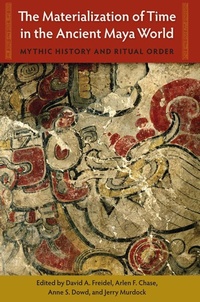
The Materialization of Time in the Ancient Maya World
Description

Newunderstandings of how Maya people expressed timekeeping in daily life
This book discussesthe range of ways the ancient Maya people made time tangible through their architecture,arts, writing, beliefs, and practices. These chapters show how the Maya incorporatedcyclicality and expanded dimensionality into the built environment, embeddingnotions of time in shared political and economic institutions, religious andphilosophical traditions, and mythology.
Beginningseveral millennia ago, the Maya observed and calculated the solar year cycle andscheduled collective activities that integrated cities, towns, and villagesover great distances. Theirtimekeeping approaches evolved from commemorative ceremonial architecturalcomplexes starting around 1000 BCE to the formal public inscription of calendarjubilees on stone monuments, the use of calendar almanacs, written propheticand historical accounts, and the customs of modern priest shamans. Contributorsto this volume discuss everyday examples of how the Maya kept time through thesepractices, including divining with snail shells, laying out center designs withcreation stories and star patterns, singing those stories while drinking fromvases depicting mythic history, and embedding symbolic temporal deposits withintheir buildings and living areas.
Thiscomprehensive volume includes analyses of groundbreaking recent discoveries,such as the early center of Aguada Fénix and the connections it shows betweenMaya and Olmec timekeeping. By sharing how the Maya crafted a cosmologicalsense of time into their daily lives, TheMaterialization of Time in the Ancient Maya World addresses and rethinksthe most famous intellectual feature of this civilization.
Avolume in the series Maya Studies, edited by Diane Z. Chase and Arlen F. Chase
More details
Other editions
Additional editions
Persons
Content
- Cover
- Half Title
- Title
- Copyright
- Dedication
- Contents
- List of Figures
- List of Tables
- Foreword
- Part I. Landesque Cosmography
- 1. The Maya Materialization of Time: An Introduction
- 2. Landesque Cosmography: Crafting Creation-Era Time on the Maya Lowland Landscape
- Part II. Building Time into Place
- 3. Spatial and Temporal Standardization in Southern Mesoamerica during the Preclassic Period: New Insights from the Middle Usumacinta Region, Mexico
- 4. Ordering Time and Space at Yaxnohcah: Creation and Renewal in a Preclassic Landscape
- 5. Domesticating Time: Quadripartite Symbolism and Founding Rituals at Yaxuná
- 6. In the Shadow of Descending Gods: Monumental Posts and Solar Cycles in the Preclassic Maya Lowlands
- 7. Stelae, Spirits, Desecration, and Devotion: The Fate of Some Time Lords in the Classic Maya World
- Part III. Chambers of Time
- 8. Balamkú's History House: Harkening to Primordial Rhythms of Mythic Time
- 9. Scorpion Star: Constellations, Seasons, and Convergences of Meaning in a Classic Maya Entity
- 10. Time as Ordinary Practice: A Divination Building at Chan
- 11. The Chamber of Secrets at Xunantunich
- Part IV. Bridging Time
- 12. Imagery of the Yearbearers in Maya Culture and Beyond
- 13. Lived Experience and Monumental Time in the Classic Maya Lowlands
- 14. The Materialization of Time in the Maya Archaeological Record: Examples from Caracol and Santa Rita Corozal, Belize
- 15. Materializing Time on Wax: The Cozumel Maya Bee Gardens
- 16. Temporal Fusion: Mythical and Mortal Time in Maya Art
- 17. "How Much May They Not Have Written?": K'atuns 11 Ajaw and the Itzá
- Part V. Materializing Mesoamerican Chronoscapes
- 18. The Ideas and Images of Cities and Centers: Teotihuacan and the Lowland Maya
- 19. Epilogue: Architects of Time
- References
- List of Contributors
- Index
- A
- B
- C
- D
- E
- F
- G
- H
- I
- J
- K
- L
- M
- N
- O
- P
- Q
- R
- S
- T
- U
- V
- W
- X
- Y
- Z
- About the Authors
