

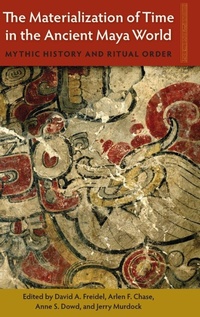
The Materialization of Time in the Ancient Maya World
Mythic History and Ritual Order
Published on 9. January 2024
Book
Hardback
604 pages
978-0-8130-6980-7 (ISBN)
Description
New understandings of how Maya people expressed timekeeping in daily life
This book discusses the range of ways the ancient Maya people made time tangible through their architecture, arts, writing, beliefs, and practices. These chapters show how the Maya incorporated cyclicality and expanded dimensionality into the built environment, embedding notions of time in shared political and economic institutions, religious and philosophical traditions, and mythology.
Beginning several millennia ago, the Maya observed and calculated the solar year cycle and scheduled collective activities that integrated cities, towns, and villages over great distances. Their timekeeping approaches evolved from commemorative ceremonial architectural complexes starting around 1000 BCE to the formal public inscription of calendar jubilees on stone monuments, the use of calendar almanacs, written prophetic and historical accounts, and the customs of modern priest shamans. Contributors to this volume discuss everyday examples of how the Maya kept time through these practices, including divining with snail shells, laying out center designs with creation stories and star patterns, singing those stories while drinking from vases depicting mythic history, and embedding symbolic temporal deposits within their buildings and living areas.
This comprehensive volume includes analyses of groundbreaking recent discoveries, such as the early center of Aguada Fenix and the connections it shows between Maya and Olmec timekeeping. By sharing how the Maya crafted a cosmological sense of time into their daily lives, The Materialization of Time in the Ancient Maya World addresses and rethinks the most famous intellectual feature of this civilization.
A volume in the series Maya Studies, edited by Diane Z. Chase and Arlen F. Chase
This book discusses the range of ways the ancient Maya people made time tangible through their architecture, arts, writing, beliefs, and practices. These chapters show how the Maya incorporated cyclicality and expanded dimensionality into the built environment, embedding notions of time in shared political and economic institutions, religious and philosophical traditions, and mythology.
Beginning several millennia ago, the Maya observed and calculated the solar year cycle and scheduled collective activities that integrated cities, towns, and villages over great distances. Their timekeeping approaches evolved from commemorative ceremonial architectural complexes starting around 1000 BCE to the formal public inscription of calendar jubilees on stone monuments, the use of calendar almanacs, written prophetic and historical accounts, and the customs of modern priest shamans. Contributors to this volume discuss everyday examples of how the Maya kept time through these practices, including divining with snail shells, laying out center designs with creation stories and star patterns, singing those stories while drinking from vases depicting mythic history, and embedding symbolic temporal deposits within their buildings and living areas.
This comprehensive volume includes analyses of groundbreaking recent discoveries, such as the early center of Aguada Fenix and the connections it shows between Maya and Olmec timekeeping. By sharing how the Maya crafted a cosmological sense of time into their daily lives, The Materialization of Time in the Ancient Maya World addresses and rethinks the most famous intellectual feature of this civilization.
A volume in the series Maya Studies, edited by Diane Z. Chase and Arlen F. Chase
More details
Series
Language
English
Place of publication
Florida
United States
Target group
Professional and scholarly
Product notice
Paper over boards
Illustrations
143 b&w illustrations
Dimensions
Height: 240 mm
Width: 161 mm
Thickness: 37 mm
Weight
1063 gr
ISBN-13
978-0-8130-6980-7 (9780813069807)
Copyright in bibliographic data and cover images is held by Nielsen Book Services Limited or by the publishers or by their respective licensors: all rights reserved.
Schweitzer Classification
Other editions
Additional editions
David A. Freidel | Arlen F. Chase | Anne S. Dowd
The Materialization of Time in the Ancient Maya World
Mythic History and Ritual Order
E-Book
01/2024
1st Edition
University Press of Florida
€245.99
Available for download
Persons
David A. Freidel is professor of anthropology emeritus at Washington University in St. Louis.
Arlen F. Chase is professor of comparative cultural studies at the University of Houston.
Anne S. Dowd is forest archaeologist, heritage program manager, and tribal liaison for the Ochoco National Forest and Crooked River National Grassland.
Jerry Murdock is a member of the Board of Trustees for the Santa Fe Institute and the Aspen Institute. Together, they are also the editors of Maya E Groups: Calendars, Astronomy, and Urbanism in the Early Lowlands.
Arlen F. Chase is professor of comparative cultural studies at the University of Houston.
Anne S. Dowd is forest archaeologist, heritage program manager, and tribal liaison for the Ochoco National Forest and Crooked River National Grassland.
Jerry Murdock is a member of the Board of Trustees for the Santa Fe Institute and the Aspen Institute. Together, they are also the editors of Maya E Groups: Calendars, Astronomy, and Urbanism in the Early Lowlands.