

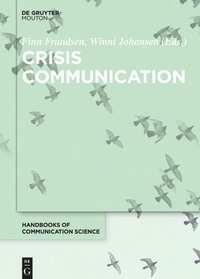
Crisis Communication
Description

Finn Frandsen and Winni Johansen have won the 2019 Danish communication prize (KOM-pris) for their world-class research in organisational crises, crisis management and crisis communication. This prize is awarded by The Danish Union of Journalists (Dansk Journalistforbund) and Kforum.
The aim of this handbook is to provide an up-to-date introduction to the discipline of crisis communication. Based on the most recent international research and through a series of levels (from the textual to the inter-societal level), this handbook introduces the reader to the most important concepts, models, theories and debates within the field of crisis communication. Crisis communication is a young and very vibrant field of research and practice. It is therefore crucial that researchers, students and practitioners have access to presentations and discussions of the most recent research. Like the other handbooks in the HOCS series, this handbook contains a general introduction, a chapter on the history of crisis communication research, a series of thematic chapters on crisis communication research at various levels, a chapter perspectives, a glossary of key terms, and lists of further reading for each chapter (with references to publications in English, German, and French).
Overview
Section I - Introducing the field
General introduction
A brief history of crisis management and crisis communication: From organizational practice to academic discipline
Reframing the field: Public crisis management, political crisis management, and corporate crisis management
Section II - Between text and context
Image repair theory
Situational crisis communication theory: Influences, provenance, evolution, and prospects
Contingency theory: Evolution from a public relations theory to a theory of strategic conflict management
Discourse of renewal: Understanding the theory's implications for the field of crisis communication
Making sense of crisis sensemaking theory: Weick's contributions to the study of crisis communication
Arenas and voices in organizational crisis communication: How far have we come?
Visual crisis communication
Section III - Organizational level
To minimize or mobilize? The trade-offs associated with the crisis communication process
Internal crisis communication: On current and future research
Whistleblowing in organizations
Employee reactions to negative media coverage
Crisis communication and organizational resilience
Section IV - Interorganizational level
Fixing the broken link: Communication strategies for supply chain crises
Reputational interdependence and spillover: Exploring the contextual challenges of spillover crisis response
Crisis management consulting: An emerging field of study
Section V - Societal level
Crisis and emergency risk communication: Past, present, and future
Crisis communication in public organizations
Communicating and managing crisis in the world of politics
Crisis communication and the political scandal
Crisis communication and social media: Short history of the evolution of social media in crisis communication
Mass media and their symbiotic relationship with crisis
Section VI - Intersocietal level
Should CEOs of multinationals be spokespersons during an overseas product harm crisis?
Intercultural and multicultural approaches to crisis communication
Section VII - Critical approaches
Ethics in crisis communication
Section VIII - The future
The future of organizational crises, crisis management and crisis communication
For a detailed table of contents, please see here.
More details
Other editions
Additional editions
Persons
Content
- Intro
- Preface to Handbooks of Communication Science series
- Acknowledgements
- Contents
- Section I - Introducing the field
- 1. General introduction
- 2. A brief history of crisis management and crisis communication: From organizational practice to academic discipline
- 3. Reframing the field: Public crisis management, political crisis management, and corporate crisis management
- Section II - Between text and context
- 4. Image repair theory
- 5. Situational crisis communication theory: Influences, provenance, evolution, and prospects
- 6. Contingency theory: Evolution from a public relations theory to a theory of strategic conflict management
- 7. Discourse of renewal: Understanding the theory's implications for the field of crisis communication
- 8. Making sense of crisis sensemaking theory: Weick's contributions to the study of crisis communication
- 9. Arenas and voices in organizational crisis communication: How far have we come?
- 10. Visual crisis communication
- Section III - Organizational level
- 11. To minimize or mobilize? The trade-offs associated with the crisis communication process
- 12. Internal crisis communication: On current and future research
- 13. Whistleblowing in organizations
- 14. Employee reactions to negative media coverage
- 15. Crisis communication and organizational resilience
- Section IV - Interorganizational level
- 16. Fixing the broken link: Communication strategies for supply chain crises
- 17. Reputational interdependence and spillover: Exploring the contextual challenges of spillover crisis response
- 18. Crisis management consulting: An emerging field of study
- Section V - Societal level
- 19. Crisis and emergency risk communication: Past, present, and future
- 20. Crisis communication in public organizations
- 21. Communicating and managing crisis in the world of politics
- 22. Crisis communication and the political scandal
- 23. Crisis communication and social media: Short history of the evolution of social media in crisis communication
- 24. Mass media and their symbiotic relationship with crisis
- Section VI - Intersocietal level
- 25. Should CEOs of multinationals be spokespersons during an overseas product harm crisis?
- 26. Intercultural and multicultural approaches to crisis communication
- Section VII - Critical approaches
- 27. Ethics in crisis communication
- Section VIII - The future
- 28. The future of organizational crises, crisis management and crisis communication
- Biographical sketches
- Index
