

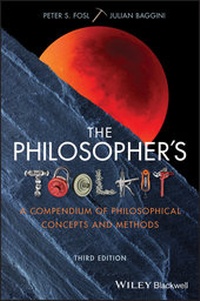
The Philosopher's Toolkit
Description

Whether used as a guide to basic principles or a resource for key concepts and methods, The Philosopher's Toolkit equips readers with all the intellectual 'tools' necessary for engaging closely with philosophical argument and developing fluency in the methods and language of philosophical inquiry. Featuring accessible explanations, practical examples, and expert guidance, this text empowers readers to understand traditional philosophical thinking and to engage with new ideas.
* Focuses on the practical methods and concepts necessary for philosophical inquiry
* Presents a versatile resource for both novice and advanced students in areas of philosophy, critical theory, and rhetoric
* Adopts a pluralistic approach to teaching philosophy, making this a suitable resource for many courses
* Delivers extensive cross-referenced entries, recommended readings, and updated online resources
* Covers an array of topics, from basic tools of argumentation to sophisticated philosophical principles
* Fully revised and updated to include new topics and entries as well as expanded recommended reading lists to encourage further study
More details
Other editions
Additional editions
Persons
Peter S. Fosl is Professor of Philosophy and Chair of PPE at Transylvania University, Kentucky. He is author of Hume's Scepticism (2020), co-author of The Critical Thinking Toolkit (Wiley Blackwell, 2016) and The Ethics Toolkit (Wiley Blackwell, 2007), editor of The Big Lebowski and Philosophy (Wiley Blackwell, 2012), and co-editor of Philosophy: The Classic Readings (Wiley Blackwell, 2009).
Julian Baggini is Academic Director of the Royal Institute of Philosophy and an Honorary Research Fellow at the University of Kent. He was the founding editor of The Philosophers' Magazine and has written for numerous newspapers and magazines, as well as for the think tanks The Institute of Public Policy Research, Demos, and Counterpoint. He is the author, co-author, or editor of over 20 books, including How the World Thinks, The Virtues of the Table, The Ego Trick, Freedom Regained, and The Edge of Reason.
Content
Acknowledgements xiii
Alphabetical Table of Contents xv
Preface xix
Internet Resources for Philosophers xxi
1 Basic Tools for Argument 1
1.1 Arguments, premises, and conclusions 1
1.2 Deduction 7
1.3 Induction 9
1.4 Validity and soundness 15
1.5 Invalidity 19
1.6 Consistency 21
1.7 Fallacies 25
1.8 Refutation 28
1.9 Axioms 31
1.10 Definitions 34
1.11 Certainty and probability 38
1.12 Tautologies, self-contradictions, and the law of non-contradiction 42
2 More Advanced Tools 47
2.1 Abduction 47
2.2 Hypothetico-deductive method 51
2.3 Dialectic 55
2.4 Analogies 58
2.5 Anomalies and exceptions that prove the rule 61
2.6 Intuition pumps 64
2.7 Logical constructions 66
2.8 Performativity and speech acts 69
2.9 Reduction 72
2.10 Representation 76
2.11 Thought experiments 80
2.12 Useful fictions 82
3 Tools for Assessment 85
3.1 Affirming, denying, and conditionals 86
3.2 Alternative explanations 90
3.3 Ambiguity and vagueness 93
3.4 Bivalence and the excluded middle 97
3.5 Category mistakes 100
3.6 Ceteris paribus 102
3.7 Circularity 104
3.8 Composition and division 108
3.9 Conceptual incoherence 110
3.10 Contradiction/contrariety 112
3.11 Conversion, contraposition, obversion 115
3.12 Counterexamples 118
3.13 Criteria 121
3.14 Doxa/para-doxa 123
3.15 Error theory 125
3.16 False dichotomy 128
3.17 False cause 129
3.18 Genetic fallacy 132
3.19 Horned dilemmas 135
3.20 Is/ought gap 138
3.21 Masked man fallacy 141
3.22 Partners in guilt 143
3.23 Principle of charity 145
3.24 Question-begging 149
3.25 Reductios 152
3.26 Redundancy 154
3.27 Regresses 156
3.28 Saving the phenomena 158
3.29 Self-defeating arguments 161
3.30 Sufficient reason 164
3.31 Testability 167
4 Tools for Conceptual Distinctions 171
4.1 A priori/a posteriori 172
4.2 Absolute/relative 176
4.3 Analytic/synthetic 179
4.4 Belief/knowledge 182
4.5 Categorical/modal 185
4.6 Cause/reason 186
4.7 Conditional/biconditional 189
4.8 De re/de dicto 191
4.9 Defeasible/indefeasible 194
4.10 Entailment/implication 196
4.11 Endurantism/perdurantism 199
4.12 Essence/accident 202
4.13 Internalism/externalism 205
4.14 Knowledge by acquaintance/description 208
4.15 Mind/body 211
4.16 Necessary/contingent 215
4.17 Necessary/sufficient 219
4.18 Nothingness/being 221
4.19 Objective/subjective 225
4.20 Realist/non-realist 227
4.21 Sense/reference 230
4.22 Substratum/bundle 232
4.23 Syntax/semantics 234
4.24 Universal/particular 236
4.25 Thick/thin concepts 239
4.26 Types/tokens 241
5 Tools of Historical Schools and Philosophers 245
5.1 Aphorism, fragment, remark 245
5.2 Categories and specific differences 248
5.3 Elenchus and aporia 251
5.4 Hegel's master/slave dialectic 254
5.5 Hume's fork 257
5.6 Indirect discourse 260
5.7 Leibniz's law of identity 263
5.8 Ockham's razor 267
5.9 Phenomenological method(s) 270
5.10 Signs and signifiers 273
5.11 Transcendental argument 276
6 Tools for Radical Critique 281
6.1 Class critique 281
6.2 Différance, deconstruction, and the critique of presence 284
6.3 Empiricist critique of metaphysics 286
6.4 Feminist and gender critiques 289
6.5 Foucaultian critique of power 292
6.6 Heideggerian critique of metaphysics 296
6.7 Lacanian critique 298
6.8 Critiques of naturalism 300
6.9 Nietzschean critique of Christian-Platonic culture 303
6.10 Pragmatist critique 305
6.11 Sartrean critique of 'bad faith' 308
7 Tools at the Limit 311
7.1 Basic beliefs 311
7.2 Godel and incompleteness 314
7.3 Hermeneutic circle 316
7.4 Philosophy and/as art 319
7.5 Mystical experience and revelation 322
7.6 Paradoxes 325
7.7 Possibility and impossibility 328
7.8 Primitives 332
7.9 Self-evident truths 334
7.10 Scepticism 337
7.11 Underdetermination and incommensurability 341
Index 345
1
Basic Tools for Argument
- 1.1 Arguments, premises, and conclusions
- 1.2 Deduction
- 1.3 Induction
- 1.4 Validity and soundness
- 1.5 Invalidity
- 1.6 Consistency
- 1.7 Fallacies
- 1.8 Refutation
- 1.9 Axioms
- 1.10 Definitions
- 1.11 Certainty and probability
- 1.12 Tautologies, self-contradictions, and the law of non-contradiction
1.1 Arguments, premises, and conclusions
Philosophy is for nit-pickers. That's not to say it is a trivial pursuit. Far from it. Philosophy addresses some of the most important questions human beings ask themselves. The reason philosophers are nit-pickers is that they are commonly concerned with the ways in which the claims and beliefs people hold about the world either are or are not rationally supported, usually by rational argument. Because their concern is serious, it is important for philosophers to demand attention to detail. People reason in a variety of ways using a number of techniques, some legitimate and some not. Often one can discern the difference between good and bad reasoning only if one scrutinises the content and structure of arguments with supreme and uncompromising diligence.
Argument and inference
What, then, is an 'argument' proper? For many people, an argument is a contest or conflict between two or more people who disagree about something. An argument in this sense might involve shouting, name-calling, and even a bit of shoving. It might also - but need not - include reasoning.
Philosophers, in contrast, use the term 'argument' in a very precise and narrow sense. For them, an argument is the most basic complete unit of reasoning - an atom of reasoning. An 'argument' understood this way is an inference from one or more starting points (truth claims called a 'premise' or 'premises') to an end point (a truth claim called a 'conclusion'). All arguments require an inferential movement of this sort. For this reason, arguments are called discursive.
Argument vs explanation
'Arguments' are to be distinguished from 'explanations'. A general rule to keep in mind is that arguments attempt to demonstrate that something is true, while explanations attempt to show how something is true. For example, consider encountering an apparently dead woman. An explanation of the woman's death would undertake to show how it happened. ('The existence of water in her lungs explains the death of this woman.') An argument would undertake to demonstrate that the person is in fact dead ('Since her heart has stopped beating and there are no other vital signs, we can conclude that she is in fact dead.') or that one explanation is better than another ('The absence of bleeding from the laceration on her head combined with water in the lungs indicates that this woman died from drowning and not from bleeding.')
The place of reason in philosophy
It's not universally realised that reasoning comprises a great deal of what philosophy is about. Many people have the idea that philosophy is essentially about ideas or theories about the nature of the world and our place in it that amount just to opinions. Philosophers do indeed advance such ideas and theories, but in most cases their power, their scope, and the characteristics that distinguish them from mere opinion stem from their having been derived through rational argument from acceptable premises. Of course, many other regions of human life also commonly involve reasoning, and it may sometimes be impossible to draw clean lines demarcating philosophy from them. (In fact, whether or not it is possible to demarcate philosophy from non-philosophy is itself a matter of heated philosophical debate!)
The natural and social sciences are, for example, fields of rational inquiry that often bump up against the borders of philosophy (especially in inquiries into the mind and brain, theoretical physics, and anthropology). But theories composing these sciences are generally determined through certain formal procedures of experimentation and reflection to which philosophy has little to add. Religious thinking sometimes also enlists rationality and shares an often-disputed border with philosophy. But while religious thought is intrinsically related to the divine, sacred, or transcendent - perhaps through some kind of revelation, article of faith, or ritualistic practice - philosophy, by contrast, in general is not.
Of course, the work of certain prominent figures in the Western philosophical tradition presents decidedly non-rational and even anti-rational dimensions (for example, that of Heraclitus, Kierkegaard, Nietzsche, Heidegger, and Derrida). We will examine the non-argumentative philosophical methods of these authors in what follows of this book. Furthermore, many include the work of Asian (Confucian, Taoist, Shinto), African, Aboriginal, and Native American thinkers under the rubric of philosophy, even though they seem to make little use of argument and have generally not identified their work as philosophical.
But, perhaps despite the intentions of its authors, even the work of non-standard thinkers involves rationally justified claims and subtle forms of argumentation too often missed. And in many cases, reasoning remains on the scene at least as a force with which thinkers must reckon.
Philosophy, then, is not the only field of thought for which rationality is important. And not all that goes by the name of philosophy is argumentative. But it is certainly safe to say that one cannot even begin to master the expanse of philosophical thought without learning how to use the tools of reason. There is, therefore, no better place to begin stocking our philosophical toolkit than with rationality's most basic components, the subatomic particles of reasoning - 'premises' and 'conclusions'.
Premises and conclusions
For most of us, the idea of a 'conclusion' is as straightforward as a philosophical concept gets. A conclusion is just that with which an argument concludes, the product and result of an inference or a chain of inferences, that which the reasoning claims to justify and support. What about 'premises', though? Premises are defined in relation to the conclusion. They are, of course, what do the justifying. There is, however, a distinctive and a bit less obvious property that all premises and conclusions must possess.
In order for a sentence to serve either as a premise or as a conclusion, it must exhibit this essential property: it must make a claim that is either true or false. A sentence that does that is in logical terms called a statement or proposition.
Sentences do many things in our languages, and not all of them possess that property and thence not all of them are statements. Sentences that issue commands, for example ('Forward march, soldier!'), or ask questions ('Is this the road to Edinburgh?'), or register exclamations ('Wow!'), are neither true nor false. Hence, it's not possible for sentences of those kinds to serve as premises or as conclusions.
This much is pretty easy, but things can get sticky in a number of ways. One of the most vexing issues concerning arguments is the problem of implicit claims. That is, in many arguments, key premises or even the conclusion remain unstated, implied or masked inside other sentences. Take, for example, the following argument: 'Socrates is a man, so Socrates is mortal.' What's left implicit is the claim that 'all men are mortal'. Arguments with unstated premises like this are often called enthymemes or enthymemetic.
It's also the case that sometimes arguments nest inside one another so that in the course of advancing one, main conclusion several ancillary conclusions are proven along the way. Untangling arguments nested in others can get complicated, especially as those nests can pile on top of one another and interconnect. It often takes a patient, analytical mind to sort it all out (just the sort of mind you'll encounter among philosophers).
In working out precisely what the premises are in a given argument, then, ask yourself first what the principal claim is that the argument is trying to demonstrate. Then ask yourself what other claims the argument relies upon (implicitly or explicitly) in order to advance that demonstration. Sometimes certain words and phrases will explicitly indicate premises and conclusions. Phrases like 'therefore', 'in conclusion', 'it follows that', 'we must conclude that', and 'from this we can see that' often indicate conclusions. ('The DNA, the fingerprints, and the eyewitness accounts all point to Smithers. It follows that she must be the killer.') Words like 'because' and 'since', and phrases like 'for this reason' and 'on the basis of this', on the other hand, often indicate premises. (For example,...
