

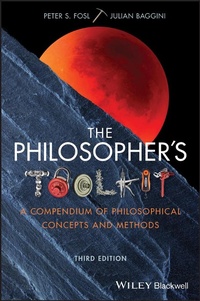
The Philosopher's Toolkit
A Compendium of Philosophical Concepts and Methods
3rd Edition
Published on 7. May 2020
Book
Paperback/Softback
376 pages
978-1-119-10321-9 (ISBN)
Description
A new edition of the bestselling guide to the study of philosophy: the ideal intellectual 'toolkit' for sharpening analytical skills and building philosophical acuity
Whether used as a guide to basic principles or a resource for key concepts and methods, The Philosopher's Toolkit equips readers with all the intellectual 'tools' necessary for engaging closely with philosophical argument and developing fluency in the methods and language of philosophical inquiry. Featuring accessible explanations, practical examples, and expert guidance, this text empowers readers to understand traditional philosophical thinking and to engage with new ideas.
* Focuses on the practical methods and concepts necessary for philosophical inquiry
* Presents a versatile resource for both novice and advanced students in areas of philosophy, critical theory, and rhetoric
* Adopts a pluralistic approach to teaching philosophy, making this a suitable resource for many courses
* Delivers extensive cross-referenced entries, recommended readings, and updated online resources
* Covers an array of topics, from basic tools of argumentation to sophisticated philosophical principles
* Fully revised and updated to include new topics and entries as well as expanded recommended reading lists to encourage further study
More details
Other editions
Additional editions
Peter S. Fosl | Julian Baggini
The Philosopher's Toolkit
A Compendium of Philosophical Concepts and Methods
E-Book
04/2020
3rd Edition
Wiley
€17.99
Available for download
Peter S. Fosl | Julian Baggini
The Philosopher's Toolkit
A Compendium of Philosophical Concepts and Methods
E-Book
04/2020
3rd Edition
Wiley
€17.99
Available for download
Previous edition
Julian Baggini | Peter S. Fosl
The Philosopher's Toolkit
A Compendium of Philosophical Concepts and Methods
Book
04/2010
2nd Edition
Wiley
€19.90
Article exhausted; check for reprint
Persons
Peter S. Fosl is Professor of Philosophy and Chair of PPE at Transylvania University, Kentucky. He is author of Hume's Scepticism (2020), co-author of The Critical Thinking Toolkit (Wiley Blackwell, 2016) and The Ethics Toolkit (Wiley Blackwell, 2007), editor of The Big Lebowski and Philosophy (Wiley Blackwell, 2012), and co-editor of Philosophy: The Classic Readings (Wiley Blackwell, 2009).
Julian Baggini is Academic Director of the Royal Institute of Philosophy and an Honorary Research Fellow at the University of Kent. He was the founding editor of The Philosophers' Magazine and has written for numerous newspapers and magazines, as well as for the think tanks The Institute of Public Policy Research, Demos, and Counterpoint. He is the author, co-author, or editor of over 20 books, including How the World Thinks, The Virtues of the Table, The Ego Trick, Freedom Regained, and The Edge of Reason.
Content
Acknowledgements
Alphabetical Table of Contents
Preface
Internet Resources for Philosophers
1 Basic Tools for Argument
1.1 Arguments, premises, and conclusions
1.2 Deduction
1.3 Induction
1.4 Validity and soundness
1.5 Invalidity
1.6 Consistency
1.7 Fallacies
1.8 Refutation
1.9 Axioms
1.10 Definitions
1.11 Certainty and probability
1.12 Tautologies, self-contradictions, and the law of non-contradiction
2 More Advanced Tools
2.1 Abduction
2.2 Hypothetico-deductive method
2.3 Dialectic
2.4 Analogies
2.5 Anomalies and exceptions that prove the rule
2.6 Intuition pumps
2.7 Logical constructions
2.8 Performativity and speech acts
2.9 Reduction
2.10 Representation
2.11 Thought experiments
2.12 Useful fictions
3 Tools for Assessment
3.1 Affirming, denying, and conditionals
3.2 Alternative explanations
3.3 Ambiguity and vagueness
3.4 Bivalence and the excluded middle
3.5 Category mistakes
3.6 Ceteris paribus
3.7 Circularity
3.8 Composition and division
3.9 Conceptual incoherence
3.10 Contradiction/contrariety
3.11 Conversion, contraposition, obversion
3.12 Counterexamples
3.13 Criteria
3.14 Doxa/para-doxa
3.15 Error theory
3.16 False dichotomy
3.17 False cause
3.18 Genetic fallacy
3.19 Horned dilemmas
3.20 Is/ought gap
3.21 Masked man fallacy
3.22 Partners in guilt
3.23 Principle of charity
3.24 Question-begging
3.25 Reductios
3.26 Redundancy
3.27 Regresses
3.28 Saving the phenomena
3.29 Self-defeating arguments
3.30 Sufficient reason
3.31 Testability
4 Tools for Conceptual Distinctions
4.1 A priori/a posteriori
4.2 Absolute/relative
4.3 Analytic/synthetic
4.4 Belief/knowledge
4.5 Categorical/modal
4.6 Cause/reason
4.7 Conditional/biconditional
4.8 De re/de dicto
4.9 Defeasible/indefeasible
4.10 Entailment/implication
4.11 Endurantism/perdurantism
4.12 Essence/accident
4.13 Internalism/externalism
4.14 Knowledge by acquaintance/description
4.15 Mind/body
4.16 Necessary/contingent
4.17 Necessary/sufficient
4.18 Nothingness/being
4.19 Objective/subjective
4.20 Realist/non-realist
4.21 Sense/reference
4.22 Substratum/bundle
4.23 Syntax/semantics
4.24 Universal/particular
4.25 Thick/thin concepts
4.26 Types/tokens
5 Tools of Historical Schools and Philosophers
5.1 Aphorism, fragment, remark
5.2 Categories and specific differences
5.3 Elenchus and aporia
5.4 Hegel's master/slave dialectic
5.5 Hume's fork
5.6 Indirect discourse
5.7 Leibniz's law of identity
5.8 Ockham's razor
5.9 Phenomenological method(s)
5.10 Signs and signifiers
5.11 Transcendental argument
6 Tools for Radical Critique
6.1 Class critique
6.2 Différance, deconstruction, and the critique of presence
6.3 Empiricist critique of metaphysics
6.4 Feminist and gender critique
6.5 Foucaultian critique of power
6.6 Heideggerian critique of metaphysics
6.7 Lacanian critique
6.8 Critiques of naturalism
6.9 Nietzschean critique of Christian-Platonic culture
6.10 Pragmatist critique
6.11 Sartrean critique of 'bad faith'
7 Tools at the Limit
7.1 Basic beliefs
7.2 Gödel and incompleteness
7.3 Hermeneutic circle
7.4 Philosophy and/as art
7.5 Mystical experience and revelation
7.6 Paradoxes
7.7 Possibility and impossibility
7.8 Primitives
7.9 Self-evident truths
7.10 Scepticism
7.11 Underdetermination and incommensurability
Index