

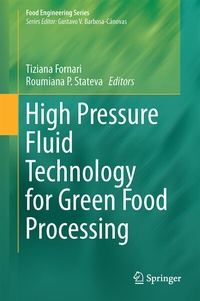
High Pressure Fluid Technology for Green Food Processing
Description

The aim of this book is to present the fundamentals of high pressure technologies from the perspective of mass transfer phenomena and thermodynamic considerations. Novel food applications are exposed and their relation to chemical analysis, extraction, reaction and particle formation processes are outlined. The chapters are written by a diverse group of scientists with expertise in chemistry, food processes, analytical chemistry, chemical engineering and chemical engineering thermodynamics, and biotechnology.
The mission of green food engineering is to promote innovative technologies that reduce or eliminate the use or generation of hazardous materials (solvents, reagents) in the design and operation of food related processes, with the view to improve food safety and quality. Several efficient, environmentally friendly and benign technologies based on the use of high pressure and green solvents have demonstrated to be sustainable alternatives to traditional processes in the food industry.
Although hundreds of new ideas are being published in the open literature, reliable engineering tools to simulate and design those processes are still under development. High Pressure Fluid Technology for Green Food Processing presents in-depth analyses and outlines the ways towards their maturity.
Tiziana Fornari, Research Institute of Food Science (CIAL) Universidad Autonoma de Madrid, Madrid, Spain
Roumiana P. Stateva, Institute of Chemical Engineering, Bulgarian Academy of Sciences, Sofia, Bulgaria
More details
Other editions
Additional editions
Persons
Content
1. High Pressure Phase Equilibria Measurement for Mixtures Comprising Food Substances.- 2. High Pressure Phase Equilibria Engineering.- 3. Mass Transfer Models for Supercritical Fluid Extraction.- 4. Thermophysical Properties of Pure Substances in the Context of Sustainable High Pressure Food Processes Modelling.- 5. Particle Formation of Food Ingredients by Supercritical Fluid Technology.- 6. Enzymatic Reactions in Supercritical Fluids.- 7. Advances in Analytical and Preparative Supercritical Fluid Chromatography. Food and Nutraceutical Applications.- 8. Direct and Indirect Applications of Sub- and Supercritical Water in Food-Related Analysis.- 9. Supercritical Fluid Processing for the Recovery of Bioactive Compounds from Food Industry By-Products.- 10. Supercritical Fluid Extraction of Compounds from Spices and Herbs.- 11. Supercritical Fluid Extraction of Carotenoids.- 12. Lipid Processing and Lipase Activity under High Pressure Conditions.- 13. Development of Multiple Unit-Fluid Processes and Bio-Refineries Using Critical Fluids.- 14. Prospective and Opportunities of High Pressure Processing in the Food, Nutraceutical and Pharmacy Market.
