

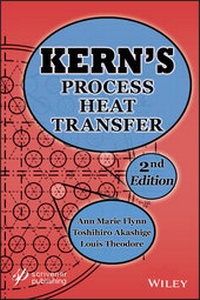
Kern's Process Heat Transfer
Description

This second edition book is divided into three parts: Fundamental Principles; Heat Exchangers; and Other Heat Transfer Equipment/ Considerations.
* Part I provides a series of chapters concerned with introductory topics that are required when solving heat transfer problems. This part of the book deals with topics such as steady-state heat conduction, unsteady-state conduction, forced convection, free convection, and radiation.
* Part II is considered by the authors to be the "meat" of the book, and the primary reason for undertaking this project. Other than minor updates, Part II remains relatively unchanged from the first edition. Notably, it includes Kern's original design methodology for double-pipe, shell-and-tube, and extended surface heat exchangers. Part II also includes boiling and condensation, boilers, cooling towers and quenchers, as well as newly designed open-ended problems.
* Part III of the book examines other related topics of interest, including refrigeration and cryogenics, batch and unsteady-state processes, health & safety, and the accompanying topic of risk. In addition, this part also examines the impact of entropy calculations on exchanger design.
A 36-page Appendix includes 12 tables of properties, layouts and design factors.
WHAT IS NEW IN THE 2ND EDITION
Changes that are addressed in the 2nd edition so that Kern's original work continues to remain relevant in 21st century process engineering include:
* Updated Heat Exchanger Design
* Increased Number of Illustrative Examples
* Energy Conservation/ Entropy Considerations
* Environmental Considerations
* Health & Safety
* Risk Assessment
* Refrigeration and Cryogenics
More details
Other editions
Additional editions
Persons
Ann Marie Flynn, PhD, the first female Manhattan College graduate to return to the school as a full-time faculty member, served as the department chair and graduate program director during her 27-year tenure in the chemical engineering department where she received multiple awards for teaching and leadership. She used Donald Q. Kern's text almost exclusively during the 16- year period when she taught Heat Transfer, and undertook the writing of the 2nd edition to bring Kern's straight forward approach towards heat exchanger design to the next generation of engineers.
Toshihiro Akashige, B.S. Chem. Eng., is a graduate from Manhattan College and currently enrolled in a PhD program for chemical and biomolecular engineering at the New York University Tandon School of Engineering. He particularly enjoyed process heat transfer class taught by Dr. Flynn and eventually joined in co-authoring this textbook with a hope that Dr. Kern's design methodology will help many other students and future engineers gain comfort in the technical knowledge of heat exchangers.
Louis Theodore, MChE and EngScD, is a retired professor of chemical engineering (50 years). He is the author of several publications, including Fluid Flow for the Practicing Chemical Engineer, Thermodynamics for the Practicing Engineer, Mass Transfer Operations for the Practicing Engineer, and Air Pollution Control Equipment Calculations. Dr. Theodore is also a contributor to Perry's Chemical Engineers' Handbook.
Content
Table of Contents (First Edition) vii
Preface to the First Edition xiii
Preface to the Second Edition xv
Acknowledgement xix
Part I Fundamentals and Principles 1
1. Introduction to Process Heat Transfer 3
1.1 Units and Dimensional Analysis 4
1.2 Key Physical Properties 10
1.3 Key Process Variables and Concepts 14
1.4 Laws of Thermodynamics 22
1.5 Heat-related Theories and Transfer Mechanisms 26
1.6 Fluid Flow and Pressure Drop Calculations 28
1.7 Process Heat Transfer 35
Reference 40
2 Steady-State and Unsteady-State Heat Conduction 43
2.1 Flow of Heat through a Wall 46
2.2 Flow of Heat through a Composite Wall: Resistances in Series 50
2.3 Flow of Heat through a Pipe Wall 54
2.4 Microscopic Approach: Steady-State Conduction 63
2.5 Unsteady-State Heat Conduction 68
2.6 Microscopic Approach: Unsteady-State Conduction 71
Reference 77
3 Forced and Free Convection 79
3.1 Forced Convection Principles 82
3.2 Convective Resistances 87
3.3 Heat Transfer Coefficients: Quantitative Information 89
3.4 Convection Heat Transfer: Microscopic Approach 105
3.5 Free Convection Principles and Applications 108
3.6 Environmental Applications 120
Reference 126
4 Radiation 129
4.1 The Origin of Radiant Energy 132
4.2 The Distribution of Radiant Energy 133
4.3 Radiant Exchange Principles 138
4.4 Kirchoff 's Law 139
4.5 Emissivity Factors and Energy Interchange 145
4.6 View Factors 152
Reference 157
Part II - Heat Exchangers 159
5. The Heat Transfer Equation 161
5.1 Heat Exchanger Equipment Classification 162
5.2 Energy Relationships 163
5.3 The Log Mean Temperature Difference (LMTD) Driving Force 166
5.4 The Overall Heat Transfer Coefficient 183
5.5 The Heat Transfer Equation 208
Reference 216
6 Double Pipe Heat Exchangers 217
6.1 Equipment Description and Details 218
6.2 Key Describing Equations 225
6.3 Pressure Drop in Pipes and Pipe Annuli 244
6.4 Calculation of Exit Temperatures 251
6.5 Open-Ended Problems 254
6.6 Kern's Design Methodology 262
Reference 286
7 Shell and Tube Heat Exchangers 287
7.1 Equipment Description and Details 288
7.2 Key Describing Equations 305
7.3 Open-Ended Problems 331
7.4 Kern's Design Methodology 337
7.5 Other Design Procedures and Applications 348
7.6 Computer Aided Heat Exchanger Design 370
Reference 377
8 Finned heat Exchangers 379
8.1 Fin Details 380
8.2 Equipment Description 386
8.3 Key Describing Equations 388
8.4 Fin Effectiveness and Performance 396
8.5 Kern's Design Methodology 416
8.6 Other Fin Considerations 430
Reference 432
9 Other Heat Exchangers 433
9.1 Condensers 435
9.2 Evaporators 447
9.3 Boilers and Furnace 466
9.4 Waste Heat Boilers 476
9.5 Quenchers 484
9.6 Cogeneration/Combined Heat and Power 488
9.7 Cooling towers 494
9.8 Heat pipes 504
Reference 506
Part III - Peripheral Topics 509
10 Other Heat Transfer Considerations 511
10.1 Insulation and Refractory 512
10.2 Refrigeration and Cryogenics 529
10.3 Instrumentation and Controls 542
10.4 Batch and Unsteady-state Processes 551
10.5 Operation, Maintenance and Inspection (OM & I) 558
10.6 Economics and Finance 565
Reference 581
11. Entropy Considerations and Analysis 585
11.1 Qualitative Review of the Second Law 586
11.2 Describing Equations 587
11.3 The Heat Exchanger Dilemma 591
11.4 Application to a Heat Exchanger Network 599
Reference 602
Chapter 12 - Health and Safety Concerns 603
12.1 Definitions 607
12.2 Legislation 616
12.3 Material Safety Data Sheets (MSDSs) 619
12.4 Health Risk versus Hazard Risk 624
12.5 Health Risk Assessment 625
12.6 Hazard Risk Assessment 636
Reference 646
Appendix 649
AT.1 Conversion Constants 641
AT.2 Steam Tables 653
AT.3 Properties of Water (Saturated Liquid) 662
AT.4 Properties of Air at 1 atm 664
AT.5 Properties of Selected Liquids at 1 atm and 20°C (68°F) 665
AT.6 Properties of Selected Gases at 1 atm and 20.°C (68.°F) 667
AT.7 Dimensions, Capacities, and Weights of Standard Steel Pipes 669
AT.8 Dimensions of Heat Exchanger Tubes 671
AT.9 Tube-Sheet Layouts (Tube Counts) on a Square Pitch 673
AT.10 Tube-Sheet Layouts (Tube Counts) on a Triangular Pitch 675
AT.11 Approximate Design Overall Heat Transfer Coefficients (Btu/hr·ft2.°F) 678
AT.12 Approximate Design Fouling Coefficient Factors (hr·ft2.°F/Btu) 679
Figures
AF.1 Fanning Friction Factor (f) vs. Reynolds Number (Re) Plot 683
AF.2 Psychometric Chart: Low Temperatures: Barometric Pressure, 29.92 in. Hg. 684
AF.3 Psychometric Chart: High Temperatures: Barometric Pressure, 29.92 in. Hg. 685
Index 000
Chapter 1
Introduction to Process Heat Transfer
Introduction
The science of thermodynamics deals with the quantitative transitions and rearrangements of energy as heat in bodies of matter. Heat transfer is the science which deals with the rates of exchange of heat between hot and cold bodies called the source and receiver, respectively. The equipment employed to bring about this heat exchange is referred to as a heat exchanger.
Perhaps the simplest example of the various types of heat exchangers is the double pipe heat exchanger, a unit that will receive extensive treatment in Part II, Chapter 6. A simple diagram representing this exchanger is provided in Figure 1.1. This unit consists of two concentric pipes. Each of the two fluids - hot and cold - flow either through the inside of the inner pipe or through the annulus formed between the outside of the inner pipe and the inside of the outer pipe. Generally, it is more economical (from heat efficiency and design perspectives) for the hot fluid (the source) to flow-through the inner pipe and the cold fluid (the receiver) through the annulus, thereby reducing heat losses from the hot fluid to the surroundings.
Figure 1.1 Line diagram of a cocurrent flow heat exchanger.
Fundamentally, a temperature difference between the two bodies in close proximity (or between two parts of the same body) results in heat flow from higher to lower temperatures. There are three different (and classic) mechanisms by which this heat transfer can occur: conduction, convection, and radiation. When the heat transfer is the result of molecular motion (e.g., the vibrational energy of molecules in a solid being passed along from molecule to molecule), the mechanism of transfer is conduction. When heat transfer results from macroscopic motion, such as currents in a fluid, the mechanism is convection. When heat is transferred by electromagnetic waves, radiation is the mechanism. In most industrial applications, multiple mechanisms are usually involved in the transmission of heat. However, since each mechanism is governed by its own set of physical laws, it is beneficial to discuss them independently of each other (see Chapters 2-4).
This introductory chapter consists of the following eight sections:
- 1.1 Units and Dimensional Analysis
- 1.2 Key Physical Properties
- 1.3 Key Process Variables and Concepts
- 1.4 Laws of Thermodynamics
- 1.5 Heat-related Theories and Transfer Mechanisms
- 1.6 Fluid Flow and Pressure Drop Considerations
- 1.7 Environmental Considerations
- 1.8 Process Heat Transfer
1.1 Units and Dimensional Analysis
This section is primarily concerned with units. The units used in the text are consistent with those adopted by the engineering profession in the United States [1-3]. One usually refers to them as English or engineering units. Since engineers are often concerned with units and conversion of units, both the English and SI (International System of Units) units are used throughout the book. All quantities of the physical and chemical properties to be discussed are expressed using either or both of these two systems. Although the English (engineering) system of units is primarily employed in this text (Kern originally used engineering units), a discussion on the metric and SI system of units is warranted. Background histories are provided in the next two subsections.
The Metric System [1, 2]. The need for a single worldwide coordinated measurement system was recognized nearly 350 years ago. In 1670, Gabriel Mouton, Viscar of St. Paul's church in Lyon, proposed a comprehensive decimal measurement system based on the length of one minute of arc of a great circle of the Earth. In 1671, Jean Picard, a French astronomer, proposed that the period of an instrument called a "seconds pendulum" be precisely two seconds - thereby denoting that one unit of time, a second, be one swing of the seconds pendulum. (Such a pendulum would have been fairly easy to reproduce, thus facilitating the widespread distribution of uniform standards.) Other proposals were made, but over a century elapsed before any action was taken.
In 1790, in the midst of the French Revolution, the National Assembly of France requested the French Academy of Sciences to "deduce an invariable standard for all the measures and weights." The Commission appointed by the Academy created a system that was, at once, simple and scientific. The unit of length was to be a portion of the Earth's circumference. Measures for capacity (volume) and mass (weight) were to be derived from the unit of length, thus relating the basic units of the system to each other and to nature. Furthermore, the larger and smaller versions of each unit were to be created by multiplying or dividing the basic units by 10 and its multiples. This feature provided a great convenience to users of the system by eliminating the need for such calculations as dividing by 16 (to convert ounces to pounds) or by 12 (to convert inches to feet). Similar calculations in the metric system could be performed simply by shifting the decimal point. Thus, the metric system is a base-10 or decimal system.
The Commission assigned the name metre (which is now spelled meter) to the unit of length. This name was derived from the Greek word metron meaning "a measure." The physical standard representing the meter was to be constructed so that it would equal one ten-millionth of the distance from the north pole to the equator along the meridian of the Earth running near Dunkirk in France and Barcelona in Spain.
The metric unit of mass, called the gram, was defined as the mass of one cubic centimeter (a cube that is 1/100 of a meter on each side) of water at its temperature of maximum density. The cubic decimeter (a cube 1/10 of a meter on each side) was chosen as the unit of fluid capacity. This measure was given the name liter.
Although the metric system was not accepted with enthusiasm at first, adoption by other nations occurred steadily after France made its use compulsory in 1840. The standardized character and decimal features of the metric system made it well suited to scientific and engineering work. Consequently, it is not surprising that the rapid spread of the system coincided with an age of rapid technological development. In the United States, by Act of Congress in 1866, it was made "lawful throughout the United States of America to employ the weights and measures of the metric system in all contracts, dealings, or court proceedings."
By the late 1860s, even better metric standards were needed to keep pace with scientific advances. In 1875, an international treaty, the "Treaty of the Meter," set up well-defined metric standards for length and mass. The treaty also established permanent machinery to recommend and adopt further refinements in the metric system. This treaty, known as the Metric Convention, was signed by 17 countries, including the United States. As a result of the treaty, metric standards were constructed and distributed to each nation that ratified the Convention. Since 1893, the internationally agreed to metric standards have served as the fundamental weights and measures standards of the United States.
By 1900, a total of 35 nations - including the major nations of continental Europe and most of South America - had officially accepted the metric system. Today, with the exception of the United States and a few small countries, the entire world is predominantly using the metric system or is committed to such use. In 1971, the Secretary of Commerce, in transmitting to Congress the results of a 3-year study authorized by the Metric Study Act of 1968 recommended that the U.S. change to the use of the metric system through a coordinated national program.
The International Bureau of Weights and Measures located at Sevres, France, serves as a permanent secretariat for the Metric Convention, coordinating the exchange of information about the use and refinement of the metric system. As measurement science develops more precise and easily reproducible ways of defining the measurement units, the General Conference of Weights and Measures - the diplomatic organization made up of adherents to the Convention - meets periodically to ratify improvements in the system and the standards.
The SI System [1, 2]. In 1960, the General Conference adopted an extensive revision and simplification of the system. The name Le Systeme International d'Unites (International System of Units), with the international abbreviation SI, was adopted for this modernized metric system. Further improvements in and additions to SI were made by the General Conferences in 1964, 1968, and 1971.
The basic units in the SI system are the kilogram (mass), meter (length), second (time), Kelvin (temperature), ampere (electric current), candela (the unit of luminous intensity), and radian (angular measure). All are commonly used by the practicing engineer and scientist. The Celsius scale of temperature (0 °C = 273.15 K) is commonly used with the absolute Kelvin scale. The important derived units are the newton (SI unit of force), the joule (SI unit of energy), the watt (SI unit of power), the pascal (SI unit of pressure),...
