

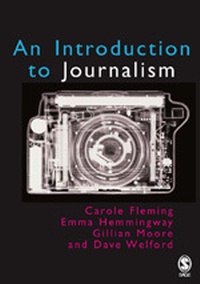
Introduction to Journalism
1st Edition
Published on 15. November 2005
256 pages
978-1-84860-521-3 (ISBN)
Description

'The book does what it says on the label. It is punctuated throughout with useful and relevant quotes from working journalists - their opinions, tips and warnings - a technique that drives home the message and adds life and colour' -THES Textbook Guide
The job of a journalist has changed dramatically over the past few decades with satellite links, 24 hour rolling news, and the Internet creating constant pressure for the latest updates. But for all that, the fundamentals of doing the job remain the same: it's about identifying a story, getting the interviews, and delivering a balanced and interesting report.
'Introduction to Journalism' examines the skills needed to work as a journalist in newspapers, television, radio and online:
" Provides case studies as a guide to researching stories, interviewing, and writing for each medium, as well as recording material for both radio and television.
" Offers a wide range of comment and tips on the best way to approach stories
" Includes interviews with journalists working on a variety of news outlets from the BBC to weekly newspapers.
This book provides a lively and authoritative introduction to journalism and readers will enjoy the insight from a range of journalists.
The job of a journalist has changed dramatically over the past few decades with satellite links, 24 hour rolling news, and the Internet creating constant pressure for the latest updates. But for all that, the fundamentals of doing the job remain the same: it's about identifying a story, getting the interviews, and delivering a balanced and interesting report.
'Introduction to Journalism' examines the skills needed to work as a journalist in newspapers, television, radio and online:
" Provides case studies as a guide to researching stories, interviewing, and writing for each medium, as well as recording material for both radio and television.
" Offers a wide range of comment and tips on the best way to approach stories
" Includes interviews with journalists working on a variety of news outlets from the BBC to weekly newspapers.
This book provides a lively and authoritative introduction to journalism and readers will enjoy the insight from a range of journalists.
All prices
More details
Edition
First Edition
Language
English
Place of publication
London
United Kingdom
Target group
College/higher education
ISBN-13
978-1-84860-521-3 (9781848605213)
Copyright in bibliographic data and cover images is held by Nielsen Book Services Limited or by the publishers or by their respective licensors: all rights reserved.
Schweitzer Classification
Other editions
Additional editions
Carole Fleming | Emma Hemmingway | Gillian Moore
Introduction to Journalism
Book
11/2005
1st Edition
SAGE Publications Inc
€228.78
Shipment within 15-20 days
Carole Fleming | Emma Hemmingway | Gillian Moore
Introduction to Journalism
Book
11/2005
1st Edition
SAGE Publications Inc
€104.20
Shipment within 15-20 days
Persons
Content
Introduction
What is News?
Researching a Story
Writing a Story
Interviewing
Broadcast Skills
An Introduction to the English Legal System
The Journalist and the Law
Reporting in the Courts
Reporting Local Government and Politics
Regulation
Glossary of Legal Terms
Glossary of Journalism Terms
What is News?
Researching a Story
Writing a Story
Interviewing
Broadcast Skills
An Introduction to the English Legal System
The Journalist and the Law
Reporting in the Courts
Reporting Local Government and Politics
Regulation
Glossary of Legal Terms
Glossary of Journalism Terms
