

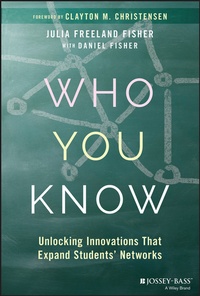
Who You Know
Unlocking Innovations That Expand Students' Networks
1st Edition
Published on 24. July 2018
192 pages
978-1-119-45294-2 (ISBN)
Description

Improve student outcomes with a new approach to relationships and networks
Relationships matter. Who You Know explores this simple idea to give teachers and school administrators a fresh perspective on how to break the pattern of inequality in American classrooms. It reveals how schools can invest in the power of relationships to increase social mobility for their students.
Discussions about inequality often focus on achievement gaps. But opportunity is about more than just test scores. Opportunity gaps are a function of not just what students know, but who they know. This book explores the central role that relationships play in young people's lives, and provides guidance for a path forward. Schools can:
* Integrate student support models that increase access to caring adults in students' lives
* Invest in learning models that strengthen teacher-student relationships
* Deploy emerging technologies that expand students' networks to experts and mentors from around world
Exploring the latest tools, data, and real-world examples, this book provides evidence-based guidance for educators looking to level the playing field and expert analysis on how policymakers and entrepreneurs can help.
Networks need no longer be limited by geography or circumstance. By making room for relationships, K-12 schools can transform themselves into hubs of next-generation learning and connecting. Who You Know explains how.
Relationships matter. Who You Know explores this simple idea to give teachers and school administrators a fresh perspective on how to break the pattern of inequality in American classrooms. It reveals how schools can invest in the power of relationships to increase social mobility for their students.
Discussions about inequality often focus on achievement gaps. But opportunity is about more than just test scores. Opportunity gaps are a function of not just what students know, but who they know. This book explores the central role that relationships play in young people's lives, and provides guidance for a path forward. Schools can:
* Integrate student support models that increase access to caring adults in students' lives
* Invest in learning models that strengthen teacher-student relationships
* Deploy emerging technologies that expand students' networks to experts and mentors from around world
Exploring the latest tools, data, and real-world examples, this book provides evidence-based guidance for educators looking to level the playing field and expert analysis on how policymakers and entrepreneurs can help.
Networks need no longer be limited by geography or circumstance. By making room for relationships, K-12 schools can transform themselves into hubs of next-generation learning and connecting. Who You Know explains how.
More details
Other editions
Additional editions
Book
10/2018
1st Edition
Jossey-Bass
€28.50
Shipment within 15-20 days
Content
- Who You Know: Unlocking Innovations That Expand Students' Networks
- Contents
- Foreword
- Introduction
- Why Are We Ignoring Students' Networks?
- The Potential to Disrupt Opportunity Gaps
- Innovating toward Relationships
- The Purpose of This Book
- Chapter 1: The Social Side of Opportunity: Why Relationships Matter to Meritocracy
- Meritocracy's Mythical Origins
- Opportunity by the Numbers: A Tale of Two Childhoods
- Relationship Gaps: Hidden Disparity
- How Schools Can Address Relationship Gaps
- A Glimpse at the Consequences of Relationship Gaps
- Investing in Students' Social Capital
- Notes
- Chapter 2: Getting by with a Little Help from Our Friends: What Schools Need to Know about Social Capital
- Cosmic Coincidences
- Valuing Relationships
- Strong Ties Make Us Stronger
- The Surprising Strength of Weak Ties
- The Spectrum of Our Connections
- Homophily's Stronghold on Networks
- Institutional Designs Can Make-or Break-Our Networks
- Integrating Social Capital into the Architecture of School
- Why Schools' Modular Architecture Costs Students
- Notes
- Chapter 3: There's No App for That: The Power of Integrating Access to Strong Ties and Care
- Love Leads the Way
- Transcending Challenges with Care
- City Connects: Constructing an Individualized Network of Care
- Relationships at the Core
- Covering the Costs of Care
- Integrating Forward to Address Opportunity Gaps
- Tools Expanding Access to Opportunity
- Notes
- Chapter 4: Edtech That Connects: How New Technologies Can Disrupt Students' Networks
- Reaching beyond Your Inherited Network
- Networks as a Gateway to Opportunity
- Is Technology Disrupting Our Social Networks?
- New Technologies Disrupting the Limits of Inherited Networks
- On-Demand Advice: Multiplying Access to Relatable Guidance
- Brief Encounters: Scaling Access to Industry Professionals
- More Supports: Increasing Academic Help and Spurring Motivation
- Charting a Disruptive Path Forward
- Improving Quality, Monitoring Safety
- Diversifying on the Basis of Similarity
- Designing Tools with Homophily in Mind
- A New Design for Schools
- Notes
- Chapter 5: Making Space for Relationships: Redesigning School as a Caring and Networking Hub
- ``How Do I Slot In?´´
- The Current Architecture Closing Off School
- Innovations Reshaping School Architecture
- Transitioning away from Batch-Processing Students
- Going Online to Get Offline
- Awarding Credit for Real-World Experiences
- Opening Up to Out-of-School Learning
- Can Innovations in Learning and Connecting Work Together?
- Strengthening Teacher-Student Ties
- Other Ties in Students' Lives
- The Next Phase of Schools: Walled Gardens for Learning and Connecting
- Tools to Curate Walled Gardens
- Building a Networking and Opportunity Hub
- Notes
- Chapter 6: If You Build It, Will They Connect?: Engaging Outsiders inside Schools
- ``Boom, Boom, Boom!´´
- Getting at the Job to Be Done
- A Milkshake Is More Than a Milkshake
- Mentors' Various Jobs to Be Done
- Jobs Transcend Demographic Categories
- ``Unbundling´´ across Jobs
- What Are Students Hiring For?
- Why Teachers Hire Schools and Tools
- Using Jobs to Reach Your Goals
- Defining the Metrics of Success
- Notes
- Chapter 7: What Gets Measured Gets Done: School Metrics and Policies Reconsidered
- Pulling Back the Curtain on Network Gaps
- The Power of Transparency to Drive Change
- Taking Stock: Relationships as Outcomes
- Relationships Can Keep on Giving
- Preparing for the Unknown
- How Schools Can Measure Webs of Relationships over Time
- Measurement Approaches for System Leaders and Policymakers
- Enabling Conditions-Policies That Will Open Up Schools and Ensure Safety
- Extended Learning Opportunities
- Competency-Based Learning Policies
- Privacy and Infrastructure Policies to Secure Students' Networks
- A Relationship-Rich Future
- Notes
- Conclusion: Designing for a Networked Society, Labor Market, and Life
- Zuckerberg Goes Analog
- Schools' Role in a Networked Future
- Shifting Social Capital to Match Our Needs
- Notes
- About the Authors
- Acknowledgments
- Index
- End User License Agreement
