

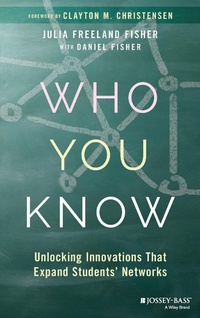
Who You Know
Unlocking Innovations That Expand Students' Networks
1st Edition
Published on 2. October 2018
Book
Hardback
192 pages
978-1-119-45292-8 (ISBN)
Description
Improve student outcomes with a new approach to relationships and networks
Relationships matter. Who You Know explores this simple idea to give teachers and school administrators a fresh perspective on how to break the pattern of inequality in American classrooms. It reveals how schools can invest in the power of relationships to increase social mobility for their students.
Discussions about inequality often focus on achievement gaps. But opportunity is about more than just test scores. Opportunity gaps are a function of not just what students know, but who they know. This book explores the central role that relationships play in young people's lives, and provides guidance for a path forward. Schools can:
Integrate student support models that increase access to caring adults in students' lives
Invest in learning models that strengthen teacher-student relationships
Deploy emerging technologies that expand students' networks to experts and mentors from around world
Exploring the latest tools, data, and real-world examples, this book provides evidence-based guidance for educators looking to level the playing field and expert analysis on how policymakers and entrepreneurs can help.
Networks need no longer be limited by geography or circumstance. By making room for relationships, K-12 schools can transform themselves into hubs of next-generation learning and connecting. Who You Know explains how.
Relationships matter. Who You Know explores this simple idea to give teachers and school administrators a fresh perspective on how to break the pattern of inequality in American classrooms. It reveals how schools can invest in the power of relationships to increase social mobility for their students.
Discussions about inequality often focus on achievement gaps. But opportunity is about more than just test scores. Opportunity gaps are a function of not just what students know, but who they know. This book explores the central role that relationships play in young people's lives, and provides guidance for a path forward. Schools can:
Integrate student support models that increase access to caring adults in students' lives
Invest in learning models that strengthen teacher-student relationships
Deploy emerging technologies that expand students' networks to experts and mentors from around world
Exploring the latest tools, data, and real-world examples, this book provides evidence-based guidance for educators looking to level the playing field and expert analysis on how policymakers and entrepreneurs can help.
Networks need no longer be limited by geography or circumstance. By making room for relationships, K-12 schools can transform themselves into hubs of next-generation learning and connecting. Who You Know explains how.
More details
Other editions
Additional editions
E-Book
07/2018
1st Edition
Wiley
€19.99
Available for download
E-Book
07/2018
1st Edition
Wiley-Scrivener
€19.99
Available for download
Persons
JULIA FREELAND FISHER is director of education research at the Clayton Christensen Institute, a nonprofit, nonpartisan think tank. She leads a team devoted to informing policymakers and community leaders on the power of disruptive innovation to transform schools.
DANIEL FISHER works as a subject matter expert for the U.S. government. Previously, he was an officer in the U.S. Army and a veterans' field representative for Congressman Joe Courtney (CT-02).
DANIEL FISHER works as a subject matter expert for the U.S. government. Previously, he was an officer in the U.S. Army and a veterans' field representative for Congressman Joe Courtney (CT-02).
Content
Foreword vii
Clayton M. Christensen
Introduction 1
1 The Social Side of Opportunity: Why Relationships Matter to Meritocracy 17
2 Getting by with a Little Help from Our Friends: What Schools Need to Know about Social Capital 35
3 There's no App for that: The Power of Integrating Access to Strong Ties and Care 53
4 Edtech that Connects: How New Technologies can Disrupt Students' Networks 69
5 Making Space for Relationships: Redesigning School as a Caring and Networking Hub 89
6 If You Build it, will they Connect? Engaging Outsiders Inside Schools 111
7 What gets Measured gets Done: School Metrics and Policies Reconsidered 133
Conclusion: Designing for a Networked Society, Labor Market, and Life 153
About the Authors 161
Acknowledgments 163
Index 167
Clayton M. Christensen
Introduction 1
1 The Social Side of Opportunity: Why Relationships Matter to Meritocracy 17
2 Getting by with a Little Help from Our Friends: What Schools Need to Know about Social Capital 35
3 There's no App for that: The Power of Integrating Access to Strong Ties and Care 53
4 Edtech that Connects: How New Technologies can Disrupt Students' Networks 69
5 Making Space for Relationships: Redesigning School as a Caring and Networking Hub 89
6 If You Build it, will they Connect? Engaging Outsiders Inside Schools 111
7 What gets Measured gets Done: School Metrics and Policies Reconsidered 133
Conclusion: Designing for a Networked Society, Labor Market, and Life 153
About the Authors 161
Acknowledgments 163
Index 167