

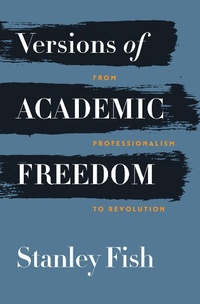
Versions of Academic Freedom
From Professionalism to Revolution
Published on 4. March 2020
178 pages
978-0-226-17025-1 (ISBN)
Description

The author and New York Times columnist sheds light on the intersection of academia and politics with this look at the debate surrounding academic freedom. Depending on who's talking, academic freedom is an essential bulwark of democracy, an absurd fig leaf disguising liberal agendas, or, most often, some in-between muddle that both exaggerates its own importance and misunderstands its actual value to scholarship. The crucial question, Fish tells us, is located in the phrase itself: Do you emphasize "academic" or "freedom"?
Putting the stress on "academic" suggests a limited, professional freedom, while the conception of freedom implied by the latter could expand almost infinitely. Guided by that distinction, Fish analyzes various arguments for the value of academic freedom: Does it contribute to society's common good? Does itauthorize professors to critique the status quo, both inside and outside the university? Is it an engine of revolution? Are academics inherently different from other professionals? Or is academia just a job, and academic freedom merely a tool for doing that job? No reader of Fish will be surprised by the deftness with which he dismantles weak arguments, corrects misconceptions, and clarifies muddy ideas. And while his conclusion may surprise, it is unquestionably bracing. Stripping away the mystifications that obscure academic freedom allows its beneficiaries to concentrate on what they should be doing: following their intellectual interests and furthering scholarship.More details
Other editions
Additional editions
Book
10/2014
University of Chicago Press
€25.50
Article not available at the moment
Person
Stanley Fish is the Davidson-Kahn Distinguished University Professor of Law and the Humanities in the College of Law at Florida International University and the author of numerous books.
Content
- Intro
- Contents
- Preface
- Acknowledgments
- Chapter 1. Academic Freedom Studies: The Five Schools
- Chapter 2. The "It's Just a Job" School: Professionalism, Pure and Simple
- Chapter 3. The "For the Common Good" School: Academic Freedom, Shared Governance, and Democracy
- Chapter 4. Professionalism vs. Critique: The Post-Butler Debates
- Chapter 5. Academic Exceptionalism and Public Employee Law
- Chapter 6. Virtue before Professionalism: The Road to Revolution
- Coda
- Appendix. Academic Freedom, the First Amendment, and Holocaust Denial (a talk given by the author at Rice University, April 2012)
- Works Cited
- Index
