

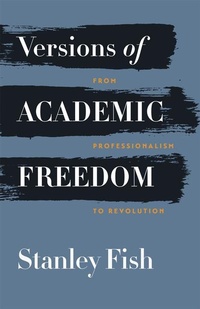
Versions of Academic Freedom
From Professionalism to Revolution
Will be published approx. on 23. October 2014
Book
Hardback
192 pages
978-0-226-06431-4 (ISBN)
Description
Through his columns in the New York Times and his numerous best-selling books, Stanley Fish has established himself as our foremost public analyst of the fraught intersection of academia and politics. Here Fish for the first time turns his full attention to one of the core concepts of the contemporary academy: academic freedom. Depending on who's talking, academic freedom is an essential bulwark of democracy, an absurd fig leaf disguising liberal agendas, or, most often, some in-between muddle that both exaggerates its own importance and misunderstands its actual value to scholarship. Fish enters the fray with his typical clear-eyed, no-nonsense analysis. The crucial question, he says, is located in the phrase "academic freedom" itself: Do you emphasize "academic" or "freedom"? The former, he shows, suggests a limited, professional freedom, while the conception of freedom implied by the latter could expand almost infinitely. Guided by that distinction, Fish analyzes various arguments for the value of academic freedom: Is academic freedom a contribution to society's common good? Does it authorize professors to critique the status quo, both inside and outside the university?
Does it license and even require the overturning of all received ideas and policies? Is it an engine of revolution? Are academics inherently different from other professionals? Or is academia just a job, and academic freedom merely a tool for doing that job? No reader of Fish will be surprised by the deftness with which he dismantles weak arguments, corrects misconceptions, and clarifies muddy arguments. And while his conclusion - that academic freedom is simply a tool, an essential one, for doing a job - may surprise, it is unquestionably bracing. Stripping away the mystifications that obscure academic freedom allows its beneficiaries to concentrate on what they should be doing: following their intellectual interests and furthering scholarship.
Does it license and even require the overturning of all received ideas and policies? Is it an engine of revolution? Are academics inherently different from other professionals? Or is academia just a job, and academic freedom merely a tool for doing that job? No reader of Fish will be surprised by the deftness with which he dismantles weak arguments, corrects misconceptions, and clarifies muddy arguments. And while his conclusion - that academic freedom is simply a tool, an essential one, for doing a job - may surprise, it is unquestionably bracing. Stripping away the mystifications that obscure academic freedom allows its beneficiaries to concentrate on what they should be doing: following their intellectual interests and furthering scholarship.
Reviews / Votes
"Fish's pieces on higher education and American culture circulate perhaps more than anyone else's in academe.... Nobody else has slid in and out of controversy and dispute so often, nor has anyone proven so willing and able to combat conservatives and (sometimes) liberals in academic forums and nationwide media alike. Think of major debates inliterary and cultural studies, and Fish is there." (Chronicle of Higher Educotion)"More details
Series
Language
English
Place of publication
Chicago
United States
Publishing group
The University of Chicago Press
Target group
College/higher education
Product notice
sewn/stitched
Cloth over boards
With dust jacket
Dimensions
Height: 223 mm
Width: 146 mm
Thickness: 27 mm
Weight
374 gr
ISBN-13
978-0-226-06431-4 (9780226064314)
Copyright in bibliographic data and cover images is held by Nielsen Book Services Limited or by the publishers or by their respective licensors: all rights reserved.
Schweitzer Classification
Other editions
Additional editions
E-Book
03/2020
University of Chicago Press
€18.18
Available for download
Person
Stanley Fish is the Davidson-Kahn Distinguished University Professor of Law and the Humanities in the College of Law at Florida International University and the author of numerous books.