

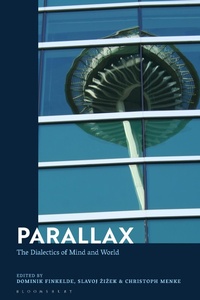
Parallax
The Dialectics of Mind and World
1st Edition
Published on 15. July 2021
272 pages
978-1-350-17204-3 (ISBN)
Description

Parallax, or the change in the position of an object viewed along two different lines of sight and more precisely, the assumption that this adjustment is not only due to a change of focus, but a change in that object's ontological status has been a key philosophical concept throughout history.
Building upon Slavoj Zizek's The Parallax View, this volume shows how parallax is used as a figure of thought that proves how the incompatibility between the physical and the theoretical touches not only upon the ontological, but also politics and aesthetics. With articles written by internationally renowned philosophers such as Frank Ruda, Graham Harman, Paul Livingston and Zizek himself, this book shows how modes of parallax remain in numerous modern theoretical disciplines, such as the Marxian parallax in the critique of political economy and politics; and the Hegelian parallax in the concept of the work of art, while also being important to debates surrounding speculative realism and dialectical materialism. Spanning philosophy, parallax is then a rich and fruitful concept that can illuminate the studies of those working in epistemology, ontology, German Idealism, political philosophy and critical theory.
Building upon Slavoj Zizek's The Parallax View, this volume shows how parallax is used as a figure of thought that proves how the incompatibility between the physical and the theoretical touches not only upon the ontological, but also politics and aesthetics. With articles written by internationally renowned philosophers such as Frank Ruda, Graham Harman, Paul Livingston and Zizek himself, this book shows how modes of parallax remain in numerous modern theoretical disciplines, such as the Marxian parallax in the critique of political economy and politics; and the Hegelian parallax in the concept of the work of art, while also being important to debates surrounding speculative realism and dialectical materialism. Spanning philosophy, parallax is then a rich and fruitful concept that can illuminate the studies of those working in epistemology, ontology, German Idealism, political philosophy and critical theory.
More details
Edition
1. Auflage
Language
English
Place of publication
London
United Kingdom
Publishing group
Bloomsbury Publishing PLC
Target group
Professional and scholarly
Illustrations
10 b/w illus
ISBN-13
978-1-350-17204-3 (9781350172043)
Copyright in bibliographic data and cover images is held by Nielsen Book Services Limited or by the publishers or by their respective licensors: all rights reserved.
Schweitzer Classification
Other editions
Additional editions
Book
02/2023
Bloomsbury Academic
€44.10
Shipment within 15-20 days
Book
08/2021
Bloomsbury Academic
€141.36
Shipment within 15-20 days
Persons
Dominik Finkelde is Professor of Epistemology and Contemporary Philosophy at the Munich School of Philosophy. He publishes on contemporary philosophy and German Idealism, especially on Hegel, Kant, Lacan, Frege, Wittgenstein, Benjamin, Zizek and Badiou.
Christoph Menke is Professor for Practical Philosophy at the Goethe University in Frankfurt am Main. His research focuses on political and legal philosophy, theories of subjectivity, ethics and aesthetics.
Slavoj Zizek is Professor at the Institute for Sociology and Philosophy at the University of Ljubljana, Slovenia and the International Director of the Birkbeck Institute for the Humanities, University of London, UK. His recent publications include Hegel in a Wired Brain (2020), Sex and the Failed Absolute (2019), Disparities (2016), and Antigone (2016), all published by Bloomsbury.
Christoph Menke is Professor for Practical Philosophy at the Goethe University in Frankfurt am Main. His research focuses on political and legal philosophy, theories of subjectivity, ethics and aesthetics.
Slavoj Zizek is Professor at the Institute for Sociology and Philosophy at the University of Ljubljana, Slovenia and the International Director of the Birkbeck Institute for the Humanities, University of London, UK. His recent publications include Hegel in a Wired Brain (2020), Sex and the Failed Absolute (2019), Disparities (2016), and Antigone (2016), all published by Bloomsbury.
Content
Preface: Hegel and the Ethical Parallax, Slavoj Zizek
Introduction
Part 1: Parallax in Ontology
1. Parallactic Entanglement: On the Subject-Object-Relation in New Materialism and Adorno's Critical Ontology, Dirk Quadflieg (University of Leipzig, Germany)
2. Zizek's Parallax, or The Inherent Stupidity of All Philosophical Positions, Graham Harman (SCI-Arc, Los Angeles, USA)
3. How Mind fits into Nature. Mental Realism after Nagel, Markus Gabriel (University of Bonn, Germany)
4. Parallax in Hermeneutic Realism, Anton Friedrich Koch (University of Heidelberg, Germany)
5. Object-Disoriented Ontology. Realism in Psychoanalysis,Alenka Zupancic (Slovenian Academy of Sciences and Arts, Slovenia)
6. Temporal Paradox, Realism, and Subjectivity, Paul Livingston (Albuquerque University, USA)
7. The Parallactic Leap: Fichte, Apperception, and the Hard Problem of Consciousness, G. Anthony Bruno (Royal Holloway, University of London, UK)
8. The Parallax of Ontology: Reality and its Transcendental Supplement, Slavoj Zizek (Birkbeck, University of London, UK)
Part 2: Parallax in Normative Orders
9. Truth as Subjective Effect. Adorno or Hegel, Christoph Menke (Goethe University Frankfurt am Main, Germany)
10. Is Sex a Transcendental Category of Parallax? Revisiting the Feminist Second Wave, Nina Power (Roehampton University, UK)
11. The Irony of Self-Consciousness: Hegel, Derrida, and the Animal that therefore I am, Thomas Khurana (Yale University, USA)
12. A Squinting Gaze on the Parallax Between Spirit and Nature, Frank Ruda (University of Dundee, UK)
13. "I am nothing, but I make everything": Marx, Lacan, and the Labor Theory of Suture, Adrian Johnston (University of New Mexico at Albuquerque)
Part 3: Parallax in Aesthetics
14. Drama as Philosophy. The Tragedy of the End of Art, Todd McGowan (University of Vermont, USA)
15. Parallaxes of Sinister Enjoyment: The Lessons of Interpassivity and the Contemporary Troubles with Pleasure, Robert Pfaller (University of the Arts, Linz, Austria)
16. Whiteheadian Aesthetics: On "Nautical Positionality" from a Process-Ontological Perspective, Eva Schürmann(University of Magdeburg, Germany)
17. Feeling at a Distance, or the Aesthetics of Unconscious Transmission, Tracy McNulty (Cornell University, USA)
18. The Dream That Knew Too Much. On Freud, Lacan, and Philip K. Dick, Dominik Finkelde (Munich School of Philosophy, Germany)
Notes on the contributors
Index of names
Index of subjects
Introduction
Part 1: Parallax in Ontology
1. Parallactic Entanglement: On the Subject-Object-Relation in New Materialism and Adorno's Critical Ontology, Dirk Quadflieg (University of Leipzig, Germany)
2. Zizek's Parallax, or The Inherent Stupidity of All Philosophical Positions, Graham Harman (SCI-Arc, Los Angeles, USA)
3. How Mind fits into Nature. Mental Realism after Nagel, Markus Gabriel (University of Bonn, Germany)
4. Parallax in Hermeneutic Realism, Anton Friedrich Koch (University of Heidelberg, Germany)
5. Object-Disoriented Ontology. Realism in Psychoanalysis,Alenka Zupancic (Slovenian Academy of Sciences and Arts, Slovenia)
6. Temporal Paradox, Realism, and Subjectivity, Paul Livingston (Albuquerque University, USA)
7. The Parallactic Leap: Fichte, Apperception, and the Hard Problem of Consciousness, G. Anthony Bruno (Royal Holloway, University of London, UK)
8. The Parallax of Ontology: Reality and its Transcendental Supplement, Slavoj Zizek (Birkbeck, University of London, UK)
Part 2: Parallax in Normative Orders
9. Truth as Subjective Effect. Adorno or Hegel, Christoph Menke (Goethe University Frankfurt am Main, Germany)
10. Is Sex a Transcendental Category of Parallax? Revisiting the Feminist Second Wave, Nina Power (Roehampton University, UK)
11. The Irony of Self-Consciousness: Hegel, Derrida, and the Animal that therefore I am, Thomas Khurana (Yale University, USA)
12. A Squinting Gaze on the Parallax Between Spirit and Nature, Frank Ruda (University of Dundee, UK)
13. "I am nothing, but I make everything": Marx, Lacan, and the Labor Theory of Suture, Adrian Johnston (University of New Mexico at Albuquerque)
Part 3: Parallax in Aesthetics
14. Drama as Philosophy. The Tragedy of the End of Art, Todd McGowan (University of Vermont, USA)
15. Parallaxes of Sinister Enjoyment: The Lessons of Interpassivity and the Contemporary Troubles with Pleasure, Robert Pfaller (University of the Arts, Linz, Austria)
16. Whiteheadian Aesthetics: On "Nautical Positionality" from a Process-Ontological Perspective, Eva Schürmann(University of Magdeburg, Germany)
17. Feeling at a Distance, or the Aesthetics of Unconscious Transmission, Tracy McNulty (Cornell University, USA)
18. The Dream That Knew Too Much. On Freud, Lacan, and Philip K. Dick, Dominik Finkelde (Munich School of Philosophy, Germany)
Notes on the contributors
Index of names
Index of subjects
