

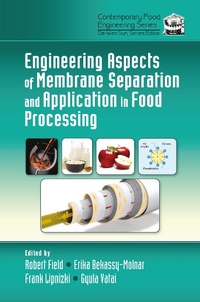
Engineering Aspects of Membrane Separation and Application in Food Processing
1st Edition
Published on 26. June 2017
390 pages
978-1-315-35721-8 (ISBN)
Description

Engineering Aspects of Membrane Separation and Application in Food Processing presents an overview and introduction to a wide range of membrane processes, their unique characteristics and challenges. In the food industry, as in many industries, membranes have an environmental advantage over conventional processes that they displace, because they are less energy intensive. The processing at near-ambient conditions also retains flavors and nutritional value. These advantages, together with significant reductions in the cost of membrane modules, augers well for their future not only in the dairy industry but in other parts of the food industry, such as alcohol processing, animal product processing, and fruit and vegetable processing.
Chapters address a wide range of membranes separations in the food and beverage industries, and applications are provided that will be of value not only to food engineers but also to process engineers working in other areas. The processing of food is now a highly interdisciplinary science, and anyone concerned with food processing will benefit from reading this book and understanding what membrane processes of the twenty-first century have to offer.
Chapters address a wide range of membranes separations in the food and beverage industries, and applications are provided that will be of value not only to food engineers but also to process engineers working in other areas. The processing of food is now a highly interdisciplinary science, and anyone concerned with food processing will benefit from reading this book and understanding what membrane processes of the twenty-first century have to offer.
More details
Series
Edition
1. Auflage
Language
English
Place of publication
London
United Kingdom
Publishing group
Taylor & Francis Ltd
Target group
Professional and scholarly
Product notice
Reflowable
Illustrations
52 Tables, black and white; 121 Illustrations, black and white
ISBN-13
978-1-315-35721-8 (9781315357218)
Copyright in bibliographic data and cover images is held by Nielsen Book Services Limited or by the publishers or by their respective licensors: all rights reserved.
Schweitzer Classification
Other editions
Additional editions
Robert W. Field | Erika Bekassy-Molnar | Frank Lipnizki
Engineering Aspects of Membrane Separation and Application in Food Processing
Book
06/2017
1st Edition
CRC Press
€293.50
Shipment within 15-20 days
Persons
Robert Field is an alumnus of the University of Cambridge where he earned MEng and PhD degrees in chemical engineering. He is currently a professor of engineering science at the University of Oxford and Fellow of Balliol College, Oxford. His work in membrane science and technology has examined the physical phenomena governing the performance, particularly limitations to performance, of both pressure-driven and activity-driven membrane processes. The greatest industrial impact of this research continues to be in the evolution of strategies for fouling mitigation in mem-brane processes. He has made a world-leading contribution to the development of critical flux theory for porous membrane processes, which has led to a revolution in membrane operation because designers of these processes no longer seek high fluxes by way of large driving pressures and high cross-flow velocity but tend to select modest fluxes to reduce the energy usage and cleaning costs. The change of mind-set can truly be described as a paradigm shift. There has also been significant work in pervaporation and membrane distillation. He has served as vice president of the European Membrane Society, and to date has written more than 100 papers and edited or coauthored five books on the different aspects of membrane science and technology. He also worked for a number of years in the membrane group at Bath University and has been on sabbatical leave to MIT on three occasions.
Erika Bekassy-Molnar graduated from the Technical University of Budapest (TUB), Hungary in 1962 as a mechanical engineer with specialization in chemical industry. She then worked at the TUB, Faculty of Chemical Engineering as assis-tant, associate, and full professor. Her academic qualifications include Doctor of the TUB (1969), Specialist of Cybernetics (1970), Candidate of Chemical Sciences of the Hungarian Academy of Sciences (HAS) (1989), PhD from TUB (1994), Dr Habil from TUB (1994), and Doctor of the HAS (2004).In 1995, she became the head of the Department of Food Engineering at Szent Istvan University, Budapest and where she worked in the field of membrane science and application. The main focus of her research is wine, fruit juice, and drinking water production using different mild and cheaper membrane methods. Her research has been published in 83 English and 33 Hungarian scientific papers and books, 89 international congress full papers, and 242 proceedings. In 2001, she was awarded by the Ministry of Agriculture for the industrial applications of her patents. In 2009, she received the Gold Merit Cross of the Hungarian Republic. Currently, she works as a professor emerita at Szent Istvan University, Budapest.
Frank Lipnizki earned his BEng (Hons) in manufacturing and management from the University of Bath, United Kingdom in 1995; diploma in mechanical engineer-ing from the University of Bochum, Germany in 1996; PhD in chemical engineer-ing from the University of Bath, United Kingdom in 1999; and post-doc in food engineering from Lund University, Sweden in 2000. He is a business/product and associated R&D manager at Alfa Laval-Business Centre Membranes, Denmark since 2001, and an adjunct professor of chemical engineering at Lund University, Sweden since January 1, 2014.His main research interests are the integration and optimization of membrane process for the food, biotech, and process industry. He has authored more than 30 publications in reviewed journals and books and more than 90 contributions in international conferences and workshops on membrane technology.
Gyula Vatai qualified as a chemical engineer, with specialization in process engineering, from the Faculty of Technology, University of Novi Sad, Novi Sad, Yugoslavia in 1975. He earned his PhD in technical sciences from the Faculty of Technology, University of Novi Sad, Novi Sad, Yugoslavia in 1986; candidate of Chemical Sciences from the Hungarian Academy of Sciences in 1995; Dr Habil from the University of Horticulture and Food Industry, Budapest in 1999; and Academy Doctor of Agricultural Sciences degree from the Hungarian Academy of Sciences in 2010. He is a university professor since 2000 and the head of the Department of Food Engineering, Faculty of Food Science, Szent Istvan University, Budapest, Hungary. He is one of the founders of the educational structure of the process engineering branch. He is also the head of the Food Science Doctoral School, teaching and supervising PhD students.He has made significant achievements in the elaboration of hydrodynamics and mass transfer in bioreactors, liquid-liquid extraction, and membrane separation processes. His research is focused on the application of membrane technology in drinking water treatment, edible oil filtration, fruit juice concentration with complex membrane processes, and waste water separation as well as modeling of mass trans-fer in membrane separation processes. He has authored more than 200 scientific papers, of which 130 papers are in English with more than 1000 citations. He is the author of eight chapters in technical books (membrane applications) in English. He is a member of several national and international research organizations.
Erika Bekassy-Molnar graduated from the Technical University of Budapest (TUB), Hungary in 1962 as a mechanical engineer with specialization in chemical industry. She then worked at the TUB, Faculty of Chemical Engineering as assis-tant, associate, and full professor. Her academic qualifications include Doctor of the TUB (1969), Specialist of Cybernetics (1970), Candidate of Chemical Sciences of the Hungarian Academy of Sciences (HAS) (1989), PhD from TUB (1994), Dr Habil from TUB (1994), and Doctor of the HAS (2004).In 1995, she became the head of the Department of Food Engineering at Szent Istvan University, Budapest and where she worked in the field of membrane science and application. The main focus of her research is wine, fruit juice, and drinking water production using different mild and cheaper membrane methods. Her research has been published in 83 English and 33 Hungarian scientific papers and books, 89 international congress full papers, and 242 proceedings. In 2001, she was awarded by the Ministry of Agriculture for the industrial applications of her patents. In 2009, she received the Gold Merit Cross of the Hungarian Republic. Currently, she works as a professor emerita at Szent Istvan University, Budapest.
Frank Lipnizki earned his BEng (Hons) in manufacturing and management from the University of Bath, United Kingdom in 1995; diploma in mechanical engineer-ing from the University of Bochum, Germany in 1996; PhD in chemical engineer-ing from the University of Bath, United Kingdom in 1999; and post-doc in food engineering from Lund University, Sweden in 2000. He is a business/product and associated R&D manager at Alfa Laval-Business Centre Membranes, Denmark since 2001, and an adjunct professor of chemical engineering at Lund University, Sweden since January 1, 2014.His main research interests are the integration and optimization of membrane process for the food, biotech, and process industry. He has authored more than 30 publications in reviewed journals and books and more than 90 contributions in international conferences and workshops on membrane technology.
Gyula Vatai qualified as a chemical engineer, with specialization in process engineering, from the Faculty of Technology, University of Novi Sad, Novi Sad, Yugoslavia in 1975. He earned his PhD in technical sciences from the Faculty of Technology, University of Novi Sad, Novi Sad, Yugoslavia in 1986; candidate of Chemical Sciences from the Hungarian Academy of Sciences in 1995; Dr Habil from the University of Horticulture and Food Industry, Budapest in 1999; and Academy Doctor of Agricultural Sciences degree from the Hungarian Academy of Sciences in 2010. He is a university professor since 2000 and the head of the Department of Food Engineering, Faculty of Food Science, Szent Istvan University, Budapest, Hungary. He is one of the founders of the educational structure of the process engineering branch. He is also the head of the Food Science Doctoral School, teaching and supervising PhD students.He has made significant achievements in the elaboration of hydrodynamics and mass transfer in bioreactors, liquid-liquid extraction, and membrane separation processes. His research is focused on the application of membrane technology in drinking water treatment, edible oil filtration, fruit juice concentration with complex membrane processes, and waste water separation as well as modeling of mass trans-fer in membrane separation processes. He has authored more than 200 scientific papers, of which 130 papers are in English with more than 1000 citations. He is the author of eight chapters in technical books (membrane applications) in English. He is a member of several national and international research organizations.
Content
Basic Principles of Membrane Separation Processes. Applications of Membrane Separations in Food Processing. Design, Development and Optimization of Complex Separation Processes.
