
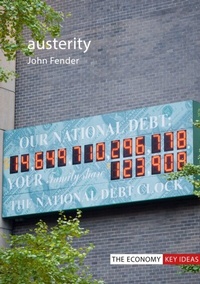
Austerity
Description
Alles über E-Books | Antworten auf Fragen rund um E-Books, Kopierschutz und Dateiformate finden Sie in unserem Info- & Hilfebereich.
Austerity has dominated economic debate since the financial crisis of 2008. Governments have implemented austerity policies by reducing their spending on goods and services, increasing taxation and cutting welfare budgets.
John Fender explains how austerity (or "fiscal consolidation") works in theory and how it has played out in practice especially in the UK and the eurozone. He provides a clear and rigorous guide to the principles and mechanisms of austerity economics and offers a balanced account of the economic thinking behind contentious policy decisions.
Boris Johnson has said that the UK government "has absolutely no intention of returning to the 'A-word'", but with the Covid-19 crisis likely to result in much more government debt, it will be difficult to avoid more austerity. Understanding the impact of austerity policies is more important than ever and this book offers a first step on that path. For anyone seeking answers to such questions as: "What can we learn from the UK's economic history that is relevant to current policy?", "Is austerity ever necessary or desirable?" and "Can the harmful effects of austerity programmes be mitigated?" then this book will be welcome reading.
All prices
More details
Other editions
Additional editions

Person
John Fender is Professor of Macroeconomics and leader of the Macroeconomics and Finance Research Group at the University of Birmingham. His books include Understanding Keynes, Inflation: A Contemporary Perspective and Monetary Policy.
Content
1. Introduction
2. The economics of austerity I
3. The economics of austerity II
4. The term structure of interest rates
5. A simple model
6. Austerity in the United Kingdom
7. Austerity in the eurozone
8. Austerity in the rest of the world
9. The optimal time path of government debt (or how should fiscal policy be conducted?)
10. Policy in a world where severe deflationary shocks are possible
11. Conclusion: when are austerity measures necessary or desirable?

System requirements
File format: ePUB
Copy protection: Adobe-DRM (Digital Rights Management)
System requirements:
- Computer (Windows; MacOS X; Linux): Install the free reader Adobe Digital Editions prior to download (see eBook Help).
- Tablet/smartphone (Android; iOS): Install the free app Adobe Digital Editions or the app PocketBook before downloading (see eBook Help).
- E-reader: Bookeen, Kobo, Pocketbook, Sony, Tolino and many more (not Kindle).
The file format ePub works well for novels and non-fiction books – i.e., „flowing” text without complex layout. On an e-reader or smartphone, line and page breaks automatically adjust to fit the small displays.
This eBook uses Adobe-DRM, a „hard” copy protection. If the necessary requirements are not met, unfortunately you will not be able to open the eBook. You will therefore need to prepare your reading hardware before downloading.
Please note: We strongly recommend that you authorise using your personal Adobe ID after installation of any reading software.
For more information, see our ebook Help page.
File format: ePUB
Copy protection: Watermark-DRM (Digital Rights Management)
System requirements:
- Computer (Windows; MacOS X; Linux): Use a reading software that can process the file format ePUB: e.g., Adobe Digital Editions or FBReader – both free (see eBook Help).
- Tablet/Smartphone (Android; iOS): Before downloading, install the free app Adobe Digital Editions (see eBook Help).
- E-reader: Bookeen, Kobo, Pocketbook, Sony, Tolino and many more (not Kindle).
The file format ePUB works well for novels and non-fiction books – i.e., „flowing” text without complex layout. On an e-reader or smartphone, line and page breaks automatically adjust to fit the small displays.
This eBook uses Watermark-DRM, a „soft” copy protection. This means that there are no technical restrictions to prevent illegal distribution. However, there is a personalised watermark embedded in the eBook that can be used to identify the purchaser of the eBook in the event of misuse and to provide evidence for legal purposes.
For more information, see our eBook Help page.