

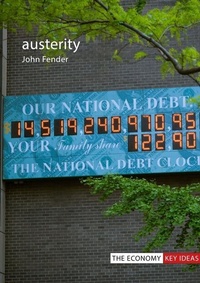
Austerity
When is it a mistake and when is it necessary?
Published on 10. September 2020
Book
Paperback/Softback
144 pages
978-1-911116-93-6 (ISBN)
Description
Austerity has dominated economic debate since the financial crisis of 2008. Governments have implemented austerity policies by reducing their spending on goods and services, increasing taxation and cutting welfare budgets.
John Fender explains how austerity (or "fiscal consolidation") works in theory and how it has played out in practice especially in the UK and the eurozone. He provides a clear and rigorous guide to the principles and mechanisms of austerity economics and offers a balanced account of the economic thinking behind contentious policy decisions.
Boris Johnson has said that the UK government "has absolutely no intention of returning to the 'A-word'", but with the Covid-19 crisis likely to result in much more government debt, it will be difficult to avoid more austerity. Understanding the impact of austerity policies is more important than ever and this book offers a first step on that path. For anyone seeking answers to such questions as: "What can we learn from the UK's economic history that is relevant to current policy?", "Is austerity ever necessary or desirable?" and "Can the harmful effects of austerity programmes be mitigated?" then this book will be welcome reading.
John Fender explains how austerity (or "fiscal consolidation") works in theory and how it has played out in practice especially in the UK and the eurozone. He provides a clear and rigorous guide to the principles and mechanisms of austerity economics and offers a balanced account of the economic thinking behind contentious policy decisions.
Boris Johnson has said that the UK government "has absolutely no intention of returning to the 'A-word'", but with the Covid-19 crisis likely to result in much more government debt, it will be difficult to avoid more austerity. Understanding the impact of austerity policies is more important than ever and this book offers a first step on that path. For anyone seeking answers to such questions as: "What can we learn from the UK's economic history that is relevant to current policy?", "Is austerity ever necessary or desirable?" and "Can the harmful effects of austerity programmes be mitigated?" then this book will be welcome reading.
Reviews / Votes
This book is extremely timely. Moreover, its balanced and clear-headed approach is a valuable antidote to the kind of emotive discussion that has dominated the debate over the past ten years. -- Tim Besley, London School of Economics A concise, thoughtful, and temperate guide ... I warmly recommend it. -- Society of Professional EconomistsMore details
Series
Language
English
Place of publication
Newcastle upon Tyne
United Kingdom
Target group
College/higher education
Professional and scholarly
Product notice
Paperback (trade)
Dimensions
Height: 216 mm
Width: 138 mm
Thickness: 10 mm
Weight
207 gr
ISBN-13
978-1-911116-93-6 (9781911116936)
Copyright in bibliographic data and cover images is held by Nielsen Book Services Limited or by the publishers or by their respective licensors: all rights reserved.
Schweitzer Classification
Other editions
Additional editions

E-Book
09/2020
1st Edition
Agenda Publishing
from
€57.99
Available for download

E-Book
09/2020
1st Edition
Agenda Publishing
from
€57.99
Available for download
Person
John Fender is Professor of Macroeconomics and leader of the Macroeconomics and Finance Research Group at the University of Birmingham. His books include Understanding Keynes, Inflation: A Contemporary Perspective and Monetary Policy.
Content
1. Introduction
2. The economics of austerity I
3. The economics of austerity II
4. The term structure of interest rates
5. A simple model
6. Austerity in the United Kingdom
7. Austerity in the eurozone
8. Austerity in the rest of the world
9. The optimal time path of government debt (or how should fiscal policy be conducted?)
10. Policy in a world where severe deflationary shocks are possible
11. Conclusion: when are austerity measures necessary or desirable?
2. The economics of austerity I
3. The economics of austerity II
4. The term structure of interest rates
5. A simple model
6. Austerity in the United Kingdom
7. Austerity in the eurozone
8. Austerity in the rest of the world
9. The optimal time path of government debt (or how should fiscal policy be conducted?)
10. Policy in a world where severe deflationary shocks are possible
11. Conclusion: when are austerity measures necessary or desirable?