

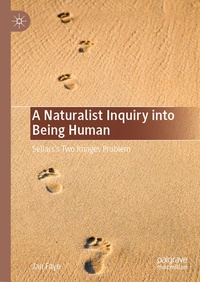
A Naturalist Inquiry into Being Human
Description

This book provides a naturalistic account of the problems that led Wilfrid Sellars to formulate two rival images of humans and their place in the world. According to Sellars, the scientific image separated from the manifest image during the Renaissance because philosophers and scientists agreed that mind and matter were independent of each other, and because they found that a mathematical description of matter is possible if matter is characterized by what can be measured and weighed.
Sellars argued that these two alternative images cannot be reduced to each other and indeed seemed to think that they stand as opposites to one another. This book, on the other hand, tries to show that both the manifest image and the scientific image are incomplete in different ways. The manifest picture of humanity is incomplete in the sense that new scientific discoveries about humanity are constantly being added to the picture and become part of everyday knowledge, whereas the scientific picture is incomplete so long as it either ignores or is unable to explain the nature of human experiences on which the manifest picture is based.
The book is essential reading for all philosophers of science. It is also ideal for philosophers working on ontology and metaphysics.
More details
Other editions
Additional editions
Person
Jan Faye is Emeritus Professor of theoretical philosophy at the University of Copenhagen. He has published multiple books and articles. With Palgrave Macmillan he has published After Postmodernism (2012); The Nature of Scientific Thinking (2014); Experience and Beyond (2016); How Matter Becomes Conscious (2019), and The Biological and Social Dimensions of Human Knowledg e (2023).
Content
Chapter 1: The Perennial Question.- Chapter 2: The Two Images Problem.- Chapter 3: Common Sense and Ordinary Knowledge.- Chapter 4: The Language of Science.- Chapter 5: Is the Classical World an Illusion?.- Chapter 6: Time, Change, and Becoming.- Chapter 7: Endogenous and Exogenous Explanations.- Chapter 8: Grasping the Mind by Itself.- Chapter 9: Free Will: A Natural or Social Phenomenon?.- Chapter 10: What Is It to Be a Human?.
