

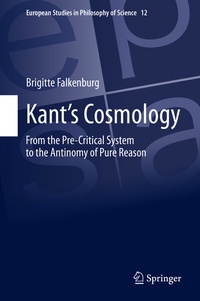
Kant's Cosmology
Description

This book provides a comprehensive account of Kant's development from the 1755/56 metaphysics to the cosmological antinomy of 1781. With the Theory of the Heavens (1755) and the Physical Monadology (1756), the young Kant had presented an ambitious approach to physical cosmology based on an atomistic theory of matter, which contributed to the foundations of an all-encompassing system of metaphysics. Why did he abandon this system in favor of his critical view that cosmology runs into an antinomy, according to the Critique of Pure Reason (CPR) ? This book answers this question by focusing on Kant's methodology and the internal problems of his 1755/56 theory of nature. A decisive role for Kant's critical turn plays the argument from incongruent counterparts (1768), which drew much attention among philosophers of science, though not sufficiently in Kant research. Furthermore, the book analyses the genesis of the cosmological antinomy in the 1770s, the logical structure of the antinomy in the CPR , its relation to transcendental idealism, as explained in the "experiment of pure reason" (1787), and its role for the teleology of human reason. The book is addressed to Kant scholars, philosophers of science, and students of Kant's philosophy.
Reviews / Votes
"This new work from Brigitte Falkenburg is a revised and thoroughly updated edition of her earlier Kants Kosmologie . . It is structured chronologically and combines the narrative approach typical of intellectual biography with more detailed discussions of specific moments and themes in Kant's intellectual development." (Courtney D. Fugate, Journal for General Philosophy of Science, Vol. 53, 2022)More details
Other editions
Additional editions
Person
Brigitte Falkenburg is Professor for Philosophy (retired) at the Department of Philosophy and Political Science at the Technische Universität Dortmund. She holds a diploma in physics, a PhD in Philosophy and a 2nd PhD in Physics. Her areas of specialization are: philosophy of science (philosophy of physics, philosophy of neuroscience), history of philosophy (Kant, Hegel, Neo-Kantianism), philosophy of technology. Selected publications: Mythos Determinismus (Heidelberg: Springer 2012); Particle Metaphysics (Berlin/Heidelberg: Springer 2007); Kants Kosmologie (Frankfurt am Main: Klostermann 2000); Wem dient die Technik? Johann Joachim Becher-Preis 2002. Ed. by the J.J.Becher-Stiftung (Baden-Baden: Nomos 2004). As editor: Mechanistic Explanations in Physics and Beyond (with G. Schiemann, Springer Nature AG Switzerland 2019); Why More is Different (with M. Morrison, Berlin/Heidelberg: Springer 2015); From Ultrarays to Astroparticles (with W. Rhode) (Dordrecht: Springer 2012); Natur - Technik - Kultur (Paderborn: Mentis 2007); Erhard Scheibe: Between Rationalism and Empiricism. Selected Papers in the Philosophy of Physics (New York: Springer 2001).
