

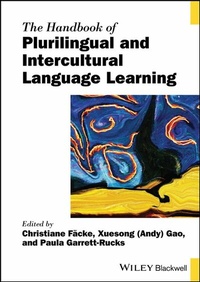
The Handbook of Plurilingual and Intercultural Language Learning
Description

The most up-to-date reference text on the latest science in plurilingual and intercultural language education, covering both new research and current practice
The Handbook of Plurilingual and Intercultural Language Learning reveals the nuances and complexities of teaching and learning languages while providing a timely account of the most recent developments and research in the field. The first reference work to examine plurilingual and intercultural language teaching and learning trends across five continents, this innovative volume examines the various ways learners acquire language.
Divided into four sections, this Handbook explains the conceptual basis of intercultural and plurilingual learning, describes core pedagogical concepts in different contexts, discusses various learning and teaching approaches, and surveys the historical development of foreign language instruction, methods, and theories. In-depth chapters address code-switching and translanguaging, equity in foreign language learning, intercultural sensitivity, technology-enhanced learning, world Englishes, the role of language policy in nation-building, the situations of migrants in language classrooms, and more.
A field-defining overview of the latest research on the science of language education and acquisition, The Handbook of Plurilingual and Intercultural Language Learning:
- Explores how policy and pedagogy can adapt to the shifting demographics of local student populations as the world becomes increasingly mobile
- Addresses new trends and evolving themes that are currently determining the future of language education and policy around the world
- Discusses future trends in language education policy, assessment, and teacher training in light of new attitudes about language, community, and statehood
- Features contributions from a wide range of scholars reflecting different cultural, linguistic, regional, and ideological perspectives
- Introduces European research discourses on intercomprehension into the English-speaking world
Part of the Wiley Blackwell Handbooks in Linguistics series, The Handbook of Plurilingual and Intercultural Language Learning is an essential resource for students, educators, and researchers in Applied Linguistics, language teaching and learning, English as a Lingua Franca, plurilingualism/multilingualism, TESOL, cognitive linguistics, language policy, language acquisition, and intercultural communication.
More details
Other editions
Additional editions

Persons
Christiane Fäcke is Professor and Chair of Didactics of Romance Languages and Literatures at the University of Augsburg, Germany. Her research examines intercultural learning, plurilingual education, assessment and evaluation, and didactics of literature. She edited the Handbook of Didactics of Plurilingualism and Pluriculturalism and authored the Manual of Language Acquisition.
Andy Gao is Professor of Language and Literacy Education at the University of New South Wales, Australia. He is an expert in language teaching, language education policy, and language strategy. He has published articles in journals such as Language, Culture and Curriculum and Language Policy. He is Associate Editor of the Encyclopedia of Applied Linguistics.
Paula Garrett-Rucks is Associate Professor of Second Language Acquisition at Georgia State University, USA. Her work focuses on social justice in language learning, computer-assisted language learning, and learners' cultural perceptions and stereotypes. She is the author of Intercultural Competence in Instructed Language Learning: Bridging Theory and Practice.
Content
Notes on Contributors Introduction: Key Perspectives on Intercultural and Plurilingual Discourses 1 Christiane Fäcke, Paula Garrett-Rucks, and Xuesong (Andy) Gao
Section 1 Fundamentals of Intercultural and Plurilingual Learning 13
Section 1a Culture 15
1 Identity, Diversity, Equity, and Inclusion 17 Michele Back
2 From Multiculturalism to Social Justice: Implications for Language Education in the United States and Canada 29 Ryuko Kubota
3 Intercultural Competence 43 Lamia Nemouchi and Michael Byram
4 Critical Interculturality in Language Learning: Plurilingualism for Problematizing and Enriching the Notion 59 Fred Dervin
Section 1b Language 71
5 Language, Languages, Plurilingual Education 73 Claudia Polzin-Haumann
6 Endangered Languages and Language Revitalization 83 Anna Fenyvesi and Marianne Bakró-Nagy
7 Conceptualizing and Positioning Lingua Francas: English and Other Languages 97 Piotr Romanowski and Ioannis Karras
8 Language Comparison in Plurilingual Learning and Processing 111 Johannes Müller-Lancé
9 Rethinking Code- Switching and Translanguaging as Language Management Strategies in the Dynamic Model of Multilingualism 123 Ulrike Jessner, Elisabeth Allgäuer-Hackl, and Susan Coetzee-Van Rooy
10 Multimodality and Trans-Semiotics 139 Mastin Prinsloo
Section 1c Language Policies 153
11 Languages and Nation Building 155 David Martínez-Prieto
12 Language Policy and Planning: A Focus on ASEAN and EU Contexts 167 Huan Yik Lee
13 Critical Approaches to World Englishes 181 Peter I. De Costa, Curtis Green-Eneix, Praew Bupphachuen, Madelynne Gregory, and Gerardo Melgar
14 Issues of Equity and Access in Foreign Language Education 191 Kelly Frances Davidson
15 Plurilingual Language Policies and Teaching Approaches in Higher Education 203 Jasone Cenoz and Durk Gorter
Section 2 Pedagogical Concepts 215
Section 2a Pedagogical Concepts of Intercultural Learning 217
16 Intercultural Discourses between Universalism and Particularism 219 Christiane Fäcke
17 Transculturality (Revisited) 233 Werner Delanoy
18 Assessing Intercultural Competence 247 Paula Garrett-Rucks
19 Intercultural Education through Literature 261 Ana Gonçalves Matos
20 Intercultural Learning in Preschool and Primary School Contexts 275 Yuko Goto Butler and Shiyu Jiang
21 Intercultural Learning in Secondary School Contexts and in Adult Education 289 Manuela Wagner and Dominique Galvez
22 Linguistic and Cultural Mediation 303 Anthony J. Liddicoat and Martine Derivry- Plard
Section 2b Pedagogical Concepts of Plurilingual Learning 317
23 Didactics of Plurilingualism- A European View 319 Michel Candelier and Jean-François de Pietro
24 Plurilingual and Pluricultural Competence: Origins, Current Trends, and Future Directions 333 Angelica Galante
25 Plurilingual Assessment 349 Elisabetta Bonvino and Diego Cortés Velásquez
26 Many Languages- One Curriculum 365 Britta Hufeisen and Nicole Marx
27 Using Telecollaboration to Prepare Teacher Candidates for Plurilingual Students 379 Babürhan Üzüm, Sedat Akayoglu, John Turnbull, and Bedrettin Yazan
Section 3 Learning and Teaching Approaches 399
28 Teaching Intercomprehension and Foreign Language Learning Competence 401 Jochen Strathmann
29 Teaching and Learning Materials to Foster Plurilingualism 415 Michaela Rückl
30 Intercultural and Plurilingual Aspects in Language Teacher Education 431 Xuesong (Andy) Gao and Shiyao Wang
31 Teaching Plurilingualism 445 Christian Ollivier
32 Teaching Intercultural Sensitivity and Competence 459 Mehry Haddad Narafshan
33 Plurilingual Learning Competence 473 Hélène Martinez
34 Doing Language and Gender in the Classroom: Teaching toward Justice 483 Kris Aric Knisely
Section 4 Diachronic Aspects 495
35 Methods and Motivations in Foreign Language Teaching from Antiquity to the Present 497 Simon Coffey
36 From Native Speaker to Intercultural Plurilingual Speaker: About the Eventful History of Guiding Concepts in Applied Linguistics and Foreign Language Pedagogy 511 Adelheid Hu
37 Critical Applied Language/Linguistics Imaginings and Academic Legacies for a Better World 525 Gertrude Tinker Sachs
Index 539
Notes on Contributors
Sedat Akayoglu is an Associate Professor at the Department of Foreign Language Education, Bolu Abant Izzet Baysal University in Turkiye, Turkey. His research interests include teacher education, computer assisted language learning, computer-mediated communication, telecollaboration, and intercultural education.
Elisabeth Allgäuer-Hackl worked as a teacher (Spanish, English, German as a second language, French, multilingualism) in schools and taught adult education in Latin America and in Vorarlberg (Austria). Additionally, she was a freelance writer in the programme "mehrSprache" set up by okay.zusammen leben (Vorarlberg). She has developed multilingual teaching and learning concepts. Her current focus is on in-service teacher training and school development in connection with multilingual education and whole school curricula. As a member of the DyME research team at Innsbruck University, her main research interests are multilingual/metalinguistic awareness, language management and language maintenance strategies in educational contexts, (early) multilingual development, and inclusive (multilingual) teaching methodology.
Michele Back is an Associate Professor, World Languages Education, at the University of Connecticut, USA, where she conducts research in language teacher development; study abroad; the intersections of race and discourse; the role of discourse in constructing identities; and how translanguaging and multilingual ecology can transform schools and other communities of practice. She has published articles in the Modern Language Journal, Foreign Language Annals, TESOL Quarterly, and Teaching and Teacher Education, and the monograph Transcultural Performance: Negotiating Globalized Indigenous Identities (Palgrave, 2015). She has also coedited Racialization and Language: Interdisciplinary Perspectives from Perú (Routledge, 2018) and Racismo y lenguaje (PUCP, 2017) with Dr. Virginia Zavala.
Marianne Bakró-Nagy is a Professor Emerita at the Hungarian Research Centre for Linguistics, Budapest, and the University of Szeged, Hungary. Her research focuses on historical changes of highly endangered languages in Western Siberia on the verge of extinction; many varieties are extinct already. Identifying these changes allows the study and description of the impact of language contact on diachronic processes that influence considerably language use and grammatical structure. She was a member of the "Ob-Ugric languages: Conceptual structures, lexicon, constructions, categories" ESF EuroBabel project and is co-editor of The Oxford Guide to the Uralic Languages (2022). Bakró-Nagy is a member of Academia Europaea.
Elisabetta Bonvino is a Full Professor in Second Language Education at the University of Roma Tre, Italy. She holds a Ph.D. in Linguistics from École Pratique des Hautes Études (Paris). Currently, Elisabetta Bonvino is the scientific coordinator of the Italian L2 Certification (Certit) at Roma Tre. She has actively participated in transnational projects on plurilingualism, such as REDINTER, EVAL-IC (ÉVALuation des compétences en InterCompréhension) and is currently involved in the PEP Project (Promouvoir L'éducation Plurilingue/Promoting Plurilingual Education). Her scientific focus includes plurilingualism and intercomprehension among Romance languages, the assessment of linguistic skills, and the analysis of spoken language by both native and non-native speakers.
Praew Bupphachuen is a Master's student in Teaching English to Speakers of Other Languages (MA TESOL) at Michigan State University, USA. Her main research interests center around project-based teaching, differentiated instruction, and language teacher identity.
Yuko Goto Butler is a Professor of Educational Linguistics at the Graduate School of Education at the University of Pennsylvania, USA. She also serves as the director of Teaching English to Speakers of Other Languages (TESOL) program at Penn. Her research focuses on the improvement of second and foreign language pedagogy and assessment among young learners in the U.S. and Asia in response to the diverse needs of increasing globalization and digitalization.
Michael Byram studied languages at King's College Cambridge, wrote a PhD in Danish literature, and then taught French and German in secondary and adult education. He then moved to Durham University from 1980 in the School of Education and is now a Professor Emeritus there and Guest Research Professor at Sofia University, Bulgaria. In the 2000s, he was Adviser to the Language Policy Division of the Council of Europe, and then involved in work on the Reference Framework of Competences for Democratic Culture and the accompanying Portfolio. He recently co-edited with Mike Fleming and Joe Sheils Quality and Equity in Education: A Practical Guide to the Council of Europe Vision of Education for Plurilingual, Intercultural and Democratic Citizenship, and with Maria Stoicheva, The Experience of Examining the PhD: An International Comparative Study of Processes and Standards of Doctoral Examination.
Michel Candelier is a Professor Emeritus at the University of Le Mans (France) and has devoted three decades of research to the didactics of plurilingualism and its implementation. He has coordinated several European projects funded by European institutions, notably the EVLANG project (Awakening to languages/Multilingual language awareness) and the CARAP/FREPA project (Framework of Reference for Pluralistic Approaches to Languages and Cultures). His recent publications deal with educating teachers for pluralistic approaches, integrated language teaching, and language-sensitive subject teaching. He is Honorary President of two international associations: EDiLiC-Éducation et diversité linguistique et culturelle and FIPLV-Fédération internationale des professeurs de langues vivantes.
Jasone Cenoz is a member of the Advisory Board for the Organization of Ibero-American States (Organización de Estados Iberoamericanos) and a former Professor of Education at the University of the Basque Country UPV/EHU, Spain. She has published extensively and has presented her work at conferences and seminars in many countries. Some of her recent publications in collaboration with Durk Gorter are The Minority Language as a Second Language (2024), A Panorama of Linguistic Landscape Studies (2023), and Pedagogical Translanguaging (2021).
Susan Coetzee-Van Rooy is a Research Professor in UPSET in the Faculty of Humanities at the North-West University in South Africa. UPSET is a research entity that focuses on the "Understanding and processing of language in complex settings." She studies the multilingual repertoires of people and is always busy with thought experiments to determine which research methods best answer which types of research questions. The research methods that she uses include language portraits, language repertoire surveys, language history interviews, social networks, and ethnographies of communication. She is a B2 rated researcher at the National Research Foundation in South Africa.
Simon Coffey is a Reader in Languages Education at King's College London, where he is Director of the Initial Teacher Education program and subject lead for languages. His research aims to expand common conceptions of "language" and "learning" by adopting a sociohistorical lens, focusing both on the affective-emotional dimension of language learning and the historiography of language learning and teaching, with special reference to the teaching of French in England.
Diego Cortés Velásquez is an Associate Professor of Second Language Education at Roma Tre University, Italy. He earned his Ph.D. in 2013 with a thesis on oral intercomprehension among Romance languages. His research interests include plurilingualism, task-based language teaching, cross-cultural pragmatics, and telecollaborative exchanges in language learning. He has actively participated in transnational projects on plurilingualism, such as REDINTER, EVAL-IC (ÉVALuation des compétences en InterCompréhension) and is currently involved in the PEP Project (Promouvoir L'éducation Plurilingue/Promoting Plurilingual Education). He serves as a member of the Italian L2 Certification (Certit) board and is Assistant Editor of the ISLA (Instructed Second Language Acquisition) journal.
Kelly Frances Davidson is an Associate Professor of French and Foreign Language Education and Coordinator of the Foreign Language Education Graduate Program at Valdosta State University in Valdosta, Georgia, in the United States. She teaches undergraduate and graduate courses in French and language education. Her research interests include early language learning and social justice and community engagement. She has served as the Chair of the Language Learning for Children and the Teaching and Learning of Culture ACTFL Special Interest Groups. She is the Editor for Learning Languages, the journal of the National Network for Early Language Learning, and is the co-editor of How We Take Action: Social Justice in PreK-16 Language Classrooms (2023).
Peter I. De Costa is a Professor in the Department of Linguistics, Languages & Cultures, and...
