

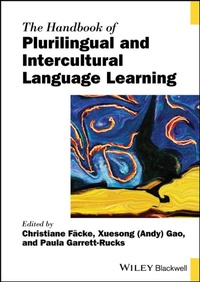
The Handbook of Plurilingual and Intercultural Language Learning
1st Edition
Published on 19. December 2024
Book
Hardback
576 pages
978-1-394-16591-9 (ISBN)
Description
The most up-to-date reference text on the latest science in plurilingual and intercultural language education, covering both new research and current practice
The Handbook of Plurilingual and Intercultural Language Learning reveals the nuances and complexities of teaching and learning languages while providing a timely account of the most recent developments and research in the field. The first reference work to examine plurilingual and intercultural language teaching and learning trends across five continents, this innovative volume examines the various ways learners acquire language.
Divided into four sections, this Handbook explains the conceptual basis of intercultural and plurilingual learning, describes core pedagogical concepts in different contexts, discusses various learning and teaching approaches, and surveys the historical development of foreign language instruction, methods, and theories. In-depth chapters address code-switching and translanguaging, equity in foreign language learning, intercultural sensitivity, technology-enhanced learning, world Englishes, the role of language policy in nation-building, the situations of migrants in language classrooms, and more.
A field-defining overview of the latest research on the science of language education and acquisition, The Handbook of Plurilingual and Intercultural Language Learning:
Explores how policy and pedagogy can adapt to the shifting demographics of local student populations as the world becomes increasingly mobile
Addresses new trends and evolving themes that are currently determining the future of language education and policy around the world
Discusses future trends in language education policy, assessment, and teacher training in light of new attitudes about language, community, and statehood
Features contributions from a wide range of scholars reflecting different cultural, linguistic, regional, and ideological perspectives
Introduces European research discourses on intercomprehension into the English-speaking world
Part of the Wiley Blackwell Handbooks in Linguistics series, The Handbook of Plurilingual and Intercultural Language Learning is an essential resource for students, educators, and researchers in Applied Linguistics, language teaching and learning, English as a Lingua Franca, plurilingualism/multilingualism, TESOL, cognitive linguistics, language policy, language acquisition, and intercultural communication.
The Handbook of Plurilingual and Intercultural Language Learning reveals the nuances and complexities of teaching and learning languages while providing a timely account of the most recent developments and research in the field. The first reference work to examine plurilingual and intercultural language teaching and learning trends across five continents, this innovative volume examines the various ways learners acquire language.
Divided into four sections, this Handbook explains the conceptual basis of intercultural and plurilingual learning, describes core pedagogical concepts in different contexts, discusses various learning and teaching approaches, and surveys the historical development of foreign language instruction, methods, and theories. In-depth chapters address code-switching and translanguaging, equity in foreign language learning, intercultural sensitivity, technology-enhanced learning, world Englishes, the role of language policy in nation-building, the situations of migrants in language classrooms, and more.
A field-defining overview of the latest research on the science of language education and acquisition, The Handbook of Plurilingual and Intercultural Language Learning:
Explores how policy and pedagogy can adapt to the shifting demographics of local student populations as the world becomes increasingly mobile
Addresses new trends and evolving themes that are currently determining the future of language education and policy around the world
Discusses future trends in language education policy, assessment, and teacher training in light of new attitudes about language, community, and statehood
Features contributions from a wide range of scholars reflecting different cultural, linguistic, regional, and ideological perspectives
Introduces European research discourses on intercomprehension into the English-speaking world
Part of the Wiley Blackwell Handbooks in Linguistics series, The Handbook of Plurilingual and Intercultural Language Learning is an essential resource for students, educators, and researchers in Applied Linguistics, language teaching and learning, English as a Lingua Franca, plurilingualism/multilingualism, TESOL, cognitive linguistics, language policy, language acquisition, and intercultural communication.
More details
Series
Language
English
Place of publication
United States
Publishing group
John Wiley & Sons Inc
Target group
Professional and scholarly
Product notice
sewn/stitched
Cloth over boards
Dimensions
Height: 258 mm
Width: 183 mm
Thickness: 34 mm
Weight
1160 gr
ISBN-13
978-1-394-16591-9 (9781394165919)
Copyright in bibliographic data and cover images is held by Nielsen Book Services Limited or by the publishers or by their respective licensors: all rights reserved.
Schweitzer Classification
Other editions
Additional editions

Christiane Faecke | Xuesong (Andy) Gao | Paula Garrett-Rucks
The Handbook of Plurilingual and Intercultural Language Learning
Book
approx. 12/2027
1st Edition
Wiley-Blackwell
€45.00
Not yet published
Christiane Fäcke | Xuesong (Andy) Gao | Paula Garrett-Rucks
The Handbook of Plurilingual and Intercultural Language Learning
E-Book
11/2024
1st Edition
Wiley-ISTE
€160.99
Available for download
Christiane Fäcke | Xuesong (Andy) Gao | Paula Garrett-Rucks
The Handbook of Plurilingual and Intercultural Language Learning
E-Book
11/2024
1st Edition
Wiley-ISTE
€160.99
Available for download
Persons
Christiane Faecke is Professor and Chair of Didactics of Romance Languages and Literatures at the University of Augsburg, Germany. Her research examines intercultural learning, plurilingual education, assessment and evaluation, and didactics of literature. She edited the Handbook of Didactics of Plurilingualism and Pluriculturalism and authored the Manual of Language Acquisition.
Andy Gao is Professor of Language and Literacy Education at the University of New South Wales, Australia. He is an expert in language teaching, language education policy, and language strategy. He has published articles in journals such as Language, Culture and Curriculum and Language Policy. He is Associate Editor of the Encyclopedia of Applied Linguistics.
Paula Garrett-Rucks is Associate Professor of Second Language Acquisition at Georgia State University, USA. Her work focuses on social justice in language learning, computer-assisted language learning, and learners' cultural perceptions and stereotypes. She is the author of Intercultural Competence in Instructed Language Learning: Bridging Theory and Practice.
Andy Gao is Professor of Language and Literacy Education at the University of New South Wales, Australia. He is an expert in language teaching, language education policy, and language strategy. He has published articles in journals such as Language, Culture and Curriculum and Language Policy. He is Associate Editor of the Encyclopedia of Applied Linguistics.
Paula Garrett-Rucks is Associate Professor of Second Language Acquisition at Georgia State University, USA. Her work focuses on social justice in language learning, computer-assisted language learning, and learners' cultural perceptions and stereotypes. She is the author of Intercultural Competence in Instructed Language Learning: Bridging Theory and Practice.
Content
Notes on Contributors Introduction: Key Perspectives on Intercultural and Plurilingual Discourses 1
Christiane Faecke, Paula Garrett-Rucks, and Xuesong (Andy) Gao
Section 1 Fundamentals of Intercultural and Plurilingual Learning 13
Section 1a Culture 15
1 Identity, Diversity, Equity, and Inclusion 17
Michele Back
2 From Multiculturalism to Social Justice: Implications for Language Education in the United States and Canada 29
Ryuko Kubota
3 Intercultural Competence 43
Lamia Nemouchi and Michael Byram
4 Critical Interculturality in Language Learning: Plurilingualism for Problematizing and Enriching the Notion 59
Fred Dervin
Section 1b Language 71
5 Language, Languages, Plurilingual Education 73
Claudia Polzin-Haumann
6 Endangered Languages and Language Revitalization 83
Anna Fenyvesi and Marianne Bakro-Nagy
7 Conceptualizing and Positioning Lingua Francas: English and Other Languages 97
Piotr Romanowski and Ioannis Karras
8 Language Comparison in Plurilingual Learning and Processing 111
Johannes Mueller-Lance
9 Rethinking Code- Switching and Translanguaging as Language Management Strategies in the Dynamic Model of Multilingualism 123
Ulrike Jessner, Elisabeth Allgaeuer-Hackl, and Susan Coetzee-Van Rooy
10 Multimodality and Trans-Semiotics 139
Mastin Prinsloo
Section 1c Language Policies 153
11 Languages and Nation Building 155
David Martinez-Prieto
12 Language Policy and Planning: A Focus on ASEAN and EU Contexts 167
Huan Yik Lee
13 Critical Approaches to World Englishes 181
Peter I. De Costa, Curtis Green-Eneix, Praew Bupphachuen, Madelynne Gregory, and Gerardo Melgar
14 Issues of Equity and Access in Foreign Language Education 191
Kelly Frances Davidson
15 Plurilingual Language Policies and Teaching Approaches in Higher Education 203
Jasone Cenoz and Durk Gorter
Section 2 Pedagogical Concepts 215
Section 2a Pedagogical Concepts of Intercultural Learning 217
16 Intercultural Discourses between Universalism and Particularism 219
Christiane Faecke
17 Transculturality (Revisited) 233
Werner Delanoy
18 Assessing Intercultural Competence 247
Paula Garrett-Rucks
19 Intercultural Education through Literature 261
Ana Goncalves Matos
20 Intercultural Learning in Preschool and Primary School Contexts 275
Yuko Goto Butler and Shiyu Jiang
21 Intercultural Learning in Secondary School Contexts and in Adult Education 289
Manuela Wagner and Dominique Galvez
22 Linguistic and Cultural Mediation 303
Anthony J. Liddicoat and Martine Derivry- Plard
Section 2b Pedagogical Concepts of Plurilingual Learning 317
23 Didactics of Plurilingualism- A European View 319
Michel Candelier and Jean-Francois de Pietro
24 Plurilingual and Pluricultural Competence: Origins, Current Trends, and Future Directions 333
Angelica Galante
25 Plurilingual Assessment 349
Elisabetta Bonvino and Diego Cortes Velasquez
26 Many Languages- One Curriculum 365
Britta Hufeisen and Nicole Marx
27 Using Telecollaboration to Prepare Teacher Candidates for Plurilingual Students 379
Babuerhan UEzuem, Sedat Akayoglu, John Turnbull, and Bedrettin Yazan
Section 3 Learning and Teaching Approaches 399
28 Teaching Intercomprehension and Foreign Language Learning Competence 401
Jochen Strathmann
29 Teaching and Learning Materials to Foster Plurilingualism 415
Michaela Rueckl
30 Intercultural and Plurilingual Aspects in Language Teacher Education 431
Xuesong (Andy) Gao and Shiyao Wang
31 Teaching Plurilingualism 445
Christian Ollivier
32 Teaching Intercultural Sensitivity and Competence 459
Mehry Haddad Narafshan
33 Plurilingual Learning Competence 473
Helene Martinez
34 Doing Language and Gender in the Classroom: Teaching toward Justice 483
Kris Aric Knisely
Section 4 Diachronic Aspects 495
35 Methods and Motivations in Foreign Language Teaching from Antiquity to the Present 497
Simon Coffey
36 From Native Speaker to Intercultural Plurilingual Speaker: About the Eventful History of Guiding Concepts in Applied Linguistics and Foreign Language Pedagogy 511
Adelheid Hu
37 Critical Applied Language/Linguistics Imaginings and Academic Legacies for a Better World 525
Gertrude Tinker Sachs
Index 539
Christiane Faecke, Paula Garrett-Rucks, and Xuesong (Andy) Gao
Section 1 Fundamentals of Intercultural and Plurilingual Learning 13
Section 1a Culture 15
1 Identity, Diversity, Equity, and Inclusion 17
Michele Back
2 From Multiculturalism to Social Justice: Implications for Language Education in the United States and Canada 29
Ryuko Kubota
3 Intercultural Competence 43
Lamia Nemouchi and Michael Byram
4 Critical Interculturality in Language Learning: Plurilingualism for Problematizing and Enriching the Notion 59
Fred Dervin
Section 1b Language 71
5 Language, Languages, Plurilingual Education 73
Claudia Polzin-Haumann
6 Endangered Languages and Language Revitalization 83
Anna Fenyvesi and Marianne Bakro-Nagy
7 Conceptualizing and Positioning Lingua Francas: English and Other Languages 97
Piotr Romanowski and Ioannis Karras
8 Language Comparison in Plurilingual Learning and Processing 111
Johannes Mueller-Lance
9 Rethinking Code- Switching and Translanguaging as Language Management Strategies in the Dynamic Model of Multilingualism 123
Ulrike Jessner, Elisabeth Allgaeuer-Hackl, and Susan Coetzee-Van Rooy
10 Multimodality and Trans-Semiotics 139
Mastin Prinsloo
Section 1c Language Policies 153
11 Languages and Nation Building 155
David Martinez-Prieto
12 Language Policy and Planning: A Focus on ASEAN and EU Contexts 167
Huan Yik Lee
13 Critical Approaches to World Englishes 181
Peter I. De Costa, Curtis Green-Eneix, Praew Bupphachuen, Madelynne Gregory, and Gerardo Melgar
14 Issues of Equity and Access in Foreign Language Education 191
Kelly Frances Davidson
15 Plurilingual Language Policies and Teaching Approaches in Higher Education 203
Jasone Cenoz and Durk Gorter
Section 2 Pedagogical Concepts 215
Section 2a Pedagogical Concepts of Intercultural Learning 217
16 Intercultural Discourses between Universalism and Particularism 219
Christiane Faecke
17 Transculturality (Revisited) 233
Werner Delanoy
18 Assessing Intercultural Competence 247
Paula Garrett-Rucks
19 Intercultural Education through Literature 261
Ana Goncalves Matos
20 Intercultural Learning in Preschool and Primary School Contexts 275
Yuko Goto Butler and Shiyu Jiang
21 Intercultural Learning in Secondary School Contexts and in Adult Education 289
Manuela Wagner and Dominique Galvez
22 Linguistic and Cultural Mediation 303
Anthony J. Liddicoat and Martine Derivry- Plard
Section 2b Pedagogical Concepts of Plurilingual Learning 317
23 Didactics of Plurilingualism- A European View 319
Michel Candelier and Jean-Francois de Pietro
24 Plurilingual and Pluricultural Competence: Origins, Current Trends, and Future Directions 333
Angelica Galante
25 Plurilingual Assessment 349
Elisabetta Bonvino and Diego Cortes Velasquez
26 Many Languages- One Curriculum 365
Britta Hufeisen and Nicole Marx
27 Using Telecollaboration to Prepare Teacher Candidates for Plurilingual Students 379
Babuerhan UEzuem, Sedat Akayoglu, John Turnbull, and Bedrettin Yazan
Section 3 Learning and Teaching Approaches 399
28 Teaching Intercomprehension and Foreign Language Learning Competence 401
Jochen Strathmann
29 Teaching and Learning Materials to Foster Plurilingualism 415
Michaela Rueckl
30 Intercultural and Plurilingual Aspects in Language Teacher Education 431
Xuesong (Andy) Gao and Shiyao Wang
31 Teaching Plurilingualism 445
Christian Ollivier
32 Teaching Intercultural Sensitivity and Competence 459
Mehry Haddad Narafshan
33 Plurilingual Learning Competence 473
Helene Martinez
34 Doing Language and Gender in the Classroom: Teaching toward Justice 483
Kris Aric Knisely
Section 4 Diachronic Aspects 495
35 Methods and Motivations in Foreign Language Teaching from Antiquity to the Present 497
Simon Coffey
36 From Native Speaker to Intercultural Plurilingual Speaker: About the Eventful History of Guiding Concepts in Applied Linguistics and Foreign Language Pedagogy 511
Adelheid Hu
37 Critical Applied Language/Linguistics Imaginings and Academic Legacies for a Better World 525
Gertrude Tinker Sachs
Index 539