

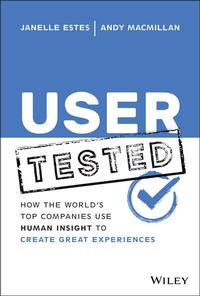
User Tested
Description

With so many digital experiences touching our lives--and businesses--it's understandable to feel like you're drowning in data. There's a dashboard or chart for just about everything, but data alone can't help you understand and empathize with your customers. No amount of it will take you inside their heads, help you see the world through their eyes, or let you experience what it's really like to be your customer. Only human insight from real people can do that.
User Tested gives both individual contributors and executives an approachable, pragmatic playbook for stepping beyond standard business metrics and infusing real human insight into every business decision, design, and experience.
In this book, you'll:
* Learn how businesses became obsessed with data--but disconnected from their customers--and why that's not sustainable
* Get the basics about how to capture human insight through user testing, including how to find the right people, ask the right questions, and make sense of and act on all the insights you uncover
* Dive into a detailed playbook that shares real-world examples of how you can collect and scale human insight across the teams in your organization--from marketing to product, and beyond
* Learn how to evangelize the power of human insight throughout your organization, so every department can create a culture of customer empathy and share a firsthand understanding of customer needs
* Find out how companies like Microsoft, AAA Club Alliance, HelloFresh, and Notre Dame's IDEA Center solidly connect with and elicit meaningful feedback from customers in friendlier, faster, and more direct ways
Perfect for any industry, User Tested: How the World's Top Companies Use Human Insight to Create Great Experiences was co-authored by the chief insights officer and the CEO of UserTesting--a SaaS company fundamentally changing the way both B2B and consumer brands find out what real people think and feel. The book reflects the authors' commitment to helping you position the customer squarely in the center of your business model by weaving their true voices throughout your company's decision making.
More details
Other editions
Additional editions
Persons
ANDY MACMILLAN is CEO of UserTesting, the world's leading user testing and human insight platform. He is a former product executive at Oracle and Salesforce. He understands the critical role human insight plays in building world class products and solutions on a global scale.
Content
Acknowledgments xiii
Preface xv
Part 1 The Challenge: Understanding Customers as Humans, Not Data Points 1
1 Competing in the Experience Economy: Many Companies Succeed Despite Sub-Par Customer Understanding 3
2 The Missing Dimension: Why and How Human Insight Powers Great Experiences 21
Part 2 The Solution: Human Insight Powers Customer-Centric Actions 41
3 What're You Trying to Answer? Mapping a User Test Approach to Your Desired Learnings 43
4 You Are Not Your Customer: How to Get Access to the Perspectives That Matter 63
5 Capture and Analyze: Sifting Through the Noise to Find the Signal 75
6 Take Action on Human Insight: Decide Where and How to Apply Your Learnings 89
Part 3 The Playbook: How Human Insight Fits into Your Business 97
7 Product Development: Creating Products People Love 99
8 Marketing: Getting Inside the Heads of Your Buyers 121
9 Every Team Owns the Experience: Optimizing the Holistic Customer Journey 149
Part 4 The Culture Shift: Applying Human Insight at Scale 173
10 Bottom Up: The Grassroots Movement 175
11 Top Down: How Executives Can Support and Model Change 191
One Final Note 205
Index 207
Preface
Imagine.
. You sit down to your annual company meeting and before the CEO even speaks, you're captivated by a video of your very own customers talking about how much they love the experiences you provide. And suggestions on how to make the experience better .
. Your company launches a new product and everyone at your company has access to customer feedback through a shared Slack channel. In the channel, you can watch real customers using the new product and sharing their perspectives .
. Anytime you'd like, you're given the opportunity to connect with customers yourself. You can ask for their opinions and get input on any aspect of your work quickly and easily .
. Your organization has an internal app that streams curated videos of customers using the experiences you provide. Employees can subscribe to channels: the most-watched customer videos, feedback from specific customer segments such as "top spenders," and a competitive intelligence channel .
. Your customers can opt in or volunteer to provide these rich perspectives, and freely do so because they're invested in the experience you provide and want to make it better .
. Once a month, you're asked to weigh in on what customer segments should be tested or which questions should be asked when customer perspectives are gathered. For example, you get to upvote competitive testing or downvote testing of a new ad campaign depending on what will help you most .
. You get to the office in the morning, grab a cup of coffee in the kitchen, and you are immediately enthralled by a video of a customer on a flatscreen above the coffee maker. You get to watch a real customer as they view and react to a recently launched marketing campaign .
. Every Friday, you get an alert on your phone reminding you to watch this week's most commented-on video of a customer using one of your competitor's experiences .
And imagine this is all done in an effort to create a company-wide, shared understanding of who your customers are as human beings, not data points, so you can make better, more empathetic decisions. So you can bring humanity into the business. And so you can do it in a way that enables everyone to build a true and meaningful connection to the customers they serve.
This shared understanding ultimately helps people at your company act with more urgency and with the needs of the customer infusing every discussion, activity, and decision. And not only is there a shared understanding, but there's also a shared desire to augment that understanding so the business can continually learn about and improve upon the experiences it provides.
But this is not how businesses have traditionally operated. For far too long, we have relied on understanding our customers-who they are, what they do, what they need-in the form of big data, analytics, and surveys. And while this information is valuable, it's incomplete. We're missing a critical dimension. We're missing the human perspective.
What is it actually like to be my customer? What is it like to see the world through their eyes? Walmart founder Sam Walton is famous for "walking the aisles" at his stores to get an on-the-ground look at his customers and how his business operated, but most teams don't have access to this perspective today. That will change. It has to.
We're living in an age where customers are in control, yet we're simultaneously losing touch with them. As the world continues to digitally transform at lightspeed and tech continues to physically separate us from our customers, the divide between our teams and the customers we serve will continue to grow.
So what do we do? How do we fill this gap? The answer is simple. We need to bring authentic customer perspectives back into key decisions. We need to pair the myriads of data we have at our fingertips with the literal voice of the customer. We need to connect with our customers, human to human, so we can make decisions that deliver better experiences.
We need human insight.
Meet the Authors
Janelle Estes, Chief Insights Officer
I've been fascinated by human behavior my entire life. My mom has said when I was about three years old, she'd take me to the grocery store, wheel me around in the front of the cart and watch me observe everyone around me with a keen eye. Then, a week or more later, I'd say, "Mom . that guy at the store in the red shirt? Why was he buying four boxes of Cheerios?" She marveled both at my ability to retain detail and my questioning mind: Why was I thinking about these things? Why did I care?
It's because people are amazing and quirky and utterly intriguing, and I've always wanted to better understand them. So I studied the fascinating intersection between cognitive science, human factors, and design. I worked at Nielsen Norman Group and Forrester as a researcher and UX specialist, often running lab-based user testing that took weeks to complete. (Translation: I was deeply nerdy about this stuff long before it had any cachet.) I decided to move to UserTesting when I saw more and more companies adopt remote user testing solutions, and I've seen a massive shift in how companies connect with their customers-through tech-enabled solutions-to meet the speed and scale required for business today.
Regardless of how this work is done, I have seen the "lightbulb" go off time and time again when people observe user tests, and it never fails to inspire me. As someone who has always believed in the importance of human insight, it's been amazing to watch my field of expertise grow from a little niche superpower to something that many companies see as hugely valuable and business-critical.
Yet there is still so much untapped potential; we can grow exponentially from here. My passion for bringing humanity back into business decisions hasn't waned, and I see this book as the perfect way to engage an even wider audience.
Andy MacMillan, CEO
The importance of customer feedback especially resonates with me because I've spent my entire career in software product development. As a former product executive at Oracle and Salesforce, I saw firsthand the critical role that customer understanding plays in creating great experiences. Technology does amazing things but it's where technology meets people-the customer experience-that makes technology most valuable to us as individuals. And I've learned that the secret to doing this is putting the customer and their interests at the center of every decision.
As the CEO of UserTesting, I genuinely love giving companies the ability to find and interact with their own customers in a way that facilitates human insight on any aspect of the experience they provide. And I know that ability is a critical one in the modern marketplace, as the speed of technology has often eclipsed the quality of the human interactions with that technology. Putting your customers at the center of your experiences can change that.
What to Expect from This Book
We've structured this book to be as approachable and pragmatic as possible.
Part 1 offers some background on how businesses became obsessed with numbers, stopped talking to customers, and why this trend can't persist. It is illustrated with plenty of great case studies and examples.
Part 2 is about the basics of capturing human insight through the practice of user testing, including how to find the right people, how to ask the right questions, how to make sense of what you capture, how to build a shared understanding, and how to take action based on your learnings.
Part 3 is a detailed playbook that walks you through a wide variety of ways to collect human insight and how they can be pulled into various parts of your business, including marketing efforts, product development, and beyond.
Part 4 is about spurring that all-important culture change within your organization to incorporate human insight everywhere, all the time.
Our hope is that, in reading this book, you'll help us build a better, brighter, customer-focused future. It'll be one where companies pull human insight into their everyday work and decision-making, organically and consistently.
That's the future we envision, and it's well within reach right now. All we have to do is commit to deepening our understanding of our customers by truly observing and listening to what they're telling us and using that to make well-informed, customer-centric decisions.
It's difficult to predict the technologies and experiences that will emerge in the coming years, but one thing is certain: Human insight is the key to staying connected to our customers in the Experience Economy.1
Note
- 1 This term is gradually entering common use, but was first coined by Joseph Pine II and James H. Gilmore in a 1998 Harvard Business Review article titled, "Welcome to the Experience Economy." It's fascinating, and well worth a read . though we'll explore many of its high points in chapters to...
