

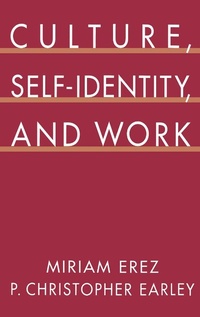
Culture, Self-Identity, and Work
1st Edition
Published on 12. August 1993
275 pages
978-0-19-536048-6 (ISBN)
Description

A great deal of research has recently been completed on behavior and the organization of work, most of which has viewed it from an ethnocentric perspective. In this work, Erez and Earley show how this is insufficient to develop a global theory of work behavior--it necessitates the inclusion of a cultural perspective. Solidly grounding their work in the fields of psychology, management, and anthropology, the authors propose a new theoretical framework utilizing individual's self-concept as a means of linking cultural beliefs and social interaction to emergent work behavior. The book includes specific recommendations for structuring work environments and managerial processes to match cultural practices and enhance productivity in the workplace, making it an essential reference for scholars, students, and professionals.
More details
Other editions
Additional editions
Miriam Erez | P. Christopher Earley
Culture, Self-Identity, and Work
Book
11/1993
Oxford University Press Inc
€165.20
Shipment within 15-20 days
Persons
P. Christopher Earley is the Corporate Partners Research Professor of Management at the Graduate School of Management, University of California, Irvine and Professor of Organization Behavior at the London Business School. Miriam Erez is Dean and Professor of Industrial Engineering and Management at the Technion, Israel Institute of Technology.
Content
- Intro
- Contents
- 1. Introduction
- Cultural Factors Influencing Organizational Behavior
- The Current State of Theory Development in Organizational Behavior
- The Identification of Cultural Characteristics
- The Application of Cognitive Models of Information Processing to Develop Models of Organizational Behavior
- The Interrelationship Among Culture, Managerial Practices, Self-Regulatory Processes, and Employee Behavior: A Case Study
- Toward the Development of a New Model of Cross-Cultural Organizational Behavior
- 2. Cultural Self-Representation Theory
- Cultural Characteristics
- Management Practices and Motivational Techniques
- The Self
- Generalized Work Behavior
- An Integration
- Summary
- 3. Cultural Frameworks
- Definitions of Culture
- Perspectives on Culture
- Summary of Approaches and Present Framework
- 4. Individualism and Collectivism
- Collectivities and Clans
- Overview of Individualism and Collectivism
- Perspectives on Individualism and Collectivism
- Antecedents and Consequences of Individualism and Collectivism
- Summary and Present Definition
- 5. Work Motivation
- The Relationship Among Needs, Values, and Culture
- Work Motivation Within a Cross-Cultural Framework
- Summary and Implications
- 6. Culture, Self, and Communication
- Culture as a Communication Phenomenon
- Communication as a Cultural Phenomenon
- Cognitive Frames and the Self
- Communication Across Cultures
- 7. Group Dynamics
- Definition and Brief History
- Group Action Model
- Application to Selected Topics
- Summary
- 8. Leadership
- Basic Framework of Leadership
- Summary
- 9. Negotiation and Bargaining
- Behavioral-Cognitive Framework
- Cultural Model of Negotiation
- Summary
- 10. Summary and Conclusions,
- Previous Research in Organizational Behavior Reexamined in Light of Cultural Self-Representation
- Practical Implications
- References
- Index
- A
- B
- C
- D
- E
- F
- G
- H
- I
- J
- K
- L
- M
- N
- O
- P
- Q
- R
- S
- T
- U
- V
- W
- Y
- Z
